To avoid these ads, REGISTER NOW!

Reed 403 1/2 advice please

JimNC

Well-known member
Joined
Jul 9, 2017
Messages
580
Location
NC
Bought one today for the princely sum of $15.

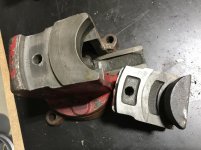
Mostly came apart pretty easy. Swivel jaw is rusted in place, have it soaking in kroil and giving it a few taps with a copper mallet every few hours. Bottom of that jaw is marked 09, does that mean anything? Should I put the vise back together and close it on a rod on one side of the jaws and then again on the other to break them loose? Once loose, how is that jaw removed?

I was expecting jaw inserts, but no.

Handle is bent and one of the ends is loose, how are the ends attached?

The swivel base spins freely. Removed the lock. Looks like I need to remove the big bolt on the bottom to get the swivel apart, looks like I need a 1 37/64” socket. Is that right, what an inconvenient size.

The vise seems oddly proportioned, kinda like a t-Rex with a big body and little bitty arms, but I think it’ll be useful if I can get the swivel jaw working.

Seller also has a Prentiss Bulldog. Wide opening and maybe 4” wide, tall and thin jaws. It was mounted to a bench in his back yard and he used it as an arbor press. Said he had $5 in it but wouldn’t sell. I’m gonna bug him in a week or two.

Thanks all!
 
To avoid these ads, REGISTER NOW!

454ragtop

Well-known member
Joined
Mar 24, 2008
Messages
5,011
Location
Carver, MA
For the socket, I usually use an axle nut socket, fairly common if you do automotive work or know someone. Probably like a 38 MM, when they get this large, they don't have to fit perfect.
 
OP
J

JimNC

Well-known member
Joined
Jul 9, 2017
Messages
580
Location
NC
For the socket, I usually use an axle nut socket, fairly common if you do automotive work or know someone. Probably like a 38 MM, when they get this large, they don't have to fit perfect.

Thanks, didn’t think to measure it for metric but it will be easier and cheaper to get that socket.
 

drivesitfar

Well-known member
Joined
Oct 23, 2013
Messages
36,033
Location
Pacific Northwest
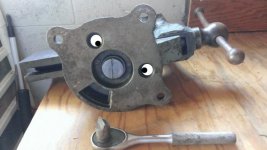
JIM: some of use use a DRAG SOCKET to take those Reed nuts off their swivel bases. here's a picture of my 404.5 and a member put a little humor into the picture that i saved to post. or is your bolt hex shaped?

speaking of pictures how about posting a few of yours. if you maybe want to get a few more eyes on your vise for future questions and to show us how you spiff it up feel free to post over on the vise repair 101 thread.

good luck and yep you OVERPAID.
 

Attachments

  • user218165_pic51056_1433176540.jpg
    user218165_pic51056_1433176540.jpg
    48.5 KB · Views: 70
  • WP_20141229_007 - Copy.jpg
    WP_20141229_007 - Copy.jpg
    98.3 KB · Views: 65
  • WP_20150530_012.jpg
    WP_20150530_012.jpg
    107.1 KB · Views: 60
OP
J

JimNC

Well-known member
Joined
Jul 9, 2017
Messages
580
Location
NC
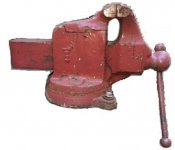
Here is what she looked like in the Craigslist photo, I’ll get some photos up later today.

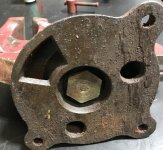
The bolt on the bottom has a hex head, not a slot.
 

Attachments

  • 18FFD5E0-5C15-44BE-BE2D-9C315F18135E.jpeg
    18FFD5E0-5C15-44BE-BE2D-9C315F18135E.jpeg
    101.4 KB · Views: 40
OP
J

JimNC

Well-known member
Joined
Jul 9, 2017
Messages
580
Location
NC
Got it mostly apart. The head on the bolt holding the swivel on is 40mm, kinda odd, anyone know if it is original? The number on the bottom of the fixed/swivel jaw is just a casting number, it matches a number on the vise.

How is the spindle nut removed?

Off to find a 40mm socket.
 

Attachments

  • 04990BDF-0BF2-4C4B-BFC8-BA5D8DB2505D.jpg
    04990BDF-0BF2-4C4B-BFC8-BA5D8DB2505D.jpg
    148.7 KB · Views: 41
  • 9410E913-C09B-445B-B9C0-6BD0B8CDE3E6.jpg
    9410E913-C09B-445B-B9C0-6BD0B8CDE3E6.jpg
    81.9 KB · Views: 33
  • 57BEDFF0-235B-4544-BD86-2F8726B1DA74.jpg
    57BEDFF0-235B-4544-BD86-2F8726B1DA74.jpg
    152.9 KB · Views: 32
  • B4E11E9D-AD6D-4EFD-B565-EADD7DFA2A19.jpg
    B4E11E9D-AD6D-4EFD-B565-EADD7DFA2A19.jpg
    149.2 KB · Views: 31

thehorse13

Well-known member
Joined
Mar 15, 2015
Messages
3,478
Location
Jefferson County, WV
There is a collar under the dynamic jaw. Just flip it over and you will see it. There will be a little grub screw holding it in place. Remove that and then slide the collar off. The spindle will then come right out of the jaw.
 
To avoid these ads, REGISTER NOW!
OP
J

JimNC

Well-known member
Joined
Jul 9, 2017
Messages
580
Location
NC
There is a collar under the dynamic jaw. Just flip it over and you will see it. There will be a little grub screw holding it in place. Remove that and then slide the collar off. The spindle will then come right out of the jaw.

Yes, got that far. From there the spindle nut is still mounted in the main vise body and I don’t know how to remove it.
 

Carla

MEMBER EMERITUS
Joined
Nov 27, 2010
Messages
672
Got it mostly apart. The head on the bolt holding the swivel on is 40mm, kinda odd, anyone know if it is original? The number on the bottom of the fixed/swivel jaw is just a casting number, it matches a number on the vise.

How is the spindle nut removed?

Off to find a 40mm socket.

Hello, Jim,

For whatever its worth, I've worked on a fair number of Reed swivel base vises, and have never seen a hex head retaining bolt, they were always screw-driver slotted.

So, it seems probable that some previous owner made that hex head bolt, but having 40mm hex stock to make it from is unusual, to say the least.

However, it won't be more than a petty inconvenience, just a little tedious, to mend the situation. That 40mm is about 75-ish thou over 1-1/2", so all you need to do is to get a die grinder with a little rotary bur into that area, and take off just under 40 thou per side, til a 1-1/2" socket will fit.

Another option, a bit brutal one, would be to drive the bolt with a cold chisel. That would leave a scar, to be sure, but it would be 'cheap and easy', and the scar wouldn't be seen once the vise is done up and back in service.

Yet another option might be to weld a, say, 5/8" heavy pattern nut (1-1/16" across flats) to the bolt, and thereby have a common socket size with which to wrench out the part. After the bolt is removed, just face off the nut, and mill or grind the bolt head flats to 1-1/2", or better, 1-7/16", a common socket wrench size. This would be my preferred option if I was doing the job.

cheers

Carla
 
OP
J

JimNC

Well-known member
Joined
Jul 9, 2017
Messages
580
Location
NC
Carla,

Thanks for the confirmation that it’s not likely original and the ideas for removing it. I was thinking that I could either drill a couple holes for a spanner or use a cutoff blade to cut a slot for a large screwdriver, both assuming that I can’t find a socket easily. I do like the idea of tacking on a nut and then fixing it all on the mill...just need to bug a buddy with a mill to execute that plan.

Jim
 
OP
J

JimNC

Well-known member
Joined
Jul 9, 2017
Messages
580
Location
NC
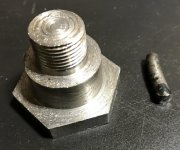
Turns out the bolt could be removed with a 1 9/16 offset wrench, wasn’t fully engaged, but close enough.

The spindle nut slides into a dovetail and is held in by a pin that is knocked out through an access hole on the base.

The nut certainly appears to be shop made, as does the retaining pin. I’ll keep the bolt, but replace the pin with one that is straight.

Next step is degrease and strip paint. No access to blasting cab. I used oven cleaner with the parts in a plastic bag for a project years ago, that still considered good, or is there a better approach?

Oh, and the balls on the handle aren’t peened on like a Wilton. One is loose, but doesn’t come off in any obvious way. Is it removable?
 

Attachments

  • 337BEB98-5617-4B6A-AFF1-11C679BAB8FC.jpg
    337BEB98-5617-4B6A-AFF1-11C679BAB8FC.jpg
    148.9 KB · Views: 16

Carla

MEMBER EMERITUS
Joined
Nov 27, 2010
Messages
672
Hello again, Jim,

Regarding the Reed vise handle ball tips, the Reed co. had a rather interesting technique for swaging the ball tips to the handle shank.

One of the patent dates given on the vise casting is the patent for that method. You can look patents up by date on Google patent.

Here, if the link works, is a reference to that patent I found on the internet.

Basically, if one of those tips has come loose, or is distorted, its not really repairable, so one should just make a new handle, taking one's choice of the many methods for making and applying ball tips to the handle shank.

http://www.datamp.org/patents/search/advance.php?pn=1106860&id=43761&set=5

cheers

Carla
 
OP
J

JimNC

Well-known member
Joined
Jul 9, 2017
Messages
580
Location
NC
Thanks again Carla, link worked and I think I’ll just make a new handle rather than try to make the swage block and develop proficiency with that method.
 
To avoid these ads, REGISTER NOW!
Top Bottom