
I don’t think I ever heard of the Wright Tool company until recently. I read about them on this forum, and I recently bought a lot of Wright Tools (mostly brand new but old stock sockets and ratchets) from a local tool distributor that is going out of business. Not knowing much about Wright, I did some research on the tools and company. There really isn’t very much information out there, but I am starting to be a Wright fan.
As some of you may know, I am a ******** Snap-On guy and I also collect old tools. When I first handled a Wright combination wrench, I knew it was professional quality (good enough to be used by professionals every day, for many years), right up there with Snap-On Mac, Proto, etc.
From this forum, I knew that TR Tool Supply sold Wright tools. I contacted them to find out more about the company and tools. The owner (Richard) was very helpful. He’s a great guy and a great ambassador for Wright tools, and he does sell other companies’ tools.
I couldn’t really understand the WRIGHTGrip design and wanted to do a test. Richard was good enough to donate a combination wrench for me to test. That’s the Wright wrench you see here. The other wrenches are all mine.
My main goal was really to just do a Wright versus Snap-On test. More specifically, I wanted to compare the open end design of a Snap-On wrench (with Flank Drive Plus) to the open end of a Wright wrench (with WRIGHTGrip). I consider the Snap-On to be the gold standard of combination wrenches. One of the ways I was planning to test these two designs was to see where the exact contact points are on a fastener when using each wrench. Here are the results.
Given the very limited amount of information on the internet about Wright, I thought some of you would be interested in this comparison. (I apologize in advance for the poor picture quality!)
I. General Comparison and Description
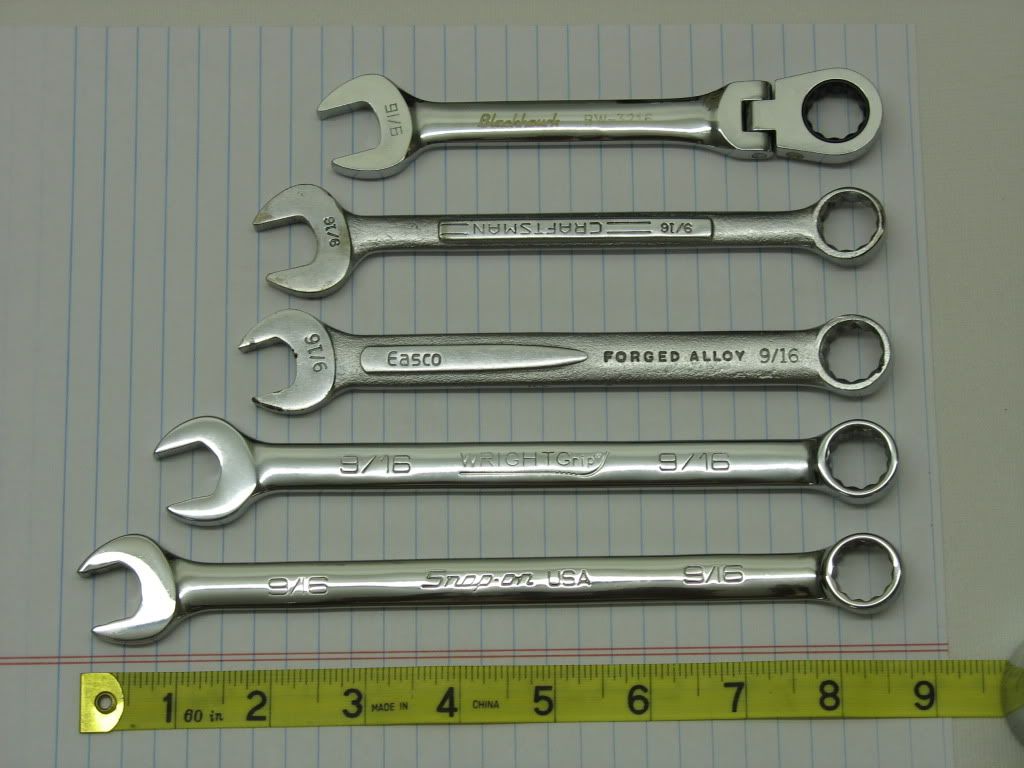
Here is what’s pictured. They are all 9/16” combination wrenches (an open end and closed/boxed end) with the boxed end being 12 point. From top to bottom:
1. A Blackhawk ratcheting combination wrench, model # BW-3216. Although it’s short, it’s not the “stubby” model. For those who care, this is an older model with a flexible head, that is non-locking and non-reversible (Made in Taiwan).
2. An old Craftsman wrench that I believe is from the mid 1960s. This has the =V= symbol with no model number.
3. An old Easco wrench, model # 63118. I think this is from the 1970s. I think this is a good representation of a common and typical 9/16” combination wrench, even for today. I believe Easco was bought by Danaher, and the Easco brand no longer exists. I also believe that Easco used to make a lot of Craftsman tools.
4. A current production wrench from Wright Tool, model # 1218. This is one of their “Full Polish” and “Long Pattern” wrenches. It has the “WRIGHTGrip” design on the open end, and “Wright Drive” design on the box/closed end.
The WRIGHTGrip design is the teeth/serrations and the subtle curves in the open end. This is supposed to help the wrench grip the fastener and make it less likely to round off. One thing that is not immediately noticeable is that the opposing surfaces of the open ends (the teeth and the curves) are not symmetrical.
The Wright Drive design is on the closed end. It’s how the wrench contacts the fastener away from the corners of the fastener making it less likely to round off of the corners when tightening (or loosening if it’s stuck).
From what I can tell, all of the combination wrenches that Wright currently sells are their “Long Pattern” wrenches.
Also, from looking at their current catalog, I believe Wright makes combination wrenches in “Flat Stem” (chrome plated with satin finish), “Heavy-Duty Flat Stem” (very thick handles), “Black Industrial Finish” (what I think is a black oxide type of finish from the way it sounds), and “Full Polish” (typical smooth mirror polish chrome plating).
5. A current production wrench from Snap-On wrench with “Flank Drive Plus”, model # SOEX18. This is a very popular model, and is pretty much the gold standard among combination wrenches. The “Flank Drive” design is the same concept as the Wright Drive design where the closed end of the wrench makes contact away from the corners of the fastener, making it less likely to round off.
The “Plus” in Flank Drive Plus is the teeth/serrations in the open end. Again, this provides an advantage where the corners of the fastener are less likely to round off.
II. Overall Length
I like long wrenches for most of what I do. I appreciate the extra leverage. Of the 4 wrenches shown, the Snap-On is the longest at about 8 3/4”. The Wright is shorter, but not by much (about 8” overall). The Easco is next at about 7”, The Craftsman about 6 7/8”, and the Blackhawk about 6 1/4”. Again, I think the Easco is the typical wrench that most people would use.

III. Other Dimensions
The Wright wrench definitely feels a little thicker than the Snap-On. Don’t take this the wrong way. The Wright is not thick (in my opinion), just a little meatier. My measurements of the head thickness and handle thickness confirm this. The Wright’s open end head is about 10% thicker, and the Wright’s handle is about 14% thicker. I don’t have a small scale, but the Wright seems a little heavier.
Wright head thickness:

Snap-On head thickness:

Wright handle thickness:

Snap-On handle thickness:

I was careful to measure the handle thickness of each wrench where there is no stamping on either side of the wrench. I think this would give the most accurate measurement. The caliper placement shows approximately where I measured on each wrench.
The extra thickness of the head and handle on the Wright MIGHT give it an advantage in strength. I’m not going to break my wrenches for a test, but I am curious which would fail first.
I’ve heard some people complain that they don’t like how the Snap-On wrenches are thin. They say it hurts their hand when they really crank on it. I’m not one of them, but if you are, the Wright is an excellent alternative.
IV. Closed End
The Wright is on the left, the Snap-On on the right. Both are designed so the wrench doesn’t contact the fastener on the corners. It’s very subtle but it’s a good idea and it works.
There are no issues with either here. The cutouts for the holes are perfectly centered on both wrenches. The holes are chamfered nicely, and there are no sharp edges on the outside. The walls of the closed ends are not too thick, so neither wrench should have much problem getting into tight spaces:

The wall of the Wright is just a tiny bit bigger (about 3%) than the Snap-On. The difference is not noticeable or significant.
Wright:

Snap-On:

V. Open End
I didn’t bother taking close up pictures of the open ends of the first three wrenches (Blackhawk, Craftsman, and Easco). I also didn’t bother taking pictures of fasteners tightened with them. The open ends were all smooth, and the fasteners were what you would expect. The wrench contact points were on the corners of the fastener, and I could see how a lot of force could damage the fastener by rounding the corners off.
Here are the open ends of the Wright (on top) and Snap-On (on bottom). If you look carefully, you can see that the upper and lower surface of the Wright are not symmetrical (not mirror images of each other). The Snap-on surfaces are symmetrical. On the Wright, you can see how the lower surface is more curved that the upper surface. Also, the lower right corner of the Wright is cut in a little further than the upper right corner. The lower right corner actually matches the WRIGHTGrip symbol on the handle of the wrench. (You can see that symbol clearly in the picture above where the Wright handle thickness is measured.):
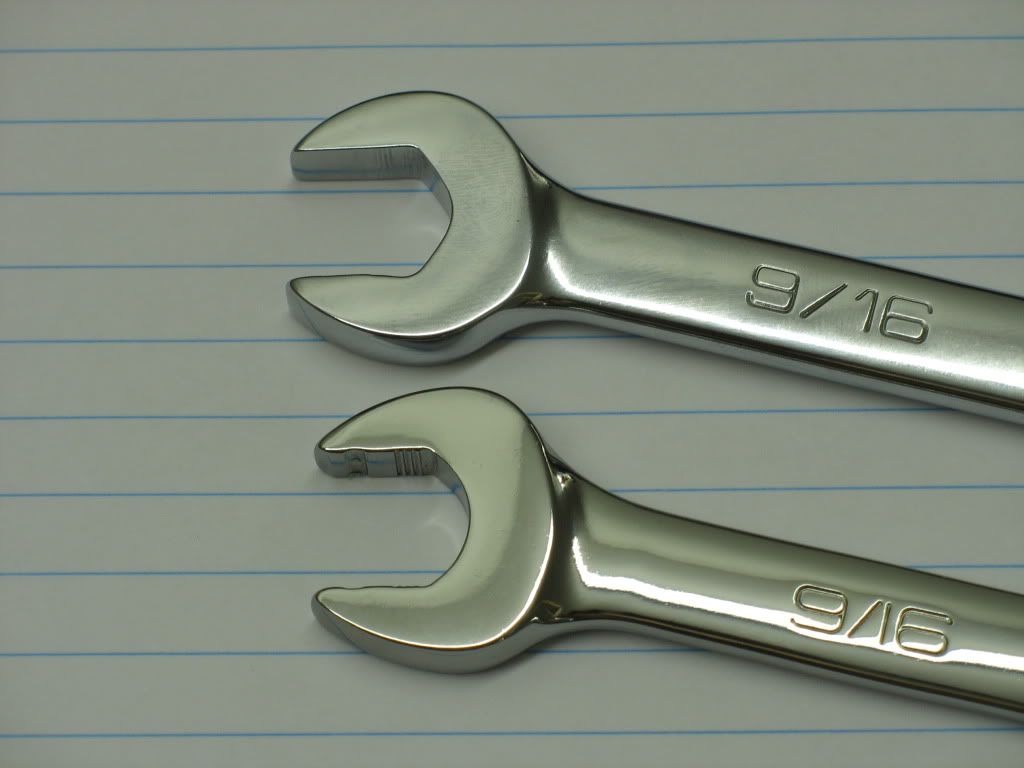
Here are 2 more pictures of the open ends on top of each other. In both pictures, the Snap-On is on top of the Wright. They are lined up exactly so you can compare how each specific area of the wrench teeth would contact a fastener. Also, as you can see in the picture, the teeth on the Wright are not very deep on the surface shown in the first of the 2 pictures:
“Upper surface” of the open ends. To clarify a definition used below, the left part of this surface is the “outer part” (“outer” being relative to the handle of the wrench):

“Lower surface” of the open ends. To clarify a definition used below, the right part of this surface is the “inner part” (“inner” being relative to the handle of the wrench):

[contiuned in the next post below]
Joe Mamma
As some of you may know, I am a ******** Snap-On guy and I also collect old tools. When I first handled a Wright combination wrench, I knew it was professional quality (good enough to be used by professionals every day, for many years), right up there with Snap-On Mac, Proto, etc.
From this forum, I knew that TR Tool Supply sold Wright tools. I contacted them to find out more about the company and tools. The owner (Richard) was very helpful. He’s a great guy and a great ambassador for Wright tools, and he does sell other companies’ tools.
I couldn’t really understand the WRIGHTGrip design and wanted to do a test. Richard was good enough to donate a combination wrench for me to test. That’s the Wright wrench you see here. The other wrenches are all mine.
My main goal was really to just do a Wright versus Snap-On test. More specifically, I wanted to compare the open end design of a Snap-On wrench (with Flank Drive Plus) to the open end of a Wright wrench (with WRIGHTGrip). I consider the Snap-On to be the gold standard of combination wrenches. One of the ways I was planning to test these two designs was to see where the exact contact points are on a fastener when using each wrench. Here are the results.
Given the very limited amount of information on the internet about Wright, I thought some of you would be interested in this comparison. (I apologize in advance for the poor picture quality!)
I. General Comparison and Description
Here is what’s pictured. They are all 9/16” combination wrenches (an open end and closed/boxed end) with the boxed end being 12 point. From top to bottom:
1. A Blackhawk ratcheting combination wrench, model # BW-3216. Although it’s short, it’s not the “stubby” model. For those who care, this is an older model with a flexible head, that is non-locking and non-reversible (Made in Taiwan).
2. An old Craftsman wrench that I believe is from the mid 1960s. This has the =V= symbol with no model number.
3. An old Easco wrench, model # 63118. I think this is from the 1970s. I think this is a good representation of a common and typical 9/16” combination wrench, even for today. I believe Easco was bought by Danaher, and the Easco brand no longer exists. I also believe that Easco used to make a lot of Craftsman tools.
4. A current production wrench from Wright Tool, model # 1218. This is one of their “Full Polish” and “Long Pattern” wrenches. It has the “WRIGHTGrip” design on the open end, and “Wright Drive” design on the box/closed end.
The WRIGHTGrip design is the teeth/serrations and the subtle curves in the open end. This is supposed to help the wrench grip the fastener and make it less likely to round off. One thing that is not immediately noticeable is that the opposing surfaces of the open ends (the teeth and the curves) are not symmetrical.
The Wright Drive design is on the closed end. It’s how the wrench contacts the fastener away from the corners of the fastener making it less likely to round off of the corners when tightening (or loosening if it’s stuck).
From what I can tell, all of the combination wrenches that Wright currently sells are their “Long Pattern” wrenches.
Also, from looking at their current catalog, I believe Wright makes combination wrenches in “Flat Stem” (chrome plated with satin finish), “Heavy-Duty Flat Stem” (very thick handles), “Black Industrial Finish” (what I think is a black oxide type of finish from the way it sounds), and “Full Polish” (typical smooth mirror polish chrome plating).
5. A current production wrench from Snap-On wrench with “Flank Drive Plus”, model # SOEX18. This is a very popular model, and is pretty much the gold standard among combination wrenches. The “Flank Drive” design is the same concept as the Wright Drive design where the closed end of the wrench makes contact away from the corners of the fastener, making it less likely to round off.
The “Plus” in Flank Drive Plus is the teeth/serrations in the open end. Again, this provides an advantage where the corners of the fastener are less likely to round off.
II. Overall Length
I like long wrenches for most of what I do. I appreciate the extra leverage. Of the 4 wrenches shown, the Snap-On is the longest at about 8 3/4”. The Wright is shorter, but not by much (about 8” overall). The Easco is next at about 7”, The Craftsman about 6 7/8”, and the Blackhawk about 6 1/4”. Again, I think the Easco is the typical wrench that most people would use.
III. Other Dimensions
The Wright wrench definitely feels a little thicker than the Snap-On. Don’t take this the wrong way. The Wright is not thick (in my opinion), just a little meatier. My measurements of the head thickness and handle thickness confirm this. The Wright’s open end head is about 10% thicker, and the Wright’s handle is about 14% thicker. I don’t have a small scale, but the Wright seems a little heavier.
Wright head thickness:
Snap-On head thickness:
Wright handle thickness:
Snap-On handle thickness:
I was careful to measure the handle thickness of each wrench where there is no stamping on either side of the wrench. I think this would give the most accurate measurement. The caliper placement shows approximately where I measured on each wrench.
The extra thickness of the head and handle on the Wright MIGHT give it an advantage in strength. I’m not going to break my wrenches for a test, but I am curious which would fail first.
I’ve heard some people complain that they don’t like how the Snap-On wrenches are thin. They say it hurts their hand when they really crank on it. I’m not one of them, but if you are, the Wright is an excellent alternative.
IV. Closed End
The Wright is on the left, the Snap-On on the right. Both are designed so the wrench doesn’t contact the fastener on the corners. It’s very subtle but it’s a good idea and it works.
There are no issues with either here. The cutouts for the holes are perfectly centered on both wrenches. The holes are chamfered nicely, and there are no sharp edges on the outside. The walls of the closed ends are not too thick, so neither wrench should have much problem getting into tight spaces:
The wall of the Wright is just a tiny bit bigger (about 3%) than the Snap-On. The difference is not noticeable or significant.
Wright:
Snap-On:
V. Open End
I didn’t bother taking close up pictures of the open ends of the first three wrenches (Blackhawk, Craftsman, and Easco). I also didn’t bother taking pictures of fasteners tightened with them. The open ends were all smooth, and the fasteners were what you would expect. The wrench contact points were on the corners of the fastener, and I could see how a lot of force could damage the fastener by rounding the corners off.
Here are the open ends of the Wright (on top) and Snap-On (on bottom). If you look carefully, you can see that the upper and lower surface of the Wright are not symmetrical (not mirror images of each other). The Snap-on surfaces are symmetrical. On the Wright, you can see how the lower surface is more curved that the upper surface. Also, the lower right corner of the Wright is cut in a little further than the upper right corner. The lower right corner actually matches the WRIGHTGrip symbol on the handle of the wrench. (You can see that symbol clearly in the picture above where the Wright handle thickness is measured.):
Here are 2 more pictures of the open ends on top of each other. In both pictures, the Snap-On is on top of the Wright. They are lined up exactly so you can compare how each specific area of the wrench teeth would contact a fastener. Also, as you can see in the picture, the teeth on the Wright are not very deep on the surface shown in the first of the 2 pictures:
“Upper surface” of the open ends. To clarify a definition used below, the left part of this surface is the “outer part” (“outer” being relative to the handle of the wrench):
“Lower surface” of the open ends. To clarify a definition used below, the right part of this surface is the “inner part” (“inner” being relative to the handle of the wrench):
[contiuned in the next post below]
Joe Mamma


