To avoid these ads, REGISTER NOW!

interpretation of Snap On Counselor 2 Analyzer output

jeffberk

Well-known member
Joined
Sep 26, 2018
Messages
106
Location
Home garage-NE Ohio
I recently acquired a Snap On Counselor 2 Analyzer that I'm trying to use on a Datsun 260z and could use help in interpreting the results since I haven't used a scope since the 1970's.
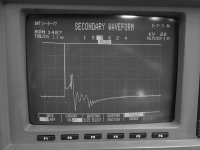
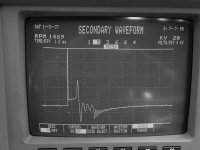
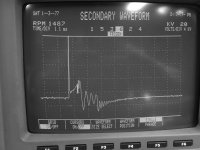
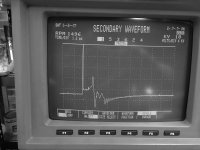
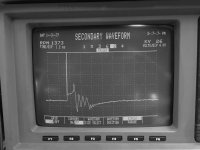
The Datsun as an aftermarket Malory electronic ignition. If I'm reading the secondary wave form correctly, there is a high resistance somewhere causing a rise in the voltage following the initial zap.
Also, there is an "ERROR" flashing in the upper right corner. It shows up in the first image. Any idea what this means?
Thanks all
Jeff
 

Attachments

  • image001.jpg
    image001.jpg
    88.7 KB · Views: 51
  • image002.jpg
    image002.jpg
    85.2 KB · Views: 45
  • image003.jpg
    image003.jpg
    85.8 KB · Views: 42
  • image004.jpg
    image004.jpg
    85.6 KB · Views: 39
  • image005.jpg
    image005.jpg
    86.9 KB · Views: 37
  • image006.jpg
    image006.jpg
    84.7 KB · Views: 35
To avoid these ads, REGISTER NOW!

American Locomotive

Well-known member
Joined
Jan 8, 2017
Messages
10,953
Location
Rhode Island
I'm not going to pretend to be an expert at this stuff. A couple of things I found online suggest that the second small sharp peak is normal when the spark ends. Based on the example wave-forms I saw, cylinder 5 looks to be firing pretty well, 1 is marginal, and the rest show signs of excessive resistance somewhere.
 

engineer2

Well-known member
Joined
Dec 13, 2009
Messages
11,798
Location
Chicago burbs
Looks OK to me but your firing line kVs are pretty high. 12-ish is more normal. Could be high secondary resistance, wide plug gaps, lean mixture, etc.
The coil oscillations look a little funky, but that could be normal for your type of ignition system.
The random squiggle in the firing line is from combustion chamber turbulence as you light the fire.
 

Attachments

  • sparkwaveform.jpg
    sparkwaveform.jpg
    73.6 KB · Views: 26
Last edited:

RPH

Well-known member
Joined
Dec 17, 2006
Messages
4,190
Location
Michigan Thumb
With the Mallory ignition system the primary voltage will be higher. 400 volts would not be uncommon. Most times, the coil has been upgraded for this and the secondary output will be higher. If the coil hasn’t been upgraded then that’s something that should be considered.
260Z is a nice car and lots of fun.
 
To avoid these ads, REGISTER NOW!
OP
J

jeffberk

Well-known member
Joined
Sep 26, 2018
Messages
106
Location
Home garage-NE Ohio
I thought there was a high resistance issue as well. An example I saw with a ramping up between the initial zap and the end of spark was attributed to either a high resistance or a lean fuel mix. I have two carb's with cylinders 1,2,3 and 4, 5, 6 on separate single SU side drafts. I might try and enrich one and see if that makes a difference between the groups. There is another test that records the highest and lowest voltage on the secondary and kV is also high as is the difference between the high and low on each cylinder. The manual doesn't state what causes this but just says there shouldn't be a big discrepancy.

The plug wires test out ok on the ohm meter and I just cleaned and regapped the plugs. I'm using the same gap as recommended for the point type ignition. Maybe electronic ignitions need a smaller gap?

At the very least, it is interesting as hell being able to look at what my ignition is doing 1 millisecond at a time.
 

Bobioz1

Well-known member
Joined
Jun 26, 2013
Messages
821
Location
Northern il. (For now)
I recently acquired a Snap On Counselor 2 Analyzer that I'm trying to use on a Datsun 260z and could use help in interpreting the results since I haven't used a scope since the 1970's.
The Datsun as an aftermarket Malory electronic ignition. If I'm reading the secondary wave form correctly, there is a high resistance somewhere causing a rise in the voltage following the initial zap.
Also, there is an "ERROR" flashing in the upper right corner. It shows up in the first image. Any idea what this means?
Thanks all
Jeff

Google Mac Vandenbrink. Lots of free stuff out there from the king of ignition scope testing.
 

engineer2

Well-known member
Joined
Dec 13, 2009
Messages
11,798
Location
Chicago burbs
An example I saw with a ramping up between the initial zap and the end of spark was attributed to either a high resistance or a lean fuel mix
The initial zap ionizes the mixture at the gap and the voltage drops suddenly as electrons can flow across the plug gap through the ionized mix. A ramping up of the spark line is normal, especially near the end. It means you lit the mixture and are building cylinder pressure. As the mixture burns and cylinder pressure rises, the spark can no longer jump the gap. The excess energy is dissipated as coil oscillations.
 
To avoid these ads, REGISTER NOW!
Top Bottom