
These photos are from a few years ago, but I thought GJ'ers might like to see them...
So, your car finally let you down. No problem you say, a quick trip to the dealer and you'll have a new part that is exactly the same in dimension, material, and function. The replacement will bolt right up and requires no input from you beyond proper installation. What we take for granted today wasn't always possible.
In the early 1800's mechanisms with interacting components were hand fitted and "tuned" to work together. If one portion of the assembly failed a new part would have to be hand-fitted in order for the mechanism to work correctly. On the battlefield this posed an especially acute problem. 500 muskets with a simple broken part were no better than bayonet mounts as their components were all unique to the individual serial number. It wasn't possible to simply exchange a broken X for a new Y and be back in the fight.
Enter ASME landmark # 119, the American Precision Museum and the production of interchangeable parts. The museum is considered to be the largest collection of historically significant machine tools in the country and is located in the original buildings of the Robbins and Lawrence Armory in Windsor, VT. Many of the exhibits are on of a kind, or the last remaining example of their type. However, the site is also the location where the first US government contract specifying interchangeable parts was filled in 1847.
The idea of interchangeable parts predates the Robbins and Lawrence armory by almost fifty years. Eli Whitney is credited with the idea of interchangeable parts for musket production as early as January 1798 when he took a government contract for 10,000 muskets to be delivered in 1800. Although the contract did not specify interchangeable parts at the time, Whitney hit upon the idea and began to design the tools and manufacturing methods required to produce the order with interchangeable parts. He did not deliver the January 1798 order until 1801 and then only 500 of the original 10,000 were produced. In 1801 he traveled to Washington where he put on an impressive display for members of the government. He laid out a large array of gun parts and assembled a complete lock assembly from random components. After which, he invited his astonished onlookers to do the same. Part of the foundation for the industrial revolution, interchangeable parts, had been laid.
In 1846, Vermont gun-makers Robbins, Kendall and Lawrence won the first contract for 10,000 Springfield rifles requiring interchangeable parts, a bold move. The Robbins and Lawrence shops invented many machines, powered by their waterwheel driven lineshafting, to perform tasks once done entirely by hand. Gun stocks were automatically carved two at a time with revolving templates, lock mortises were routed via a 3 dimensional template, early screw machines invented at Robbins and Lawrence by Mr. Gridley, then a machinist for R&L, automatically made many of the turned parts required. These machines, along with a host of other machinery made some of the finest weapons of the time and earned the firm a solid reputation worldwide.
Despite the museum's focus on very early machine tools, I came specifically to see a machine built a little later. In 1929, a disasterous year to be in business, Swedish immigrants Magnus Wahlstrom and Rudolf Bannow set out to manufacture and market an electric hedge clipper. The idea failed, more than likely due to the business climate of the time. Not to be deterred, they re-grouped and set out to build a vertical milling attachment for horizontal milling machines that were common at the time. Little did they know that their design would be copied many times over and their company, Bridgeport Machine, would become synonymous with "machine tool".
Their first vertical milling head was delivered in 1932. It was so well received that by 1938 they decided to build an entire milling machine around their vertical head. This hand-built machine designated a model 9BRM serial# 1, or simply a "Bridgeport M-head", was delivered to the Precision Die Casting Company of Syracuse, NY. This machine, later bought back by the Bridgeport company and rebuilt to new condition was on display at the Hardinge company (who now owns the Bridgeport name) in Elmira, NY for a number of years. It now resides at the American Precision museum.
Any apprentice machinist who can "tram" a Bridgeport can tell you why the machine was a success. Not only was the machine light and compact, but the ability of the head to "nod" and "tilt" combined with a movable quill made the machine much more flexible than a fixed vertical head or the light horizontals it would soon replace. Combined with a correctly proportioned table and lightweight control feel the machine is a joy to operate. The Bridgeport, now known as the Series 1 12BRJ-2 is, in form, little changed from the original except in capacity and horsepower. It is still manufactured today by the Hardinge company of Elmira, NY and used by shops throughout the world, including my own. Early M-head machines, some rebuilt multiple times, are still used in daily production.
The American Precision Museum website
Bridgeport serial #1:

Note the serial number stamped in the knee just above the Y-axis dial:
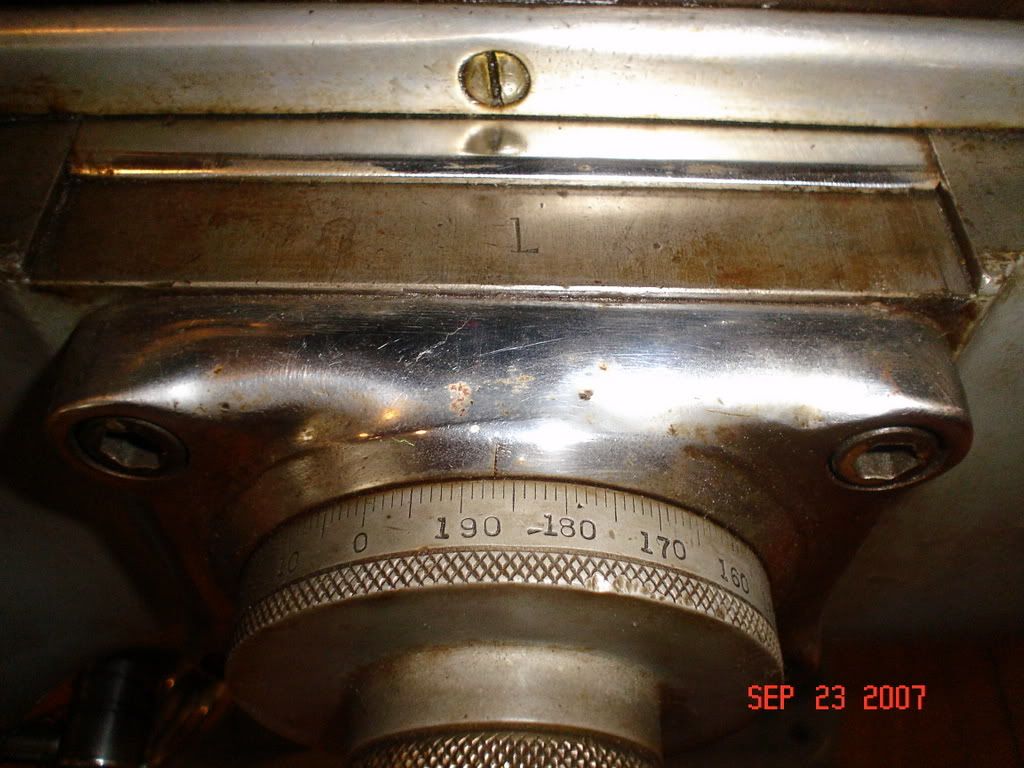
Photo from the Hardinge Bridgeport website showing the current Series 1 12BRJ-2:

Lock mortising machine:

One of the first Gridley screw machines, built at Robbins and Lawrence by Gridley himself. At far left you can see the cam drum and the wedge cams that "program" the actions of the machine:

A slightly later Gridley screw machine. Although surpassed in versatility by CNC swiss turning machines, several modern versions of this machine will bury a machinist in chips and require only minimal attention. I know several one-man screw machine shops that run their 1940's six-spindle Gridleys 24 hours. At night the machines are left to run alone.

So, your car finally let you down. No problem you say, a quick trip to the dealer and you'll have a new part that is exactly the same in dimension, material, and function. The replacement will bolt right up and requires no input from you beyond proper installation. What we take for granted today wasn't always possible.
In the early 1800's mechanisms with interacting components were hand fitted and "tuned" to work together. If one portion of the assembly failed a new part would have to be hand-fitted in order for the mechanism to work correctly. On the battlefield this posed an especially acute problem. 500 muskets with a simple broken part were no better than bayonet mounts as their components were all unique to the individual serial number. It wasn't possible to simply exchange a broken X for a new Y and be back in the fight.
Enter ASME landmark # 119, the American Precision Museum and the production of interchangeable parts. The museum is considered to be the largest collection of historically significant machine tools in the country and is located in the original buildings of the Robbins and Lawrence Armory in Windsor, VT. Many of the exhibits are on of a kind, or the last remaining example of their type. However, the site is also the location where the first US government contract specifying interchangeable parts was filled in 1847.
The idea of interchangeable parts predates the Robbins and Lawrence armory by almost fifty years. Eli Whitney is credited with the idea of interchangeable parts for musket production as early as January 1798 when he took a government contract for 10,000 muskets to be delivered in 1800. Although the contract did not specify interchangeable parts at the time, Whitney hit upon the idea and began to design the tools and manufacturing methods required to produce the order with interchangeable parts. He did not deliver the January 1798 order until 1801 and then only 500 of the original 10,000 were produced. In 1801 he traveled to Washington where he put on an impressive display for members of the government. He laid out a large array of gun parts and assembled a complete lock assembly from random components. After which, he invited his astonished onlookers to do the same. Part of the foundation for the industrial revolution, interchangeable parts, had been laid.
In 1846, Vermont gun-makers Robbins, Kendall and Lawrence won the first contract for 10,000 Springfield rifles requiring interchangeable parts, a bold move. The Robbins and Lawrence shops invented many machines, powered by their waterwheel driven lineshafting, to perform tasks once done entirely by hand. Gun stocks were automatically carved two at a time with revolving templates, lock mortises were routed via a 3 dimensional template, early screw machines invented at Robbins and Lawrence by Mr. Gridley, then a machinist for R&L, automatically made many of the turned parts required. These machines, along with a host of other machinery made some of the finest weapons of the time and earned the firm a solid reputation worldwide.
Despite the museum's focus on very early machine tools, I came specifically to see a machine built a little later. In 1929, a disasterous year to be in business, Swedish immigrants Magnus Wahlstrom and Rudolf Bannow set out to manufacture and market an electric hedge clipper. The idea failed, more than likely due to the business climate of the time. Not to be deterred, they re-grouped and set out to build a vertical milling attachment for horizontal milling machines that were common at the time. Little did they know that their design would be copied many times over and their company, Bridgeport Machine, would become synonymous with "machine tool".
Their first vertical milling head was delivered in 1932. It was so well received that by 1938 they decided to build an entire milling machine around their vertical head. This hand-built machine designated a model 9BRM serial# 1, or simply a "Bridgeport M-head", was delivered to the Precision Die Casting Company of Syracuse, NY. This machine, later bought back by the Bridgeport company and rebuilt to new condition was on display at the Hardinge company (who now owns the Bridgeport name) in Elmira, NY for a number of years. It now resides at the American Precision museum.
Any apprentice machinist who can "tram" a Bridgeport can tell you why the machine was a success. Not only was the machine light and compact, but the ability of the head to "nod" and "tilt" combined with a movable quill made the machine much more flexible than a fixed vertical head or the light horizontals it would soon replace. Combined with a correctly proportioned table and lightweight control feel the machine is a joy to operate. The Bridgeport, now known as the Series 1 12BRJ-2 is, in form, little changed from the original except in capacity and horsepower. It is still manufactured today by the Hardinge company of Elmira, NY and used by shops throughout the world, including my own. Early M-head machines, some rebuilt multiple times, are still used in daily production.
The American Precision Museum website
Bridgeport serial #1:
Note the serial number stamped in the knee just above the Y-axis dial:
Photo from the Hardinge Bridgeport website showing the current Series 1 12BRJ-2:
Lock mortising machine:
One of the first Gridley screw machines, built at Robbins and Lawrence by Gridley himself. At far left you can see the cam drum and the wedge cams that "program" the actions of the machine:
A slightly later Gridley screw machine. Although surpassed in versatility by CNC swiss turning machines, several modern versions of this machine will bury a machinist in chips and require only minimal attention. I know several one-man screw machine shops that run their 1940's six-spindle Gridleys 24 hours. At night the machines are left to run alone.



 Anything with artistic US made machinary and watchmaking is full of win.


