Jim Stabe
Well-known member
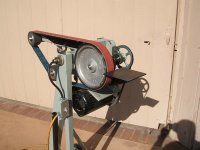
I had some people on another thread ask me for some details on my belt grinder so here goes. I like to build cars so I have a need to remove/shape metal on almost a daily basis. I started the project about a year ago after reading about similar machines that knife makers use. The ready made ones were nice but too expensive so I began a design of my own that met my needs for fabrication on my car projects. It takes 2" x 72" belts that are very common and reasonably priced.
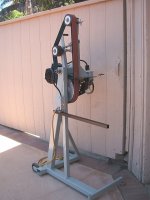
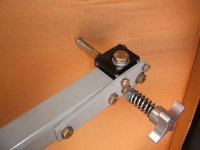
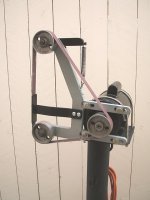
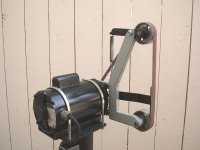
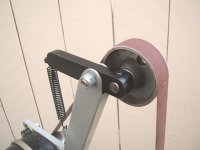
The only things I had to buy were the rubber coated wheels: the 10" wheel was from Grizzly $60 and the 4" wheels came from Sun-Ray at $30 each. I had a 1 1/2 hp 1725 rpm motor in the corner off of something that I can't remember. It an ODP not a TEFC but I have a small belt sander that I made in high school metal shop 40 years ago that has an ODP motor on it and is still going strong so my grand children may have to change it out someday when the dust finally wears it out - the price was right. All the steel was left over from other projects except for about $5 woth that I picked up scrap at $0.45 / lb. The plate that mounts the countershaft is 8" x 8" x 1/2" and has a 2" sq 1/4" wall tube welded to it at 90*. A piece of 1 1/2" sq tube telescopes inside and is locked in place by a couple screws that wedge it into the corner of the 2" tube allowing the length to be adjusted. The tension wheel is on a pivot arm that is spring loaded. I played with various springs until it felt about right for belt tension. The spring tension is adjustable with a bolt on the threaded rod much like a coil over shock.
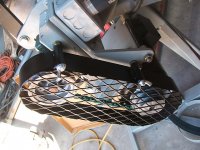
The design evolved throughout the construction as most of mine do. I originally planned on having the motor direct drive the large wheel which would give a 4500 fpm belt speed. I found this guy at Pop's Knife Supplies (very helpful and a nice guy BTW) who told me about ceramic abrasive and how much better it cuts and wears than the aluminum oxide belts but you need to run them at 6000 fpm+ or they glaze over. He also told me that if I run finer grits I need to run them slower to prevent over heating. So I moved the motor underneath and replaced it with pillow blocks and a shaft that would allow ratio changes with different pulleys. I then got some step pulleys so I have a belt spped range from 2700 fpm to 6000 fpm. A second advantage is that it gave much better access when grinding in the horizontal on the large wheel.
Original design --------------------------------------What I ended up doing
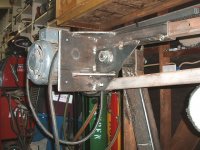
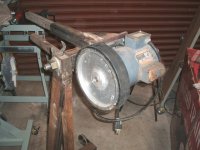

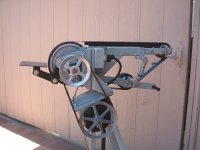
I wanted to be able to rotate the head so I could grind against the large or small wheel and be able to turn it vertical to grind against the 12" long flat platen (I can also use the platen in the horizontal mode as well). I can loosen a nut and pull the head away from the stand and then rotate it on a 2" round tube and push it back and index it at any 90 degree position (Hard to explain - look at the picture).
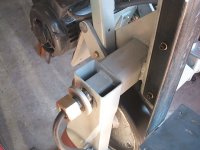
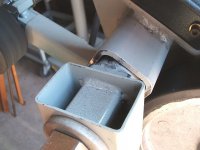
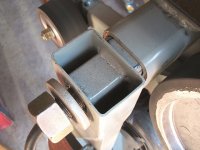
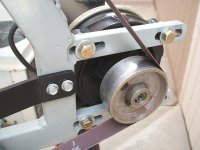
The belt tracking adjusters for the small wheels can adjust the wheels in any plane and I can get the belt to track without crowning any of the wheels if I'm grinding against the large wheel or the platen. The work rest can be set at any angle and will work in either the horizontal or vertical position.
The black tube on the stand swings up and acts as a lever to be able to move the machine around. I put a separate plug on the motor so I could remove it without having to undo the wires from the switch. The machine works well and really removes metal quickly.
More pictures in the next post
The only things I had to buy were the rubber coated wheels: the 10" wheel was from Grizzly $60 and the 4" wheels came from Sun-Ray at $30 each. I had a 1 1/2 hp 1725 rpm motor in the corner off of something that I can't remember. It an ODP not a TEFC but I have a small belt sander that I made in high school metal shop 40 years ago that has an ODP motor on it and is still going strong so my grand children may have to change it out someday when the dust finally wears it out - the price was right. All the steel was left over from other projects except for about $5 woth that I picked up scrap at $0.45 / lb. The plate that mounts the countershaft is 8" x 8" x 1/2" and has a 2" sq 1/4" wall tube welded to it at 90*. A piece of 1 1/2" sq tube telescopes inside and is locked in place by a couple screws that wedge it into the corner of the 2" tube allowing the length to be adjusted. The tension wheel is on a pivot arm that is spring loaded. I played with various springs until it felt about right for belt tension. The spring tension is adjustable with a bolt on the threaded rod much like a coil over shock.
The design evolved throughout the construction as most of mine do. I originally planned on having the motor direct drive the large wheel which would give a 4500 fpm belt speed. I found this guy at Pop's Knife Supplies (very helpful and a nice guy BTW) who told me about ceramic abrasive and how much better it cuts and wears than the aluminum oxide belts but you need to run them at 6000 fpm+ or they glaze over. He also told me that if I run finer grits I need to run them slower to prevent over heating. So I moved the motor underneath and replaced it with pillow blocks and a shaft that would allow ratio changes with different pulleys. I then got some step pulleys so I have a belt spped range from 2700 fpm to 6000 fpm. A second advantage is that it gave much better access when grinding in the horizontal on the large wheel.
Original design --------------------------------------What I ended up doing
I wanted to be able to rotate the head so I could grind against the large or small wheel and be able to turn it vertical to grind against the 12" long flat platen (I can also use the platen in the horizontal mode as well). I can loosen a nut and pull the head away from the stand and then rotate it on a 2" round tube and push it back and index it at any 90 degree position (Hard to explain - look at the picture).
The belt tracking adjusters for the small wheels can adjust the wheels in any plane and I can get the belt to track without crowning any of the wheels if I'm grinding against the large wheel or the platen. The work rest can be set at any angle and will work in either the horizontal or vertical position.
The black tube on the stand swings up and acts as a lever to be able to move the machine around. I put a separate plug on the motor so I could remove it without having to undo the wires from the switch. The machine works well and really removes metal quickly.
More pictures in the next post
Last edited: