To avoid these ads, REGISTER NOW!

Craftsman 115-19500 Pre-block Restore

jerryd67

Active member
Joined
Feb 11, 2019
Messages
36
Location
NW Arkansas
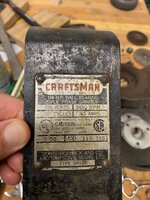
I was fortunate enough to find this "Pre-block" Craftsman Bench Grinder on local CL for $25. Unlike the later "Block" (model prefix 397 or 257), that are primarily cast aluminum, these 115 prefix models (made for Sears by Packard Electric Co.) utilized cast iron frames and wheel guards, therefore this thing is quite heavy. Was in pretty good shape for being 60 years old, and ran strong when powered on, but definitely needs freshening up.
attachment.php

attachment.php


This particular 1/4 hp model does not have covers on the wheel guards, unlike the larger 1/3 and 1/2 hp models of the same series. After removing the arbor nuts and outer flanges, I discovered the original 1959 Craftsman grinding wheels. The wheels were in good shape, but with a 60 year old grinder, it's not worth the risk to try to save them. They were challenging to get off, as they had essentially "frozen" on the arbor after 60 years.
attachment.php


Close-up of switch wiring.
attachment.php


Left-hand frame housing MUST come off first on the pre-block grinders, as they have a centrifugal switch attached to the right-hand frame that acts to disengage the start-up windings when the grinder is up to speed. LH Bearing stayed on the arbor.
attachment.php


By very carefully lifting the massive winding/core assembly, I was able to get access to snip the white wire leading from the winding to the centrifugal switch (which will be replaced) and remove the winding/core assembly.
attachment.php


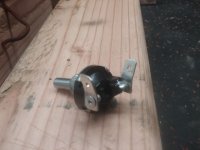
After removing the winding/core assembly, you must carefully remove the screws holding the centrifugal switch to the right-side housing, because if you attempt to remove the rotor without doing so and the right-side bearing stays on the shaft, you will damage the centrifugal switch. RH Bearing stayed in the housing for me. Close-up of the position of the centrifugal switch, which is held in by two 1/4 inch screws.
attachment.php


More to come!
 

Attachments

  • IMG_0030.jpg
    IMG_0030.jpg
    149.2 KB · Views: 493
  • IMG_0032(1).jpg
    IMG_0032(1).jpg
    106.6 KB · Views: 476
  • 20190323_145035.jpg
    20190323_145035.jpg
    151.4 KB · Views: 476
  • 20190323_145119.jpg
    20190323_145119.jpg
    149 KB · Views: 476
  • 20190323_150610.jpg
    20190323_150610.jpg
    154.5 KB · Views: 482
  • 20190323_151027.jpg
    20190323_151027.jpg
    151.4 KB · Views: 474
  • 20190323_153124.jpg
    20190323_153124.jpg
    110 KB · Views: 469
Last edited:
To avoid these ads, REGISTER NOW!

ARFLY

Well-known member
Joined
Jul 28, 2013
Messages
848
Location
NW Arkansas
I was fortunate enough to find this "Pre-block" Craftsman Bench Grinder on local CL for $25. Unlike the later "Block" (model prefix 397 or 257), that are primarily cast aluminum, these 115 prefix models (made for Sears by Packard Electric Co.) utilized cast iron frames and wheel guards, therefore this thing is quite heavy. Was in pretty good shape for being 60 years old, and ran strong when powered on, but definitely needs freshening up.
IMG_0030.jpg
IMG_0032(1).jpg
This particular 1/4 HP model does not have covers on the wheel guards, unlike the larger 1/3 and 1/2 models of the same series. After removing the arbor nuts and outer flanges, I discovered the original 1959 Craftsman grinding wheels. The wheels were in good shape, but with a 60 year old grinder, it's not worth the risk to try to save them. They were challenging to get off, as they had essentially "frozen" on the arbor after 60 years.
20190323_145035.jpg
Close-up of switch wiring.
20190323_145119.jpg
Left-hand frame housing MUST come off first on the pre-block grinders, as they have a centrifugal switch attached to the right-hand frame that acts to disengage the start-up windings when the grinder is up to speed. LH Bearing stayed on the arbor.
20190323_150610.jpg
By very carefully lifting the massive winding/core assembly, I was able to get access to snip the white wire leading from the winding to the centrifugal switch (which will be replaced) and remove the winding/core assembly.
20190323_151027.jpg
After removing the winding/core assembly, you must carefully remove the screws holding the centrifugal switch to the right-side housing, because if you attempt to remove the rotor without doing so and the right-side bearing stays on the shaft, you will damage the centrifugal switch. RH Bearing stayed in the housing for me. Close-up of the position of the centrifugal switch, which is held in by two 1/4 inch screws.
20190323_153124.jpg
More to come!
Looks great. It's going to be awesome when it's finished.
 

6PTsocket

Well-known member
Joined
Mar 12, 2014
Messages
4,593
Where the heck do you get a centrifugal switch for a grinder that old? I would be floored if you say Sears has it and those switches are not generic, as far as I know. BTW any CS can be replaced with an external solid state current relay. You just need the Amps rating off the name plate. They are great, no contacts to get pitted or springs and weights to break or bind.

Sent from my SM-G900V using Tapatalk
 
OP
J

jerryd67

Active member
Joined
Feb 11, 2019
Messages
36
Location
NW Arkansas
Where the heck do you get a centrifugal switch for a grinder that old? I would be floored if you say Sears has it and those switches are not generic, as far as I know. BTW any CS can be replaced with an external solid state current relay. You just need the Amps rating off the name plate. They are great, no contacts to get pitted or springs and weights to break or bind.

Sent from my SM-G900V using Tapatalk

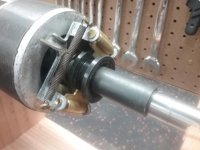
Luckily, the centrifugal switch on this one survived the disassembly, and is in good shape. I will place quick disconnects on the electrical portion of the switch where the previous wired were simply soldered directly to the contacts. So as long as it continues to work fine, I won't try to change it out. It does have various springs that are part of the mechanism on the shaft itself, but they seem to be in good shape for being 60 years old.

Close-up of the portion of the centrifugal switch mechanism on the shaft. As the grinder gets up to speed, the brass-looking portions rotate out, pulling the black bushing in, which disengages the electric contacts on the switch, and cuts power to the start-up windings.
attachment.php


After spending several days in the electrolysis tank, the cast iron pieces are clean, prepped (POR-15 metal prep) and primed.
attachment.php


Unlike the 1/3 and 1/2 hp versions, the 1/4 hp model does not come with a light, so I drilled a hole in the correct location to mount a light.
attachment.php


Center panel is done with media blasting, and painted (Rustoleum Champagne Mist Metallic).
attachment.php
 

Attachments

  • 20190405_165710.jpg
    20190405_165710.jpg
    72.4 KB · Views: 432
  • 20190405_165641.jpg
    20190405_165641.jpg
    74.7 KB · Views: 433
  • 20190405_110723.jpg
    20190405_110723.jpg
    81.8 KB · Views: 429
  • 20190405_110341.jpg
    20190405_110341.jpg
    99 KB · Views: 435
Last edited:

6PTsocket

Well-known member
Joined
Mar 12, 2014
Messages
4,593
Nice restore. I know how a mechanical CS works. It is supposed to open as the motor approaches full speed. The electronic ones monitor the start current that drops to what is on the motor plate as the motor comes to full speed. For example, if the motor plate says five amps, you order a 5 amp relay and it probably opens at 5.5 amps or so. Three wires. The monitor is in series with the motor but is such low resistance it has no effect. The solid state cintacts are wired where the CS was. Tiny little box you can stash in the base. Works as substitute with any CS motor. We had a brand new Leeson at work that came wired that way.


Sent from my SM-G900V using Tapatalk
 
OP
J

jerryd67

Active member
Joined
Feb 11, 2019
Messages
36
Location
NW Arkansas
Nice restore. I know how a mechanical CS works. It is supposed to open as the motor approaches full speed. The electronic ones monitor the start current that drops to what is on the motor plate as the motor comes to full speed. For example, if the motor plate says five amps, you order a 5 amp relay and it probably opens at 5.5 amps or so. Three wires. The monitor is in series with the motor but is such low resistance it has no effect. The solid state cintacts are wired where the CS was. Tiny little box you can stash in the base. Works as substitute with any CS motor. We had a brand new Leeson at work that came wired that way.


Sent from my SM-G900V using Tapatalk

Thanks 6 point. I can definitely see an advantage to using an electronic switch as you described. With the mechanical version, if the switch failed (broken spring, for example) and did not disengage, your start-up winding could potentially get fried.
 
OP
J

jerryd67

Active member
Joined
Feb 11, 2019
Messages
36
Location
NW Arkansas
Finally got around to finishing up this little (but heavy) 1/4 hp pre-block.

Since the original (and very brittle) wiring was soldered directly to the centrifugal switch and power switch, and since I didn't want to go that route, I pop-riveted male spade electrical connectors instead.

attachment.php

attachment.php


Close-up of my wiring...since I added a light, and wanted to be able to have the light operate independently of the grinder power switch, I added a double male-female adapter to the hot side of the switch to power the light, and then used a Wago lever nut to tie all my neutral wires together.

attachment.php


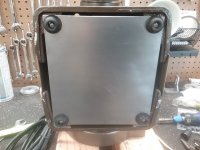
My grinder was missing the bottom plate (and feet), so I fabricated one mounted it and the feet.

attachment.php


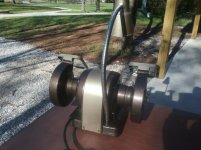
Finished product once re-assembly was complete.

attachment.php

attachment.php

attachment.php


This was my first restore, and I've certainly learned a lot along the way, but I'm happy overall with the way it turned out.

Now, on to the next one as I've got five more grinders waiting for me!
 

Attachments

  • 20190420_173325.jpg
    20190420_173325.jpg
    51.2 KB · Views: 380
  • 20190420_173233.jpg
    20190420_173233.jpg
    49.2 KB · Views: 387
  • 20190420_170249.jpg
    20190420_170249.jpg
    118.4 KB · Views: 373
  • 20190420_163846.jpg
    20190420_163846.jpg
    113.9 KB · Views: 377
  • 20190407_171954.jpg
    20190407_171954.jpg
    90.1 KB · Views: 376
  • 20190407_165720.jpg
    20190407_165720.jpg
    117.6 KB · Views: 378
  • 20190420_173443.jpg
    20190420_173443.jpg
    123.4 KB · Views: 385
To avoid these ads, REGISTER NOW!

torqueman2002

Well-known member
Joined
Jun 3, 2009
Messages
6,138
Location
SE Michigan
great job and great write up :beer:
Yes, indeed!
:thumbup:

I like the idea of the spade terminal connections and addition of the lamp.

This restore turned out very nice!

A couple of questions, if you don't mind.


  • Where did you find/source the lamp?
  • What color/brand did you use for the rest of the Block? It is a nice combination with the Champagne Mist Metallic center band.
  • Are the rivets 1/8" aluminum?
Thanks for posting.
:beer:
 
OP
J

jerryd67

Active member
Joined
Feb 11, 2019
Messages
36
Location
NW Arkansas
Yes, indeed!
:thumbup:

I like the idea of the spade terminal connections and addition of the lamp.

This restore turned out very nice!

A couple of questions, if you don't mind.


  • Where did you find/source the lamp?
  • What color/brand did you use for the rest of the Block? It is a nice combination with the Champagne Mist Metallic center band.
  • Are the rivets 1/8" aluminum?
Thanks for posting.
:beer:

Thanks Doc!

I was fortunate enough to find two of these lamps in like-new condition on eBay for under $20 and was able to media blast/prime/paint it to match the center band and eye shields, which were actually sourced from another grinder as mine only had the eye shield mounts when purchased (looked like the spot welds that hold the glass frame to the mount had failed as some point).

I used the previously mentioned Champagne Mist (a very light gold color) for the band, light and eye shields and Rustoleum Forged Hammered in Chestnut for the body, followed by several layers of clear on both.

attachment.php


I ended up using stainless steel (1/8 x 1/8) semi-tubular rivets, and setting them with a rivet clincher. I actually slightly messed up one corner of the badge during this process (trying to use a hammer to set the rivets). I've since got an arbor press and will try this instead on my next resto.
 

Attachments

  • 20190420_173618.jpg
    20190420_173618.jpg
    124.3 KB · Views: 233
Last edited:

Enigma

Well-known member
Joined
Sep 2, 2010
Messages
861
Location
Florida
I was fortunate enough to find this "Pre-block" Craftsman Bench Grinder on local CL for $25. Unlike the later "Block" (model prefix 397 or 257), that are primarily cast aluminum, these 115 prefix models (made for Sears by Packard Electric Co.) utilized cast iron frames and wheel guards, therefore this thing is quite heavy. Was in pretty good shape for being 60 years old, and ran strong when powered on, but definitely needs freshening up.
attachment.php

attachment.php


This particular 1/4 hp model does not have covers on the wheel guards, unlike the larger 1/3 and 1/2 hp models of the same series. After removing the arbor nuts and outer flanges, I discovered the original 1959 Craftsman grinding wheels. The wheels were in good shape, but with a 60 year old grinder, it's not worth the risk to try to save them. They were challenging to get off, as they had essentially "frozen" on the arbor after 60 years.
attachment.php


Close-up of switch wiring.
attachment.php


Left-hand frame housing MUST come off first on the pre-block grinders, as they have a centrifugal switch attached to the right-hand frame that acts to disengage the start-up windings when the grinder is up to speed. LH Bearing stayed on the arbor.
attachment.php


By very carefully lifting the massive winding/core assembly, I was able to get access to snip the white wire leading from the winding to the centrifugal switch (which will be replaced) and remove the winding/core assembly.
attachment.php


After removing the winding/core assembly, you must carefully remove the screws holding the centrifugal switch to the right-side housing, because if you attempt to remove the rotor without doing so and the right-side bearing stays on the shaft, you will damage the centrifugal switch. RH Bearing stayed in the housing for me. Close-up of the position of the centrifugal switch, which is held in by two 1/4 inch screws.
attachment.php


More to come!

Hi Jerry. Can you tell me how to get the housing off? I found one at the garage sale. Thanks.
 

charliemichaelis

New member
Joined
Sep 11, 2023
Messages
1
Luckily, the centrifugal switch on this one survived the disassembly, and is in good shape. I will place quick disconnects on the electrical portion of the switch where the previous wired were simply soldered directly to the contacts. So as long as it continues to work fine, I won't try to change it out. It does have various springs that are part of the mechanism on the shaft itself, but they seem to be in good shape for being 60 years old.

Close-up of the portion of the centrifugal switch mechanism on the shaft. As the grinder gets up to speed, the brass-looking portions rotate out, pulling the black bushing in, which disengages the electric contacts on the switch, and cuts power to the start-up windings.
attachment.php


After spending several days in the electrolysis tank, the cast iron pieces are clean, prepped (POR-15 metal prep) and primed.
attachment.php


Unlike the 1/3 and 1/2 hp versions, the 1/4 hp model does not come with a light, so I drilled a hole in the correct location to mount a light.
attachment.php


Center panel is done with media blasting, and painted (Rustoleum Champagne Mist Metallic).
attachment.php
Looks great. It's going to be awesome when it's finished.
Unfortunately, my centrifugal switch plate on the right side was broken during disassembly - any ideas on what to do?
 

Attachments

  • IMG_7844.jpeg
    IMG_7844.jpeg
    1,018.2 KB · Views: 3
To avoid these ads, REGISTER NOW!
Top Bottom