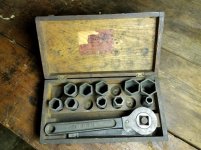
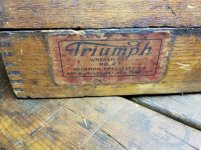
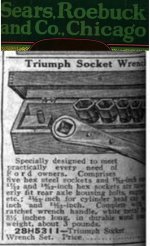
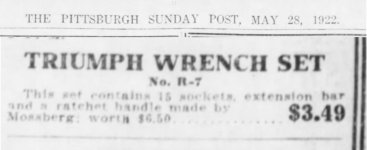
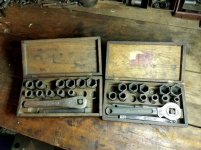
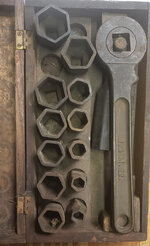
After close inspection of the Triumph Wrench Set No. R-7 in my collection, I am happy to report that everything about the set confirms the ads.
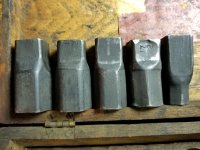
The sockets are 1/2-inch square internal drive and 11/16-inch square external drive, similar in construction and finish (some kind of black rust-proof coating) to those made by the Frank Mossberg Company for their own sets as well as for sets Mossberg was heretofore known to have made only for Sears & Roebuck. As mentioned above, some of the ads indicated that the No. R-7 wrench set had fifteen (15) sockets. The Mossberg No. 11 set had fourteen (14) sockets, and an extra deep spark plug socket, 29/32”, which went under the ratchet in a well in the wooden box. The spark plug socket is undoubtedly the fifteenth socket being referred to in the Triumph ads. The fourteen (14) sockets are 13/32, 15/32 (missing from My set), 17/32, 19/32, 5/8 (missing), 21/32, 23/32, 25/32 (missing), 13/16, 27/32, 29/32, 1 (missing), 1-1/32, and 1/3/32. The deep spark plug socket is 29/32. The sockets in my set are not marked with the Mossberg “<M>” logo. They do have a fractional size marking on the base, where Mossberg size markings are located, but the markings are quite a bit larger than Mossberg examples. They may have been made by Mossberg explicitly for Triumph and left unmarked, or they may have been made in-house by Triumph.


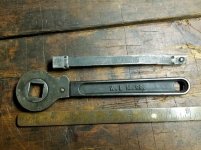
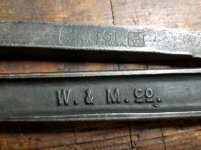
The ratchet in the No. R-7 wrench set was undoubtedly made by Mossberg. It has an 11/16-inch female square drive opening, the same black rust-proofing substance as the sockets, and it’s marked “W. & M. Co.,” just like the ratchet found inside the Sears & Roebuck Aristocrat No. 1.
And Sears also sold the Triumph kit.
The ratchet is the Tuttle patent (1,426,127), granted August 15, 1922, and assigned to Frank Mossberg Company.
The meaning of the “W. & M. Co.” marking is not known. If the “M.” signifies Mossberg, as implied, the “W.” is undoubtedly a partner. If anyone in the circle of people revolving around Frank Mossberg could be identified as rising to partner status, it would be Simon L. Wardell. He was the only person ever listed with Mossberg as a patent co-assignor, and they were co-assignors for the Mossberg Wrench Company. Another logical possibility might be Thomas F. Wilson, the founder of Auto Parts Company (APCO), who would purchase Mossberg in 1927, though searches yield no confirmation for that speculation, and it precedes the production date for the “W. & M. Co.” ratchets by a good five years.
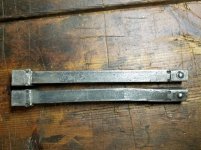
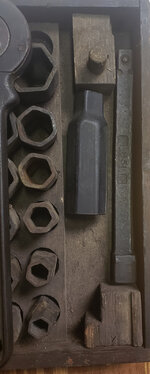
The extension is the most intriguing and important tool in the No. R-7 wrench set. I have concluded that it was made by Mossberg and I consider it a key “missing link” in understanding Mossberg’s place at the center of the pressed steel socket era universe.
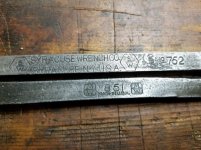
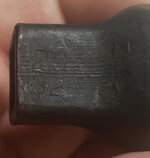
It does not resemble the Mossberg No. 351 extension in construction, which was made of tubular steel with swaged or welded drive ends, but it does function the same – one end at 11/16” O.D. for the female ratchet opening, the other end at 1/2” O.D. to drive the sockets. And it does bear a model number (“851”) similar in format to the Mossberg No. 351 extension, a common practice for mfgrs making different versions of the same tool for a different product line or for those made by a subsidiary. On that note, it also bears a very suggestive monograph. An “M” over a “W,” separated by a line, surrounded by a rounded box. There are two of these “boxed M/W” logos on the tool, one on either side of the model number, which is another common Mossberg marking practice. This tool and its marking are a FOAK, as far as I know, with no examples found in Cope’s
American Wrench Makers, Tools Archives, Alloy Artifacts, or elsewhere in the antique hand tools print or websphere libraries.
MORE TO FOLLOW