tool_scrounge
Well-known member
Yesterday there was an estate tool sale I attended.
It turned out that almost every buyer knew most of the other people there so it was a rather polite affair. The most spoken phrase was "you really need that ***, you should buy it". Translation - I already have 6 of them and would rather you buy it instead of me taking another one home.
I picked up a few things I wanted. But a couple items have me puzzled.
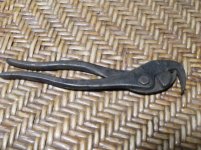
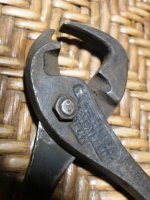
The first is a pliers that has more of a beak than jaws. It also has a wire cutter in the back. It looks pretty old. Sadly the stampings are poorly done and too worn to read. On one side I can see "Made in USA, Pat apld for". But the mfg info on the other side is unreadable. Seems like it would be good for removing box staples.
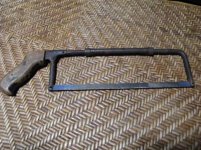
The other is obviously a hacksaw. But it is like no other I have seen. The two sides have acme threads machined into them to allow the two nuts to tension the blade. The acme threads are also formed at the ends to have a protrusion like a key in a keyway to keep the two sides angular aligned. Sadly the crude stamping cannot be read. Any thought on who made this hacksaw and what is its vintage?
Thanks
It turned out that almost every buyer knew most of the other people there so it was a rather polite affair. The most spoken phrase was "you really need that ***, you should buy it". Translation - I already have 6 of them and would rather you buy it instead of me taking another one home.
I picked up a few things I wanted. But a couple items have me puzzled.
The first is a pliers that has more of a beak than jaws. It also has a wire cutter in the back. It looks pretty old. Sadly the stampings are poorly done and too worn to read. On one side I can see "Made in USA, Pat apld for". But the mfg info on the other side is unreadable. Seems like it would be good for removing box staples.
The other is obviously a hacksaw. But it is like no other I have seen. The two sides have acme threads machined into them to allow the two nuts to tension the blade. The acme threads are also formed at the ends to have a protrusion like a key in a keyway to keep the two sides angular aligned. Sadly the crude stamping cannot be read. Any thought on who made this hacksaw and what is its vintage?
Thanks