latenttweet
Member
Recently shopping for lifts, and ran across some findings I wanted to share. I am looking for Sub 9' lifts, particularly:
Triumph NT-9 9,000 lbs ($1,800)
BendPak Grand Prix GP-7LCS 7,000 lbs ($3,200)
Came across this article here:
https://www.bendpak.com/a-study-in-lift-design/cheap-lift-vs-bendpak/
This article is going to be biased as it is written by bendpak, however its a good source to just compare the design, material, and manufacturing of both lifts.
now what's interesting is they [bendpak] make a lot of vague statements, like, our cable is stronger than theirs, with no real talk of tensile strength of cable, ratings, corrosion resistances, sourcing. Or , our metal is thicker here, but that doesn't necessary mean better, actually could be worse in some applications. its almost like someone wrote this article pretty quickly because a real mechanical engineer could really pick apart the differences from a design, longevity, and safety standpoint. Which then leads me to wonder, what kind of Stress Analysis was done on the Bendpak units? but then again, they have the certifications to back up their claims.
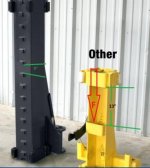
Now someone told me, that metal is never going to break when the car is resting on it. this may be true. However, Look at the diagram attached showing the differences between the locking nubs. More is better from a peace of mind standpoint when the car is rising up, but that's not the point I want to make. You have those two yellow bars on the cheaper unit, say you are lifting the car up, pump is running, line explodes (already in trouble because that can be skin piercing pressure), now the lift comes to a free fall (or whatever the resistance of the hole in the line is). Take this yellow locking tab on the cheaper unit, from a static engineering perspective, 4,500 lbs (half of what its rated for/1 side of a truck) will never bend that. But now drop the car from 13 onto that (the distance between those two locking bars, strictly a guess from the picture), and consider the lock ratchet mechanism isnt the same size as the bar, its smaller, so now you have Force X gravity(13) distributed into a tiny area of pressure where the lock mechanism is. This force could shear the lock (in my imagination anyways) You also have scenarios like the car not falling straight down, There are many lift accidents from the car not being lifted properly (setup), this type of failure will cause the vehicle to go forward backward or side to side, and who knows what weird force that will have on these lift arm restraints. Also , besides the fact of heavy metal failure and cracking, the cable system will probably go before all of that. Cable condition is what you look for when buying a used lift. I think after seeing this, I am definitely spending the extra money on a better lift. the ANSI and other certifications sold me. Obviously everything is made in China these days, but the better brands just have better quality control, but at the very least if an American standards company is willing to rate it, then that is peace of mind for me. I Will be spending the extra money on the Bendpak.
Longevity is also another issue, I know people with the cheap Chinese lifts that are years old, they seem to be fine, but just from the pics in the article you can tell some parts are going to wear faster.
The last issue I want to mention is that $1,000 price difference is pretty huge difference, but the fact that I could get the Chinese unit, have it break, then have to take it apart, ship it back, this could cost up to $1k of my time lost and shipping to have a warranty fix. Granted, most warranty would probably be something with the hydraulics.
Triumph NT-9 9,000 lbs ($1,800)
BendPak Grand Prix GP-7LCS 7,000 lbs ($3,200)
Came across this article here:
https://www.bendpak.com/a-study-in-lift-design/cheap-lift-vs-bendpak/
This article is going to be biased as it is written by bendpak, however its a good source to just compare the design, material, and manufacturing of both lifts.
now what's interesting is they [bendpak] make a lot of vague statements, like, our cable is stronger than theirs, with no real talk of tensile strength of cable, ratings, corrosion resistances, sourcing. Or , our metal is thicker here, but that doesn't necessary mean better, actually could be worse in some applications. its almost like someone wrote this article pretty quickly because a real mechanical engineer could really pick apart the differences from a design, longevity, and safety standpoint. Which then leads me to wonder, what kind of Stress Analysis was done on the Bendpak units? but then again, they have the certifications to back up their claims.
Now someone told me, that metal is never going to break when the car is resting on it. this may be true. However, Look at the diagram attached showing the differences between the locking nubs. More is better from a peace of mind standpoint when the car is rising up, but that's not the point I want to make. You have those two yellow bars on the cheaper unit, say you are lifting the car up, pump is running, line explodes (already in trouble because that can be skin piercing pressure), now the lift comes to a free fall (or whatever the resistance of the hole in the line is). Take this yellow locking tab on the cheaper unit, from a static engineering perspective, 4,500 lbs (half of what its rated for/1 side of a truck) will never bend that. But now drop the car from 13 onto that (the distance between those two locking bars, strictly a guess from the picture), and consider the lock ratchet mechanism isnt the same size as the bar, its smaller, so now you have Force X gravity(13) distributed into a tiny area of pressure where the lock mechanism is. This force could shear the lock (in my imagination anyways) You also have scenarios like the car not falling straight down, There are many lift accidents from the car not being lifted properly (setup), this type of failure will cause the vehicle to go forward backward or side to side, and who knows what weird force that will have on these lift arm restraints. Also , besides the fact of heavy metal failure and cracking, the cable system will probably go before all of that. Cable condition is what you look for when buying a used lift. I think after seeing this, I am definitely spending the extra money on a better lift. the ANSI and other certifications sold me. Obviously everything is made in China these days, but the better brands just have better quality control, but at the very least if an American standards company is willing to rate it, then that is peace of mind for me. I Will be spending the extra money on the Bendpak.
Longevity is also another issue, I know people with the cheap Chinese lifts that are years old, they seem to be fine, but just from the pics in the article you can tell some parts are going to wear faster.
The last issue I want to mention is that $1,000 price difference is pretty huge difference, but the fact that I could get the Chinese unit, have it break, then have to take it apart, ship it back, this could cost up to $1k of my time lost and shipping to have a warranty fix. Granted, most warranty would probably be something with the hydraulics.