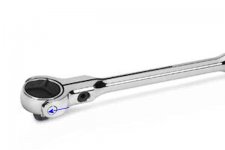
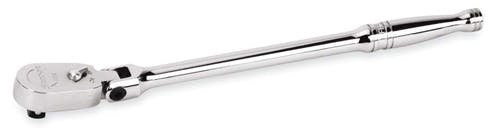
Attempting to focus on "stronger conceptual design" as opposed to precise implementation of design. Looking at visonguru's picture of two Snap-on implementations -

While the arms of the fork-on-head are heavier than the arms of the fork-on-handle, there is no intrinsic reason why the fork-on-handle could not have been made equally heavy.
If the full length of the tang fits very tightly in the fork (the joint is tight), the fork will absorb most of the strain. If the arms of the fork become spread even a little, a great deal of the force is transferred to the relatively tiny hinge pin. Eventually the hinge pin breaks
and then the fork arms either break or become grossly spread.
Can't tell from the picture, but my impression is that the pin of newer, fork-on-head design also functions as a tensioning-screw to help keep the joint tight. (Please correct me that's wrong.) When I've encountered a similar tensioning-screw/pin in breaker bar heads, due to the short, thick arms of the fork, a great deal of torque needs to be applied to the tensioning-screw/pin to tighten the joint to any appreciable degree.
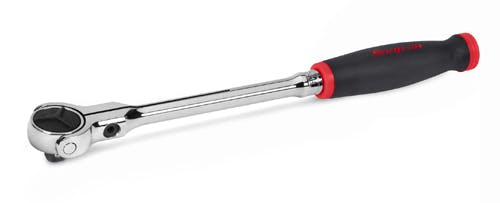
Looking at HenryAZ's picture of a Snap-on swivel head
It requires much, much less torque on the tensioning screw of this design to greatly change tightness of the joint. With just a short arm hex key and my thumb and two fingers, I can tight the joint to the point where a 7/8" deep socket and 12" extension held horizontally doesn't cause movement in the joint.
Nobody that I know of makes one, but if you could find a well implemented, fork-on-handle designed flex-head where the handle was split - like the handle of swivel head - where the pivot pin and the joint tensioning screw were separate components, then you'd have a flex-head where the flex-joint would essentially last forever -always easily tightened up. Just like the joint of even the cheapest swivel heads.




 I've managed to break a 1/2 drive breaker bar but that's another thread.