To avoid these ads, REGISTER NOW!

Garage Door Condensation During Winter in Colorado

wacomme

Well-known member
Joined
Feb 1, 2012
Messages
152
Location
Colorado Springs, CO
Hello,

I have significant condensation on my insulated garage door during winter months in Colorado. The garage itself is unheated and not insulated. I have one 6" ventilation port to the outside.

What's the best way to fix this problem? I'm currently cracking the garage door 2" and blowing a 20" fan in the one car garage.

I was looking at dehumidifiers (odd, since we use a humidifier in the attached house), but I was reading that they're only moderately effective in cold temperatures.

Should I insulate the garage and add a heater? It seems that this approach would solve a general humidity problem, but I'd still have condensation on the inside of the garage door.

Basically, how do I solve this problem? Colorado is relatively dry, and I only have this problem in the colder months. It's not an issue during the summer.
 
To avoid these ads, REGISTER NOW!
OP
W

wacomme

Well-known member
Joined
Feb 1, 2012
Messages
152
Location
Colorado Springs, CO
Yes. It's an attached single car garage within a condo unit. The inside door connects directly to the house. Both sides of the garage wall (stucco and some type of felt material) are exposed to the outside.
 
OP
W

wacomme

Well-known member
Joined
Feb 1, 2012
Messages
152
Location
Colorado Springs, CO
Oops. My mistake. One side of the garage in uninsulated. The other side has drywall, so I assume it's insulated. The ceiling is drywalled too.
 

readhead

Well-known member
Joined
Dec 8, 2012
Messages
6,207
Location
Durango, Co.
There has to be a source of water to condense and my guess is that is the snow on the car when you park. You would need a pretty large dehumidifier to get rid of that much water. Remove as much snow as you can before you park. Push what melts out the door an hour later. Even though the garage door is insulated the edges of the panels are still cold and will condense when moisture is present. Getting rid of the water plus a dehumidifier might help.
 
OP
W

wacomme

Well-known member
Joined
Feb 1, 2012
Messages
152
Location
Colorado Springs, CO
We haven't had much snow this winter. But yes. Removing as much snow from the car will help. But even in dry weather, the inside of the garage door is soaking wet throughout the winter months.
 

readhead

Well-known member
Joined
Dec 8, 2012
Messages
6,207
Location
Durango, Co.
There has to be a source of moisture. Is the dryer venting into the garage? Is anything leaking or venting into the garage?
 
OP
W

wacomme

Well-known member
Joined
Feb 1, 2012
Messages
152
Location
Colorado Springs, CO
Colorado in general is fairly dry. We humidify our home, especially in winter. I need to look at the door to the garage to make sure it's sealed and not leaking humidified air into the garage.

Could it just be the temperature differential between the outside and inside of the garage?

Our furnace is located in the garage, including the humidifier. However, the air intake and outlet vents are sealed via pipes to the roof. Would the furnace be an issue?

The dryer does not vent to the garage. We do have an old food freezer in the garage.
 

Firebrick43

Well-known member
Joined
May 12, 2015
Messages
14,450
Location
West central Indiana
You said the door is insulated but to how. Some are just thin fiberglass batt = very little and others 2" thick injected with foam = Very good.

Condensation happens when relatively warmer air contacts a cooler surface. This is all relative.

The seals around the door can be compromised allowing drafts to cool the inside surface.

As you mentioned, a dehumidifier starts loosing its ability to remove water below 65 degrees and probably wont remove any at 45 degrees.

Opening the door and using a fan while stopping condensation (equalizes the temps of the back side of the door) probably just adds to the moisture load of the garage in the long term. Have you just tried to run the fan on the door without opening it?

Insulating and heating to 50 degrees would probably fix the issue, getting a new door with better insulation would probably work well to. I have had condensation issues in my unheated pole shed in the early spring but never the well insulated door sweating.
 
OP
W

wacomme

Well-known member
Joined
Feb 1, 2012
Messages
152
Location
Colorado Springs, CO
The garage door is only a year old, and I recall buying a good insulated one - need to check. I DO need to check the seals around the garage door.

I can try running the fan and keeping the garage door closed.
 

cjarvis

Well-known member
Joined
Aug 30, 2017
Messages
359
I have to wonder if the moisture you’re putting into the interior of your home isn’t migrating into the garage where it’s condensing on the cold garage door.
 
OP
W

wacomme

Well-known member
Joined
Feb 1, 2012
Messages
152
Location
Colorado Springs, CO
OK. Maybe the garage door isn't insulated or it's inadequately insulated. It's either model 170 or model 180 of Overhead Doors. If it's model 180, then:

Our steel garage door Model 180 features a standard panel design with an embossed wood grain texture to enhance the appearance and durability of your door. The polystyrene insulation provides a 7.4 R-value for enhanced thermal efficiency of your garage space. A vinyl interior backing of the door provides a finished appearance. Model 180 steel garage doors come with a 20-year limited warranty which means they are built to last. A wide variety of window options are also available for these steel garage doors.
 

readhead

Well-known member
Joined
Dec 8, 2012
Messages
6,207
Location
Durango, Co.
Pull up the black mat and see if there is water under it. Moisture could be migrating up through the concrete.
 
OP
W

wacomme

Well-known member
Joined
Feb 1, 2012
Messages
152
Location
Colorado Springs, CO
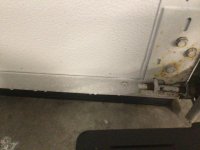
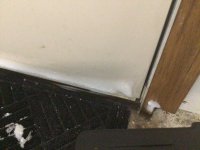
OK. I pulled up the black mat, took photos, and added the photos taken to the photo folder listed in the previous posting.

I can't tell if there is moisture migrating from the concrete. There's moisture seeping in from outside and pulled in from the mats, but I don't think there is moisture seeping in from under the concrete - though the concrete is NOT sealed.
 

Firebrick43

Well-known member
Joined
May 12, 2015
Messages
14,450
Location
West central Indiana
170 has no insulation so you must have a 180. They are an OK door, not great like an injected door. If you would removed the interior vinyl panel you would find probably alot of gaps around the insulation panel.

Also, unless they have finally updated their design. OD use a lousy panel joint design that allow mucho airflow at the joints between panels.

It looks from the pics you have quite the gaps at the bottom of the door.
 
Last edited:
To avoid these ads, REGISTER NOW!
OP
W

wacomme

Well-known member
Joined
Feb 1, 2012
Messages
152
Location
Colorado Springs, CO
Good to know about OD and the garage door model.

Yes. There is a lot of gaps at the bottom of the garage door. I'm not sure if that's because there is ice at the seam or the seal has worsened, or both.
 

cjarvis

Well-known member
Joined
Aug 30, 2017
Messages
359
That's my concern too. However, the door to the garage seems to have adequate seals.

I was thinking more about water vapor moving through the walls, not around the doors. Sheetrock is very vapor permeable.

See here: https://www.bdcnetwork.com/water-vapor-migration-101-aia-course

Pull quote: For typical buildings, water vapor flows from the warmer side to the colder side of an enclosure system. This means that the direction of water vapor flow will vary by season and sometimes even on a daily basis, depending on the local climate.
 

Firebrick43

Well-known member
Joined
May 12, 2015
Messages
14,450
Location
West central Indiana
I was thinking more about water vapor moving through the walls, not around the doors. Sheetrock is very vapor permeable.

See here: https://www.bdcnetwork.com/water-vapor-migration-101-aia-course

Pull quote: For typical buildings, water vapor flows from the warmer side to the colder side of an enclosure system. This means that the direction of water vapor flow will vary by season and sometimes even on a daily basis, depending on the local climate.

bare drywall is some what vapor permeable but painted drywall is approaching 1 perm and even some primers/ paints classified as a vapor barrier. I imagine the interior of his house is painted.

A typical latex painted 4x8 sheet of drywall will only transport about 1-2 cups of water over a year. However a 1 square inch gap (such as a non sealed 1/8 gap around a double electrical box) can transport over 30 quarts of water a year.
 

cjarvis

Well-known member
Joined
Aug 30, 2017
Messages
359
1/2" sheetrock is 23 perms per sq. ft. according to USG and as an example, SW ProMar 200 flat is 70 perms, eg-shel is 54 perms. (Tyvek Home Wrap is also 54 perms)

Anything over 1 perm is considered fairly permeable.

At 23 perms, a 4x8 sheet of bare sheetrock can pass 736 grains of water per hour per inch of Hg. That comes to about 1.6oz of water per sheet, per hour per inch of Hg.

That's quite a bit more than 1-2 cups a year.

Given the low RH outside + much higher humidity and temps inside, I'd still consider this his prime suspect if he's not tracking snow into the garage.
 

Firebrick43

Well-known member
Joined
May 12, 2015
Messages
14,450
Location
West central Indiana
1/2" sheetrock is 23 perms per sq. ft. according to USG and as an example, SW ProMar 200 flat is 70 perms, eg-shel is 54 perms. (Tyvek Home Wrap is also 54 perms)

Anything over 1 perm is considered fairly permeable.

At 23 perms, a 4x8 sheet of bare sheetrock can pass 736 grains of water per hour per inch of Hg. That comes to about 1.6oz of water per sheet, per hour per inch of Hg.

That's quite a bit more than 1-2 cups a year.

Given the low RH outside + much higher humidity and temps inside, I'd still consider this his prime suspect if he's not tracking snow into the garage.

I could cherry pick several primers around around 1 perm but typical is 5.5 to 8.6 perms still in the semi perm rating of 1-10 perms.

https://insulationinstitute.org/im-a-building-or-facility-professional/residential/installation-guidance-2/moisture-management/vapor-retarders/

1-2 cups vs 30 quarts

https://www.energyvanguard.com/blog/54110/You-Don-t-Need-a-Vapor-Barrier-Probably


Also if a house has 1” of mercury positive difference constantly it has serious, serious issues. A 48”x48” window would have 1150 lbs of force pushing out on it.
Most house have negative pressure issues due to the hvac and clothes dryers but still not on those levels
 
Last edited:

Showkey

"MEMBER EMERITUS"
Joined
Aug 9, 2014
Messages
8,638
Location
Wausau WI
Humidity and frost on cold surfaces in garage is totally normal.
Every time the garage door is opened there’s a 100% air exchange.
Vehicles coming and going are adding more moisture than the living space especially in winter ( snow/ice/rain).
Your not going to fix this issue becasue it’s not broken.
Dehumidifier in uninsulated, not heated, not sealed space is waste of time and energy.........not to mention most only work above 50* and those spend most of their time in defrost mode.

Start by measuring the temperature and humidity levels over time. Relative humidity ( %) is relative to the room or space temperature. Winter 30-40* garage space might be 60-70% humidity levels.
 

teamextreme

Well-known member
Joined
Aug 10, 2013
Messages
867
Location
Lakewood, CO
Condensation and humidity in Colorado? That makes no sense. People use humidifiers because it's so dry. I've never heard of anyone having this issue. There's something odd going on with water getting in from somewhere. I would definitely do some searching for the source. Snow on cars is a good suggestion, but like you said, we haven't had much lately.
 

Showkey

"MEMBER EMERITUS"
Joined
Aug 9, 2014
Messages
8,638
Location
Wausau WI
Condensation and humidity in Colorado? That makes no sense. People use humidifiers because it's so dry. I've never heard of anyone having this


Start by measuring and observations :

Today at 7:00 am outside it’s -17* with 81% humidity
Inside its 68* with 27% humidity. Yes, low and humidifier could be used but be very careful on what you ask for as -4* outside indoor ideal is 30%, above 30% the windows and other areas can or might frost.

Unheated attached garage it’s 29* with 67% humidity water on the floor never freezes. Frost on air leak areas are common. When the temperatures break soon the frost will disappear. Think of it’s like the ice tea glass on humid day it sweats no stopping it unless you change the humidity or temperatures or both. The garage door hardware is the ice tea glass. Pictures of today’s situation that will change by noon.

Heated shop is 65* 30% humid, no wet cars no water on the floor and there is no frost on the doors or hardware or where cold air is leaking in creating a large localized temperature change ( ice tea glass).

65BE9111-FE7F-4761-9454-0C3F1B6C7CE1.jpg

BAED3049-BF9E-4146-BE3E-D0B9B03AD138.jpg

14F79199-7297-48D0-8F8A-21BD04412F8D.jpg
 
OP
W

wacomme

Well-known member
Joined
Feb 1, 2012
Messages
152
Location
Colorado Springs, CO
Even with a fan on all night there's still frozen condensation on the garage door this morning. Thank you for all of your comments and suggestions. However, they're diverse and I'm now even more confused. How can I best approach this problem? Do I need to buy something to measure the temperature and humidity in the garage? What will that tell me? Is it the garage door itself? Do a need a new one that's better insulated? Do I need to insulate the garage, especially the one wall that is not dry walled? Do I need to paint the drywall to vapor seal it? Is the problem the door from the garage to the house? Where do I start? What should I do? I don't want to throw money at the problem if it's not going to solve the issue.

Thanks again for all of your help!

Michael
 
OP
W

wacomme

Well-known member
Joined
Feb 1, 2012
Messages
152
Location
Colorado Springs, CO
Condensation and humidity in Colorado? That makes no sense. People use humidifiers because it's so dry. I've never heard of anyone having this issue. There's something odd going on with water getting in from somewhere. I would definitely do some searching for the source. Snow on cars is a good suggestion, but like you said, we haven't had much lately.
Snow on a car is not the source. However, when it snows again I'll make sure I remove any snow from the car before putting it in the garage.

What are my other choices for moisture? Freezer? Furnace? Leaking door from garage to the house? No drywall on one wall of the garage? Other? And how should I determine the source?

Thanks!
 

Showkey

"MEMBER EMERITUS"
Joined
Aug 9, 2014
Messages
8,638
Location
Wausau WI
Snow on a car is not the source. However, when it snows again I'll make sure I remove any snow from the car before putting it in the garage.

What are my other choices for moisture? Freezer? Furnace? Leaking door from garage to the house? No drywall on one wall of the garage? Other? And how should I determine the source?

Thanks!


The outside air in Denver today 69% humidity. So without heat it’s not possible to have control of the humidity.

Seal, insulated and stop or lower the air exchange rate......:headscratmake more like your home, which is not practical it’s a garage.:lol_hitti


A51DC9A2-8E41-4BFC-A8BF-F7532136DFB4.jpg
 

csp

Well-known member
Joined
Mar 23, 2010
Messages
5,722
Location
Franktown, CO
Unless you have an unknown source of moisture, it's temporary. We've had a streak of higher humidity with very low temperatures and it will pass as will the condensation on the door.

If you saw it in your toolbox or other metal tools it could be a larger problem but that doesn't appear to be the case.
 
OP
W

wacomme

Well-known member
Joined
Feb 1, 2012
Messages
152
Location
Colorado Springs, CO
Unless you have an unknown source of moisture, it's temporary. We've had a streak of higher humidity with very low temperatures and it will pass as will the condensation on the door.

If you saw it in your toolbox or other metal tools it could be a larger problem but that doesn't appear to be the case.

Good to know. The fan seems to help a bit. I hope it passes, though I think I've had the problem with the garage door for the past 2 months. And the moisture (condensation) is isolated to just the garage door.
 

csp

Well-known member
Joined
Mar 23, 2010
Messages
5,722
Location
Franktown, CO
My last house had an uninsulated metal door. Ice crystals would form on the entire inside in the winter when it got cold like it is now like clockwork. It's perfectly normal if it's uninsulated or not coated with some sort of barrier that keeps moisture off of the metal.
 
OP
W

wacomme

Well-known member
Joined
Feb 1, 2012
Messages
152
Location
Colorado Springs, CO
My last house had an uninsulated metal door. Ice crystals would form on the entire inside in the winter when it got cold like it is now like clockwork. It's perfectly normal if it's uninsulated or not coated with some sort of barrier that keeps moisture off of the metal.

My concern is that over time mold will develop on the garage door or structures nearby due to the excessive moisture. Also, when frozen, opening the garage door puts added stress on the door. And when it's not frozen, water drips everywhere when opening and closing the garage door.
 
To avoid these ads, REGISTER NOW!
Top Bottom