I agree with laager's analysis, but S&A raises a point worth exploring more.
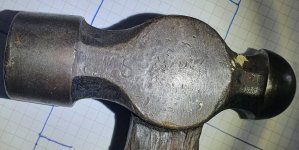
Most US prewar ball-pein hammers either had no size marking or markings that used a very early almost arcane standardized system, where "0" was 1 lb, and all other hammers went up or down in 4 oz increments from there. For example, "00" on a hammer indicated 12 ozs, whereas a "1" was 20 ozs. "000" was 8 ozs, "2" was 24 ozs. And so forth. I do have a "0000" hammer, but because of that and the even smaller "00000" 4 oz. hammer, makers started using "5-0" (as in "five 0's") or "5/0", and once they started doing that, even though "00" didn't take up any more space, you'd also see "2-0" or "2/0", etc.
As a wartime collector, size markings are usually considered iffy. Model numbers that embed the size (e.g., "BP-16") are definitely postwar.
But, I don't know anything about import hammers in that period, and it does look like an older hammer to me made for the English speaking (US/UK) export market.
What is on the flip side?
I know nothing about modern imports, either, but hammers made here in the US after the mid 1970's almost always have some form of an OSHA "WEAR SAFETY GOGGLES" warning. If I see that on the cheek of a hammer in a box of hammers at a flea, it's a quick, automatic pass. If it was made in the 1990's for the US market, wouldn't it also have to have the safety markings?