To avoid these ads, REGISTER NOW!

Electro-Cleaning/ Electrolytic rust removal

LoneGunman

Well-known member
Joined
Mar 27, 2007
Messages
2,081
Location
The Gunshine state
I'm sure some of the members must do this, never saw anyone post pics of the process though. At the end I'll post a link to a very in depth how to. I have been doing a LOT of electrolytic rust removal, it takes longer than sand blasting but once you get it going you don't need to do anything so it saves me a bunch of time. It also is a lot easier on the part than sandblasting is. Many museums ETC use it due to it's non destructive nature, it's non destructive IF you follow the instructions.

I have a 30 gallon electro cleaning set up but I didn't want to use it as I use it to clean parts for electroplating. The parts I'm going to clean tonight are covered in old oil and rust. So I made up a quick 5 gallon bath.

You'll need a DC power source that will give you 5-10 amps, I use an adjustable power supply, I use it for plating where I need to be able to adjust the voltage or current. A battery charger will work fine.

You'll need a piece of sacrificial steel. I used a cover off an old electrical panel, I save them for this reason. Some people will recommend using stainless because it does not break down as fast as. The problem using stanless is it will break down and turn your water yellow, that yellow is hexavelant chromium, ever see the movie Erin Brockovich?

Take your 5 gallon bucket and add a box of Arm & Hammer Washing Soda, most grocery stores will have it, it is marketed as a laundry booster. Mix well.

Put your sacrificial anode into the bucket and attach the POSTIVE lead from your battery charger to it. If you screw this up you will damage your part because your part will now become the sacrificial anode. Take a piece of copper wire and wire your part to a piece of wood dowel, copper tubing ETC. Your negative wire needs to be attached to your part. Make sure your part is not touching the sacrificial anode and make sure your positive and negative leads are not touching and then turn on your battery charger, use the 6 volt setting if you have one.

You'll start to see some bubbling and garbage floating to the surface, if you don't see any bubbling you have a bad connection. Be aware that the process does create hydrogen gas so it should be done outside, I am a bad example.

There are different variations of the bath, some people use Sodium Hydroxide (lye) some use acids, ETC. The Washing Soda is fairly gentle, I wouldn't want it in my eyes but it's nothing like lye. I normally leave it going overnight, sometimes it will take two days. Below is some pics and the link to the in depth article. I figured I'd post this to see if anyone is interested, once you get the basic idea and see how easy it is you can go to the article.

Here's my sacrificial anode.

IMG_1402.jpg


Here's the new bath

IMG_1404.jpg


Here's my part, it's a lever actuated collet closer for my new lathe.

IMG_1385.jpg


This is only about 2 minutes into it

IMG_1406.jpg


Here's a pic of my power supply showing the 10 amps

IMG_1405.jpg


I'll add some pics of the final result tomorrow or Sunday.

http://www.oldengine.org/members/orrin/rustdemo.htm
 
To avoid these ads, REGISTER NOW!

DrBob

Member
Joined
Dec 14, 2009
Messages
6
Location
Rockland County, NY
Great tutorial LG! I always thought of that process as 'electrolytic cleaning' but I was recently told it is also known as 'electrolysis', a term I thought only applied to the process of removing unwanted facial (and other :)) hair. Turns out that the word has both meanings.

Good Job!

DrBob
 
Last edited:

Brad54

Well-known member
Joined
Jun 13, 2006
Messages
4,646
I've been gathering info for a magazine article on this process.

My understanding is that the process is basically a "line of sight" process, with the rust ions traveling from source to sacrificial anode, meaning you have to flip the part over to expose the other side to the sacrificial anode (or, bend it like a taco as you've done... NICE! Good thinking!!!)
What I've thought of doing is getting a heavy piece of expanded metal grating, or heavy gauge livestock-type wire fence, and wrap it around the inside of the container and hood it up.

Also, it occurs to me the size of the part you can clean is only limited by the size of your container. Seems like bigger RubberMaid storage bins or maybe even a kiddie pool would allow for bigger parts to be cleaned.

-Brad
 
OP
L

LoneGunman

Well-known member
Joined
Mar 27, 2007
Messages
2,081
Location
The Gunshine state
Brad, for the most part it is "line of sight", as I said in my post, this was a quickie spur of the moment set up. The tank I'm working on will have 360 degree coverage, it started life as a 55 gallon plastic tank. I still need to scavenge a lot more anode material before I can complete it.

You can use the expanded metal to get 360 degree coverage, whatever you do do NOT cover the tank though, the hydrogen will build up.

You can also remove rust from recessed areas by using a thin sacrificial anode, I de rusted a shotgun barrel using this process. I used a piece of drill rod as the anode, I slipped on a piece of rubber hose on each side to keep the anode from touching the inside of the barrel, it worked great.

You are limited by container size and power supply size, larger parts and larger baths increase your current requirements. The power supply you see in the pics will do 50A, I do have another one that I use for chrome plating that will put out 400A. With a large power supply and a 55 gallon drum you are able to do motors a part at a time, block by itself, ETC.
 

Brad54

Well-known member
Joined
Jun 13, 2006
Messages
4,646
Brad, for the most part it is "line of sight", as I said in my post, this was a quickie spur of the moment set up. The tank I'm working on will have 360 degree coverage, it started life as a 55 gallon plastic tank. I still need to scavenge a lot more anode material before I can complete it.

You can use the expanded metal to get 360 degree coverage, whatever you do do NOT cover the tank though, the hydrogen will build up.

You can also remove rust from recessed areas by using a thin sacrificial anode, I de rusted a shotgun barrel using this process. I used a piece of drill rod as the anode, I slipped on a piece of rubber hose on each side to keep the anode from touching the inside of the barrel, it worked great.

You are limited by container size and power supply size, larger parts and larger baths increase your current requirements. The power supply you see in the pics will do 50A, I do have another one that I use for chrome plating that will put out 400A. With a large power supply and a 55 gallon drum you are able to do motors a part at a time, block by itself, ETC.
Man, I didn't think of a 55 gallon drum! That's a GREAT idea!!!

And aside from the gunk that falls off the engine, the solution is environmentally friendly, isn't it? Meaning, I can dump it out in my yard and won't grow a third ****** or something worse.

Where does one source a power supply? And what do they typically cost?

-Brad
 
OP
L

LoneGunman

Well-known member
Joined
Mar 27, 2007
Messages
2,081
Location
The Gunshine state
You can reuse the solution, after you make it up mark the level with a Sharpie, add make up water as needed. You can skim the nasty stuff off the surface. I skim it, put it in an old pan and let the water evaporate outside. The oil and grease that remains I put in a coffee container, when I gets fill I drop it off at a HazMat collection point.

Using graphite anodes instead of steel will cut way down of the amount of garbage in your tank, I just haven't gotten around to changing them, plus the steel anodes are free.

Power supplies are all over ebay, you don't need anything like mine in the pic unless you want to get into anodizing or plating. I picked up my 400a PS for just under $100 shipped, I was prepared to spend $500 or 600 for a PS that big.
 

metal1313

Well-known member
Joined
Apr 28, 2009
Messages
3,416
Location
clinton NJ
the way ive heard this type of set up powered is to use a trickle charger unless you plan on using this method often.
 

RAYJAY

Well-known member
Joined
May 29, 2006
Messages
2,638
Location
UNION DALE PA
i been trying this and been having a problem withv the 12 charger over load tripping out

any ideas why

jeff
 
OP
L

LoneGunman

Well-known member
Joined
Mar 27, 2007
Messages
2,081
Location
The Gunshine state
i been trying this and been having a problem withv the 12 charger over load tripping out

any ideas why

jeff

Drawing too many amps, piece is too large or your anode is too large. A trickle charger will usually work fine depending on the size of the piece and the size of the anode. I like constant voltage/constant current power supplies, I can set mine for whatever voltage or current I want but like I said, they are also expensive if you are only looking to remove rust. I already had the power supplies, I use the constant voltage/constant current one for anodizing, copper and nickel plating. My 400a power supply is used for chrome plating.

EDIT: I took my PS off of constant current and set it on constant voltage and dialed in 12 volts. At 12 volts I'm pulling 34 amps, if I was using a 12 volt trickle charger there is no doubt I'd trip the internal overload. Your problem is either too large an anode or a bad connection, either one will drive up the current. A weak (less conductive) solution will also increase the current.
 
Last edited:

e-tek

Well-known member
Joined
Dec 19, 2007
Messages
10,690
Location
Saskatoon, SK
I can't find WASHING SODA anywhere! Throw me a list of alternatives if ya got 'em (Oxyclean being one!).

Few questions from a totally non-electrical mind: Why is 6V better than 12V? What happens to the sacrificial anode over time? If I DID use lye, is it faster/better? Is there a fastest/best solution? (I like MAXIMUM settings!)

What's the real benefit to this? Reason I ask is that it'd take only about 10-15 minutes to clean your lathe part with a wire wheel....Is is good for rusted parts, or parts with hard to get areas?

Still awaiting the end results! THANKS!!
 
Last edited:
OP
L

LoneGunman

Well-known member
Joined
Mar 27, 2007
Messages
2,081
Location
The Gunshine state
Washing Soda is also known as Sodium Carbonate, Soda Ash or the proper name Na2C03. You can buy it on Ebay, cheap. It's used to raise the PH of pools, any pool stores near you? I'm thinking not too many in the great frozen North :)

Plain old laundry detergent will also work MOST of the times, obviously I have not tried every one. Make a small one gallon bath, add three of four cups of whatever laundry detergent you use and try it. If it's bubbling and you show a current draw with an ammeter it's working.

Trisodium Phospate, "TSP" in the cleaning section of Home Depot, ETC works but is a little harsher, not a bad thing. It will remove paint faster if that's one of your goals. Table salt also works but releases a chlorine smell. Don't use rock salt, it releases chlorine gas. Vinegar will work if you don't mind the smell so will lemon juice but that gets expensive.

I also want to reiterate, if you are using a large bath or high current remember this process does release hydrogen gas, it doesn't take too much of an imagination to think of what could happen. If you go over 10 amps you get more bubbling and more hydrogen gas release, like I said, be careful if you use this indoors.
 
Last edited:

e-tek

Well-known member
Joined
Dec 19, 2007
Messages
10,690
Location
Saskatoon, SK
THANKS Lone! now that you say Sodium Carb and pH, I realize I have that for my HotTub! Of course I also have TSP.
 
OP
L

LoneGunman

Well-known member
Joined
Mar 27, 2007
Messages
2,081
Location
The Gunshine state
You can also add some TSP to a Sodium Carbonate bath, makes it a little more aggressive, it will remove paint though. Plain Sodium Carbonate will remove all but really well adhered paint.
 

red92s

Well-known member
Joined
Dec 16, 2009
Messages
334
You can also use basic run of the mill Arm and Hammer BAKING soda if you can't find washing soda.

Whatever salt you are using (washing/baking soda) is not consumed in the reaction, so there really is no need to add more. The water does get pretty gross looking, sometimes with green or blue hues to it. As long as you are using a plain steel anode, dumping it on your lawn should be fine. I've heard some plants/grass actually like the extra iron.
 
Last edited:

redeye00

New member
Joined
Aug 23, 2012
Messages
1
Hi Lonegunman, Here's how to make your own sodium carbonate from sodium bicarbonate: buy your required qty of sodium bicarbonate (baking soda) to convert into sodium carbonate (soda ash). Heat your wife's oven to 200 degrees. Spread the bicarbonate on one or two baking sheets covered with aluminum foil. Heat for 1 hour. This process releases carbon dioxide and water from the bicarbonate and now you have sodium carbonate or soda ash. Repeat as necessary. Helpful?
 
To avoid these ads, REGISTER NOW!

drivesitfar

Well-known member
Joined
Oct 23, 2013
Messages
35,991
Location
Pacific Northwest
I am getting ready to set up a tank to clean a vise and if that works great maybe take it to some of the rusty steel weight plates I come across and other steel. I appreciate you taking your time to explain the process which i'm still trying to absorb and pictures really work for me. your pics are the first I've seen with a copper pipe holding the project in the tank which I have plenty of short pieces of copper pipe laying around. I also have plenty of rebar and maybe an old circuit box cover too. i'm wondering if I get an old Rubbermaid horse type water trough that might fit nicely under my bench with about a 30 year old battery charger that is the big one on wheels might be a good start? maybe i'll go to the pool stores in my area and get some of their stuff (not sure what that is, but many threads mention their chemicals as better than baking soda). maybe I should start with a 5 gallon bucket first to see how I do the process before I go to the 50 gallon size. any more thoughts or pictures you can post would be great and thanks for posting this thread.
 

Alchymist

Well-known member
Joined
Mar 1, 2009
Messages
4,423
Location
Central PA
Quick note - try your electrolysis with plain water - an additive MAY not be necessary - here is a setup done with water from the well. There may just be enough impurities in the water to make it conduct. And if the part won't fit the container, do half at a time. Pic 1- setup, pic 2 1st half cleaned, pic 3, finished top.
 

Attachments

  • rtrust1.jpg
    rtrust1.jpg
    136.5 KB · Views: 116
  • rtrust2.jpg
    rtrust2.jpg
    146.8 KB · Views: 164
  • rtrust3.jpg
    rtrust3.jpg
    77.8 KB · Views: 143

BFBOB

Well-known member
Joined
Sep 20, 2011
Messages
5,073
Hi
will it remove chrome from spanners or sockets.

No ... and yes. It will not directly remove chrome, but if there is underlying rust it will remove flakes of chrome as it pulls the rust out from underneath. So, a wrench that goes in the tank with an area that's rough, bubbled, with tiny pits showing through the chrome, will come out with bare steel in that area. And, with some alloys, electrolysis will darken the steel (or cast iron) to the point where it almost looks Parkerized. Wire brushing will generally restore the color,but at the edges of the previously rusty area it can chip away at the chrome.
Try it on some throwaway wrenches first!
 

Daves69

Well-known member
Joined
Feb 18, 2009
Messages
818
Location
Kernersville, N.C.
I was having trouble finding washing soda/ sodium carbonate. This is a common pool chemical called PH up. I called the manufacturer and confirmed it is sodium carbonate.
 

jabe421

New member
Joined
Jan 23, 2014
Messages
1
Look for Soda Ash, it's often used for making biodiesel. A 50# bucket should be around $35. I have also read that you can make washing soda by baking baking soda at 400° for 30 minutes but I have never tried this. Google "Turn Baking Soda into Washing Soda" to read about it.

PH Up is quite expensive in my area.

Good luck.
Jabe
 

jkwilson

Well-known member
Joined
Dec 5, 2012
Messages
758
Location
SW Indiana
With blocks and a tarp, you can make a tank of most any size. I did a few pieces about 8ft long. I built a stacked block rectangular wall 3 blocks high and put the tarp over it and filled it with water. I used six rebar electrodes clamped to a wire with ground rod clamps nds powered it with my battery charger.
 

69supercj

Well-known member
Joined
Jan 26, 2010
Messages
555
I've got to give this a try. Seems pretty simple and looks like it works great.
 

69supercj

Well-known member
Joined
Jan 26, 2010
Messages
555
So from what I've gathered, this system works better when the temps are warmer?
 

69supercj

Well-known member
Joined
Jan 26, 2010
Messages
555
So if a guy had a plastic feed trough like they use for cattle, say about 5 foot long, and took some sacrificial pieces of sheet metal and lined the trough and hooked them together, and then hooked up the power supply to an old rusty crusty 9 inch ford rearend, you could get her shinin' like a diamond in a goats behind in a few days?
 

Alchymist

Well-known member
Joined
Mar 1, 2009
Messages
4,423
Location
Central PA
So if a guy had a plastic feed trough like they use for cattle, say about 5 foot long, and took some sacrificial pieces of sheet metal and lined the trough and hooked them together, and then hooked up the power supply to an old rusty crusty 9 inch ford rearend, you could get her shinin' like a diamond in a goats behind in a few days?

Probably come out all black and would require good scrubbing - but the rust would be gone. Note that if something is really pitted, the pits will remain, though they won't be rusty!
 

stephenniall

New member
Joined
Jul 9, 2013
Messages
2
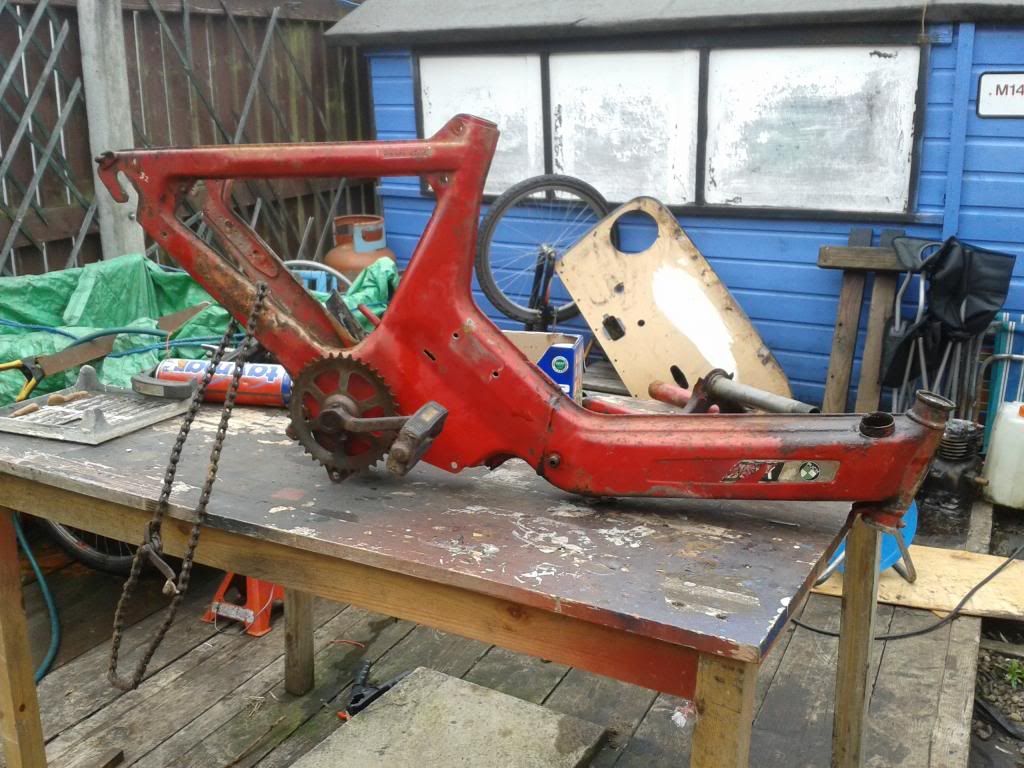
Electrolysis is the best way for rust removal in my opinion, with the exception of shot blasting.

I used the method to clear the rust off this frame

Frame1.jpg


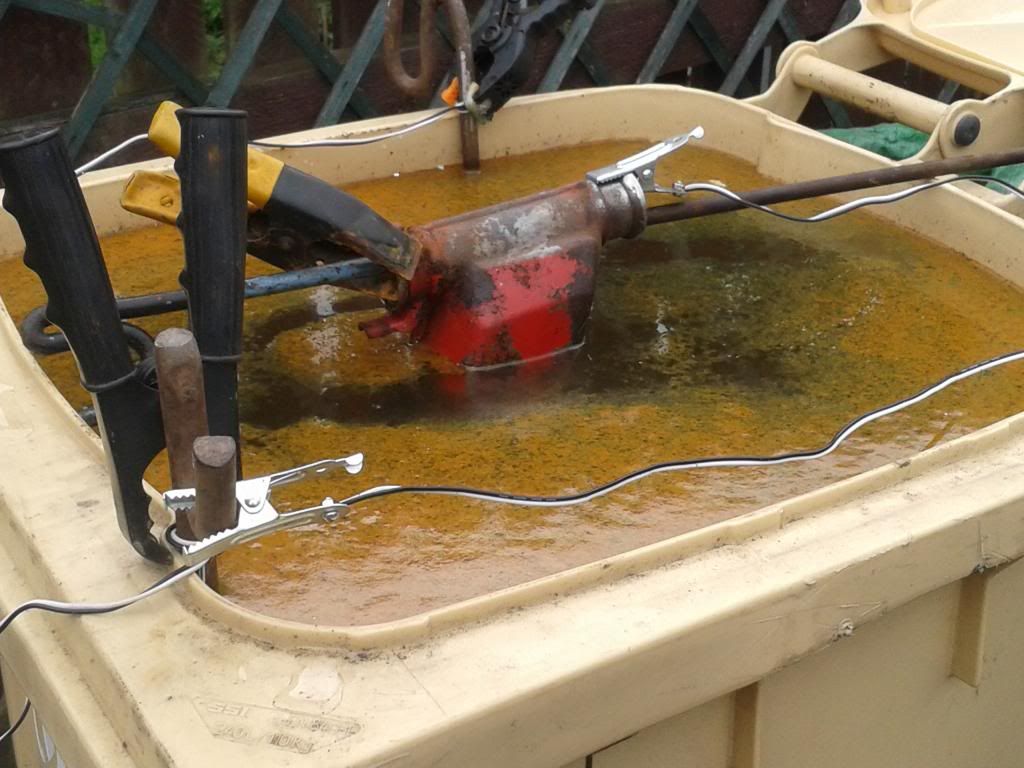
I put it in a wheelie bin (A large container us Brits use for trash), which i used as a container for electrolysis.

Bin1.jpg
 

coppersmith

New member
Joined
Dec 7, 2013
Messages
4
Location
nh
done it and agreed the best for rust removal, as you can set it up and let it go to it, i wish I would have known about this 30 years ago.
 

ilovevocs

Well-known member
Joined
Jun 26, 2009
Messages
1,966
Location
Toledo, Ohio
Thanks to the OP for sharing. I have seen this performed allot but have yet to have an application for this process. I think I will experiment with it on some junk just for fun.
 
To avoid these ads, REGISTER NOW!
Top Bottom