To avoid these ads, REGISTER NOW!

Box End Wrench Contact Points 2 (Pic heavy)

DavidB

Well-known member
Joined
Feb 6, 2010
Messages
734
Location
Navarre, FL
As promised in my previous thread of the same title I have conducted more tests to show the contact areas of various combination wrenches I own.

This test was more controlled than the previous one. In this test the wrench was held in a vise between two pieces of wood and a torque wrench was used to torque a nut in the box end to 30 ft-lbs. The nut was colored using a Sharpie marker to better show the contact areas.

Here is a picture of all the wrenches used in this test.
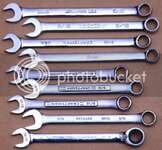
WrenchGroup.jpg

The wrenches were assigned numbers from top to bottom and are as follows:
1. Snap-On SOEX18 - Date code 1999
2. Wright 1118 - New Kindly donated by TRTOOLSUPPLY to be tested
3. Craftsman Professional 45978 - New
4. Snap On OEX18 No date code. Flank drive. Purchased used.
5. Craftsman Raised Panel 12pt Date Code: -V(inverted V)- 1990s Lightly used
6. Craftsman Raised Panel 12 pt Date Code -VV- From my grandfather.
7. Craftsman Raised Panel 6pt Date Code: -V(inverted V)- 1990s Lightly used
8. Promark Taiwan made wrench received sometime in the 90s. Unused
9. GearWrench Ratcheting Reversible Purchased early 2000s Lightly Used


Here are some pics of the box ends of the wrenches:
1. Snap-On SOEX18
W1-NewSO.jpg
2. Wright 1118
W2-Wright.jpg
3. Craftsman Professional
W3-Cpro.jpg
4. Snap On OEX18
W4-OSO.jpg
5. Craftsman Raised Panel 12pt (Newer)
W5-NC12pt.jpg
6. Craftsman Raised Panel 12 pt (Older)
W6-OC12pt.jpg
7. Craftsman Raised Panel 6pt
W7-C6pt.jpg
8. Promark
W8-Promark.jpg
9. GearWrench Ratcheting
W7-GWR.jpg


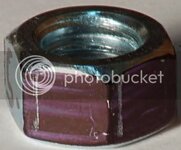
To try to get more consistent results each wrench was tested with two different nuts. One additional nut was tested on the first two wrenches holding with the torque wrench in the vise to compare the results to nuts tested with the wrench in the vice. No significant differences were noted.

Here is a picture of all the nuts tested:
Nuts.jpg

Below are two pictures of the nuts used in each wrench showing the most complete contact areas.

1. Snap-On SOEX18 - A good contact area on the face near, but not on, the edge. Flank drive doing what it is supposed to!
N1.jpg
N1a.jpg
2. Wright 1118 - A very wide contact pattern on the face. I ran several more tests to make sure this wasn't some fluke. This is called Wright Drive. Looks to work well too.
N2.jpg
N2a.jpg
3. Craftsman Professional - Contact pattern on the face pretty far way from the edge.
N3.jpg
N3a.jpg
4. Snap On OEX18 - Very similar to wrench #1
N4.jpg
N4a.jpg
5. Craftsman Raised Panel 12pt (Newer) - Very similar to wrench #3
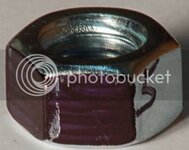
N5.jpg
N5a.jpg
6. Craftsman Raised Panel 12 pt (Older) - Contact areas are directly on the edges. This has a higher potential to round a fastener than other wrenches with contact areas on the face.
N6.jpg
N6a.jpg
7. Craftsman Raised Panel 6pt - Contact area is in the same location as the new craftsman 12 pt but wider.
N7.jpg
N7a.jpg
8. Promark - Contact area on the edge. Similar to wrench #6.
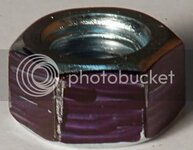
N8.jpg
N8a.jpg
9. GearWrench Ratcheting - Contact areas seems to be very close to those seen on the Snap-On wrenches.
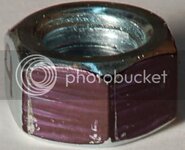
N9.jpg
N9a.jpg


I would have liked to have a new Snap-On for the test but can't justify the cost of a new one just for this testing. I'm not a professional mechanic and only work on a couple newer GMs so most of my SAE stuff is very lightly used.

If I happen to get some more wrenches I'll test them and post the results. I PMed Mike Wren and GearWrench here on the board asking if they'd like to send a wrench to be tested. I haven't heard a response from either, but I don't think they have been online here since I sent the messages. So, keep your fingers crossed that they'll respond positively and I'll have some more wrenches to test.

Please post any comments or questions and I'll do my best to answer it. Got a wrench you want tested with the results posted here? Let me know.

Thanks again to TRTOOLSUPPLY for sending me a wrench to test. As an aside: the thick beam and fully radiused edge makes for a comfortable wrench.

Hope you have found this entertaining.
 
To avoid these ads, REGISTER NOW!

Ed_EOD

Well-known member
Joined
Dec 4, 2009
Messages
603
Location
North Pole, AK
My non-pro eye thinks the Wright and the C-man pro did the best, and I'm a Snap-On koolaid drinker. That Wright is quite nice. If only they made a long version...
 

dede2897234

Well-known member
Joined
Feb 1, 2008
Messages
1,716
Location
Northern, Ohio
DavidB,


Thanks for conducting the wrench test. I have learned lots from Garage Journal members over the last couple of years about hand tool technology or usage. I appreciate it and keep these hand tool tests coming too!


Dave
 

superautobacs

Well-known member
Joined
Oct 31, 2008
Messages
3,997
Location
Vancouver, BC
Thanks for your time in performing this test.

How would you rate the wrenches in terms of its friendliness to the flank area of the nuts? Did the non-flank drive wrenches leave a clear impression on the nut?
 
OP
D

DavidB

Well-known member
Joined
Feb 6, 2010
Messages
734
Location
Navarre, FL
Thanks for your time in performing this test.

How would you rate the wrenches in terms of its friendliness to the flank area of the nuts? Did the non-flank drive wrenches leave a clear impression on the nut?

All of the wrenches will leave a mark on the fastener given enough force when tightening it. The best way to reduce this is to increase the area that the wrench contacts the fastener. These test show excessive wear on the nuts. These are cheap non graded (so I'm guessing Grade 2) nuts from Lowe's. My Pocket Ref lists the standard dry torques: Grade 1 - 12 ft-lb, Grade 2 - 20 ft-lb, and Grade 5 - 31 ft-lb. Standard dry torques "were calculated to produce a tensile stress in the fastener equal to 70% of the maximum tensile strength or 75% of the proof test." - Pocket Ref by Thomas J. Glover. I managed to break some of the bolts I was using at 30 ft-lb which that backs up what the book says. So, I'm applying 150% of what these nuts were probably designed for.

With that out of the way here are results from another test!

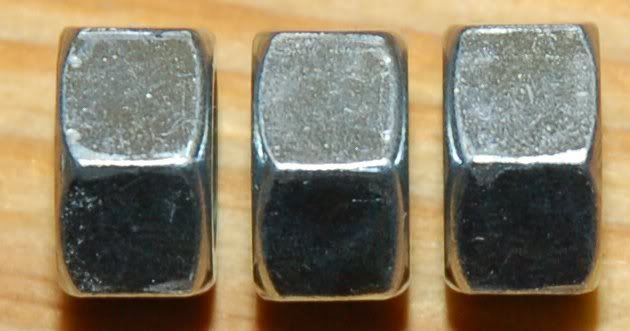
Here are some more nuts tested in three different wrenches. From left to right we have nuts tested in wrench #1, #2 and #8.
closegroup.jpg


You can see the marks here but lets take a closer look...

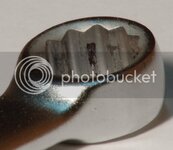
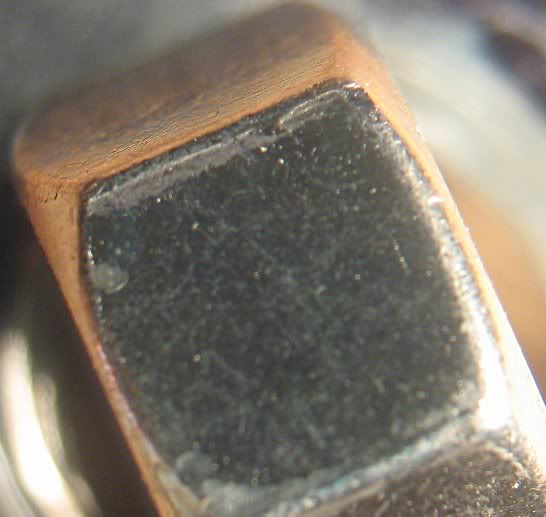
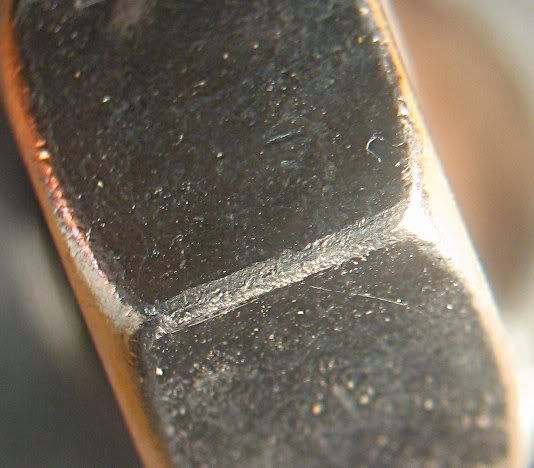
Here is an extreme close up of a nut tested on wrench #1, the newer Snap-On. The area of contact is clearly seen.
W1close.jpg


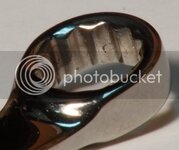
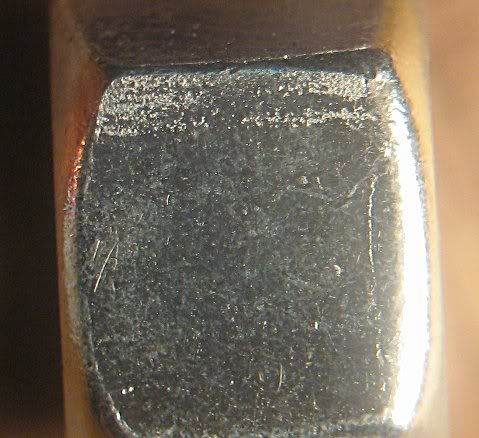
Here is an extreme close up of a nut tested on wrench #2, Wright. The patch is wider but doesn't appear to be as deep. I will note that when I first did this test with the Wright wrench there were a couple scratches on the nut. I assumed this was due to a burr or two since this is a new wrench and light touched up the inside of the box end with a rolled piece of 600 grit sand paper. Problem solved.
W2close.jpg


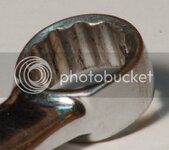
Here is an extreme close up of a nut tested on wrench #8, Promark. This has the smallest area of damage since it is directly on the corner. Though if you round the corner that won't look good either.
W8close.jpg


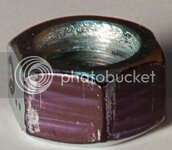
The extreme close up images and to a small extent the group shot show the marks more clearly than you'd see without a magnifying glass. The extreme close up images also start showing marks on the nuts that were there before I tested them. There were fine scratches, pits, and you can see the less than perfect edges of the nuts. Looking at the nuts with just my eyes the SO shows a clearly defined line, the Wright shows a lightly scuffed area, and the Promark shows rough edges. Due to the fact that I'm not able to torque the nuts perfectly the corners of some of the edges show a larger contact area. On the Promark this area is starting to round the nut.

So, to finally answer your question... I'd say the Wright wrench would be the nicest to the flank area because it has a larger contact area. All things equal the larger the contact area the lower the pressure which would result in less deformation to the face. After that it's probably a toss up among the the wrenches who have copied flank drive since they all have similar contact areas.

I suppose it could be argued that the non-flank drive wrenches do the least damage to the flank area since they don't contact there. On the other hand they have a higher chance of rounding the edge off which would do bad things to the flank area.

In the end though the wrench with Wright Drive, Flank-Drive, or a copy of Flank-Drive stands a much greater chance of getting that rusty nut off than the ones that contact at the edge.

Hopefully, I've provided pictures to where anyone can draw their own conclusion.
 
OP
D

DavidB

Well-known member
Joined
Feb 6, 2010
Messages
734
Location
Navarre, FL
To everyone else: Thanks for reading! I'm glad you find it interesting. I'd like to get some marking blue at some point I'm just not sure where to find it around here. I'm sure a machinist supply house would have some but I haven't drug out the phone book to track one down yet.

If anyone has some tests they'd like to see speak up and I'll see what I can do. I'm not sure what else I'll do though obviously I found something to do as evidenced by the post above this. Maybe I'll run the numbers to show how much additional force is required for a shorter wrench.

David
 

jcfields

Well-known member
Joined
Feb 1, 2010
Messages
435
Very well done; fascinating results.

Seems to reinforce that there isn't much point to a six-point box wrench with flank-drive-ish 12-points. It's also unsurprising (but nice to have proven) how much better pretty much anything is to the generic Taiwanese wrench.

I was surprised at how well the Craftsman raised-panel and GearWrench did.

Does anybody know the OEM for the Craftsman Professional wrenches? S-K, Danaher?
 

Jononon

Well-known member
Joined
Nov 28, 2006
Messages
1,636
Interesting stuff :thumbup: That Wright is extraordinary, it's hard, just looking at the drive surfaces, to see how that performance is achieved :confused:

It's also unsurprising (but nice to have proven) how much better pretty much anything is to the generic Taiwanese wrench

Although that wrench looks pretty rough, I suspect the contact areas have nothing to do with its country of origin. #6 and #8 appear to have traditional sections to the contact points, coming to a sharp angle in the 'valley' of the broaching, whereas all the others are curved since they were produced after the loss of the 'flank drive' patents. Hence, as David says, the newish Gearwrench (also Taiwanese or Chinese) performing as well as, possibly slightly better than :eek:, the Snap-on.

I'd like to see the same done with a current production Harbor Freight wrench. My guess is that the results would be very close to the Snap-on and GW.

The same test with 6 and 12 point sockets might be illuminating (and perhaps controversial), too.

Does anybody know the OEM for the Craftsman Professional wrenches? S-K, Danaher?

Danaher.
 
Last edited:
OP
D

DavidB

Well-known member
Joined
Feb 6, 2010
Messages
734
Location
Navarre, FL
Very well done; fascinating results.

Seems to reinforce that there isn't much point to a six-point box wrench with flank-drive-ish 12-points. It's also unsurprising (but nice to have proven) how much better pretty much anything is to the generic Taiwanese wrench.

I was surprised at how well the Craftsman raised-panel and GearWrench did.

Does anybody know the OEM for the Craftsman Professional wrenches? S-K, Danaher?

Yes, the 6pt vs 12pt thing has really been an eye opener for me as well. I've always tried to use 6 pt wrenches or sockets when I could because I figured the 6pts would have less chance of rounding. I'm now seeing that isn't true.
 
OP
D

DavidB

Well-known member
Joined
Feb 6, 2010
Messages
734
Location
Navarre, FL
Interesting stuff :thumbup: That Wright is extraordinary, it's hard, just looking at the drive surfaces, to see how that performance is achieved :confused:


Although that wrench looks pretty rough, I suspect the contact areas have nothing to do with its country of origin. #6 and #8 appear to have traditional sections to the contact points, coming to a sharp angle in the 'valley' of the broaching, whereas all the others are curved since they were produced after the loss of the 'flank drive' patents. Hence, as David says, the newish Gearwrench (also Taiwanese or Chinese) performing as well as, possibly slightly better than :eek:, the Snap-on.

I'd like to see the same done with a current production Harbor Freight wrench. My guess is that the results would be very close to the Snap-on and GW.

The same test with 6 and 12 point sockets might be illuminating (and perhaps controversial), too.

Danaher.

I think the Country of Origin could play a role in material the wrench is made out of and the accuracy to which it is made. If the metal is softer the wrench could deform changing how it contacts the nut. Also, if the inside of the box end is out of round or poorly made it would also negatively impact performance. I think the biggest difference material and accuracy play in a combo wrench are on the open end.

Socket tests would be interesting as well but I only have some Craftsmen ones to test.
 

Jononon

Well-known member
Joined
Nov 28, 2006
Messages
1,636
I think the Country of Origin could play a role in material the wrench is made out of and the accuracy to which it is made. If the metal is softer the wrench could deform changing how it contacts the nut. Also, if the inside of the box end is out of round or poorly made it would also negatively impact performance.

There are undoubtedly differences in quality between wrenches, I don't think anyone would argue with that, but in the case of this particular test the principal difference appears to be flank drive v. non flank drive, rather than manufacturer or COO.

I think the biggest difference material and accuracy play in a combo wrench are on the open end.

That's been my experience, especially where high stresses are encountered, such as flare nut wrenches.

*puts on flame proof suit* That being said, some of the highest quality wrenches you can buy today are made for Facom in Taiwan.

Socket tests would be interesting as well but I only have some Craftsmen ones to test.

Unfortunately I don't have a wide enough range either, perhaps someone could be persuaded to pick up the reins for that test?
 

Adam McLaughlin

Well-known member
Joined
Oct 13, 2008
Messages
1,843
Location
Santa Rosa, CA
Good Job, I too enjoyed this display.

I was surprised to see that Wright Drive seems to do the best in these tests, while Flank Drive appears to be a close second.

Adam
 
To avoid these ads, REGISTER NOW!

superautobacs

Well-known member
Joined
Oct 31, 2008
Messages
3,997
Location
Vancouver, BC
DavidB, thanks for doing further documenting.

I'd have to say that the friendliness of a wrench, regardless of it being 6/12pt; surface-drive/point-drive/edge-drive, is largely dependent on how close it's broached to the spec'd size. If a manufacturer can produce repeatedly, a wrench (or socket) with the closest tolerances (surpassing minimum industry standards), it'll then come down to how they profile the broaching. Snap-on patented theirs with a 144* angle and the result is a wrench that produces a clearly defined line, an impression on the fastener. Everyone else who's copied that profile will produce similar results (better or worse). Ko-ken patented their profile with 148* to create a better profile.


Jononon, I've read that Facom's Taiwan-made sockets (Rotar) has a very fastener-friendly profile. But I'd say that Japan's Nepros brand has the best profile available.
 
OP
D

DavidB

Well-known member
Joined
Feb 6, 2010
Messages
734
Location
Navarre, FL
Well, it appears more tests are coming. I have been contacted by a member to do some testing on some more wrenches. We'll be switching to 13mm metric wrenches and using higher grade fasteners (Class 8.8 probably) this time around.

Of the wrenches pictured in the original post I have some of the same brand and style in both Metric and SAE.
So, a question for the group, would you want to see tests of the metric versions of the wrenches tested above?

David
 

Paullew

Well-known member
Joined
Jan 13, 2010
Messages
165
Good stuff. I ma willing to donate a wrench. What size do you need?
 
OP
D

DavidB

Well-known member
Joined
Feb 6, 2010
Messages
734
Location
Navarre, FL
Here are the combo wrenches I currently have in 13mm.

Craftsman Pro
Newer Craftsman Raised Panel 6pt
Newer Craftsman Raised Panel 12pt
Older Craftsman Raised Panel 12 pt
Craftsman Ratcheting
Craftsman Pro Stubby
Gear Wrench Ratcheting Stubby
Kobalt Stubby
Pittsburgh (Harbor Freight) Stubby

The inside of the box end of Craftsman Pro wrenches look the same so I won't test the stubby. I'd rather find a regular sized non-ratcheting Gear Wrench to test.

Once I have confirmation of other wrenches I'll post.

David
 
OP
D

DavidB

Well-known member
Joined
Feb 6, 2010
Messages
734
Location
Navarre, FL
Here is an update on additional wrenches that will be making an appearence in the next test. Thats to the following users for their respective wrenches.

quattrojon - K-D,Facom,Signet, Metrinch
TRTOOLSUPPLY - Wright
Chadster1 - Snap-On

Anyone else have anything they'd like to pitch in or have any requests? I have a request for a Matco and Cromwell wrench to be tested. I ordered 200 nuts from McMaster today so there is plenty to go around. I'm going to find some machinist blue/Dykem for the next test. Stupidly, I didn't order it with the rest of the stuff from McMaster.

David
 

kburns

Well-known member
Joined
Oct 15, 2008
Messages
225
It might be interesting to see the difference in using a box end and an open end.
 

Jack90210

Well-known member
Joined
Nov 2, 2009
Messages
304
Location
VA, USA
Fantastic test -- and a testament to the reason why I don't buy older wrenches and sockets.

Thank you for being methodical with your testing procedures.

Seems to reinforce that there isn't much point to a six-point box wrench with flank-drive-ish 12-points.

I have suspected that this was the case for years (despite hearing from so many folks that "6-point is always better!") because the contact point of a well-designed 12-point is functionally similar to that of a 6-point. Bingo.
 
Last edited:
OP
D

DavidB

Well-known member
Joined
Feb 6, 2010
Messages
734
Location
Navarre, FL
I'll test whatever folks can send me. I have conformation that 5 put of the 6 wrenches are on the way. More are welcome. Like I said before, I have 200 M8 13mm nuts and need something to do with them.
 

slowcamaro

Well-known member
Joined
Aug 13, 2009
Messages
58
I dont have any to lend, but you may want to try to get some toptul results.
 

Skin

Well-known member
Joined
Feb 24, 2010
Messages
11,713
Location
Boston
I have suspected that this was the case for years (despite hearing from so many folks that "6-point is always better!") because the contact point of a well-designed 12-point is functionally similar to that of a 6-point. Bingo.

well in the past 6 point was always better. Tolerances and quality have improved quite a bit over the years. However i do wonder, being a 12 point i'd suspect that wear over the years would degrade the contact points far faster than a 6 point so i'd still consider 6 point superior. If not for box ends at least for sockets that see day to day use, especially impacts.

Plus the real test is not on new but on weather and corrosion worn fasteners. If any part of that 12 point is not distributing pressure evenly, either due to wear over the years or simply from a slight difference in tolerance during manufacturing, you'll probably take a piece out of it.

Even these results here stated that the 6 point contact area, while in the same location as the 12 point, was wider. More force distributed over more area is good.
 
Last edited:

Jack90210

Well-known member
Joined
Nov 2, 2009
Messages
304
Location
VA, USA
well in the past 6 point was always better. Tolerances and quality have improved quite a bit over the years. However i do wonder, being a 12 point i'd suspect that wear over the years would degrade the contact points far faster than a 6 point so i'd still consider 6 point superior. If not for box ends at least for sockets that see day to day use, especially impacts.

I agree with most of that. However, if the contact points are the same with a 6-point and a 12-point, then they will degrade equally. Whether the extra "wall" of a 6-point is a benefit with a worn tool is conjecture.

Plus the real test is not on new but on weather and corrosion worn fasteners. If any part of that 12 point is not distributing pressure evenly, either due to wear over the years or simply from a slight difference in tolerance during manufacturing, you'll probably take a piece out of it.

Again I agree. However, the same is true of a 6-point.

Even these results here stated that the 6 point contact area, while in the same location as the 12 point, was wider.

The contact area of the Craftsman 6-point seems to be about the same as the quality 12-points by Wright etc, although I give you that it seems to be *slightly* more than that of the 12-point Craftsman.

Maybe I'm wrong, but it seems to me that you don't get more contact with a 6-point vs. a 12-point just because it has more wall area in the vicinity of the fastener.

I'd love to learn something, and be proven wrong. I just don't see the facts here that would be necessary for that to happen. And I don't mean to be argumentative. :beer:
 
Last edited:

BackTracker

Well-known member
Joined
Sep 8, 2009
Messages
583
Location
Hawaii
Hey thanks for doing this test, you just helped me make an informed decision on wrench purchases! Thanks!
 

quattrojon

Well-known member
Joined
Feb 25, 2009
Messages
557
Location
England
It seems that the Ko-Ken wrenches (= Beta) are no longer sold through Ko-Ken. The 2010 catalog don`t list them anymore.

I never realised that Beta and Koken wrenches were the same.
Do Beta manufacture for Koken then?
 
To avoid these ads, REGISTER NOW!
Top Bottom