To avoid these ads, REGISTER NOW!

Grounding electrode at detached garage

W.I.P.

Member
Joined
Mar 4, 2010
Messages
22
Location
Twin Cities, MN
Guys,
I'm not an electrical code guru so I call upon you for some help. I've searched around and although there seems to be a lot of info out there i've found conflicting answers on this. I'm pretty sure I need a to drive a grounding conductor into the ground for my detached garage. The question is what is the proper way to hook it up? It's a 50amp 220V feeder with 4 #6 wires, Black, Red, White, and Green. I know the black and red are the 2 separate phases of 110V and the white is neutral. I have these hooked up correctly in the sub panel already. The neutral and ground bar in the sub panel are isolated from eachother as I think they should be for my situation.

There is also a gas line running from my house to the garage so because of this I can't just use the green ground conductor included with the feeders as the main ground. In this situation I need a grounding electrode at the garage correct?

So what I'm thinking I need to do is install the grounding electrode at the garage and run a #6 conductor from the electrode to the ground bar in the sub panel. Do I still need to hook the green wire coming from the house to the ground bar as well?
 
To avoid these ads, REGISTER NOW!

mrb

Well-known member
Joined
Dec 31, 2008
Messages
3,734
the detached structure needs a grounding electrode (2 rods 6 feet apart, or a UFER ground if doing a new slab) this gets connected to the ground with the feeder and to the ground in the subpanel
 
OP
W

W.I.P.

Member
Joined
Mar 4, 2010
Messages
22
Location
Twin Cities, MN
OK so I need to hook both the electrode ground and the feeder ground up the the ground buss in thew sub panel. I need 2 rods though?
 

Will S.

Well-known member
Joined
Apr 15, 2010
Messages
446
Location
The First State
I don't have a gas line to my detached garage, but otherwise have the same 4-wire, 50A feed from main panel, as O.P. Electrical inspector told me only one ground rod "per service", so NO ground rod for sub-panel, per NEC. Don't know if the gas line to the building, or local codes, change that, but that's what I was told.
 

mrb

Well-known member
Joined
Dec 31, 2008
Messages
3,734
I don't have a gas line to my detached garage, but otherwise have the same 4-wire, 50A feed from main panel, as O.P. Electrical inspector told me only one ground rod "per service", so NO ground rod for sub-panel, per NEC. Don't know if the gas line to the building, or local codes, change that, but that's what I was told.


thats incorrect. A detached structure needs a grounding electrode.
 
OP
W

W.I.P.

Member
Joined
Mar 4, 2010
Messages
22
Location
Twin Cities, MN
Do I need to wire the rods in parallel to the ground bar, or should they be wired in series to the ground bar? Or does it matter?
 

Boiler

Well-known member
Joined
Nov 20, 2009
Messages
1,967
Location
Indiana
Why are there two rods for one service, redundancy? If thats the case then you'd want them parallel I'd guess. Series just doesn't seem to have a purpose.

May I ask why it would be an isolated ground? I thought typically the ground rod and the neutral both terminated on the neutral bus. Are they isolated because they are already joined at the main panel?
 

mrb

Well-known member
Joined
Dec 31, 2008
Messages
3,734
Why are there two rods for one service, redundancy? If thats the case then you'd want them parallel I'd guess. Series just doesn't seem to have a purpose.

May I ask why it would be an isolated ground? I thought typically the ground rod and the neutral both terminated on the neutral bus. Are they isolated because they are already joined at the main panel?

each structure needs a grounding electrode. It must have less than 25 ohms resistance with the soil, if you cant prove that (needs special equipment) two rods are required.

Neutral and ground must be kept seperate past the main bonding jumper.
 

bradleys

Well-known member
Joined
Jan 23, 2009
Messages
69
Location
Seattle / Blaine / Port McNeill
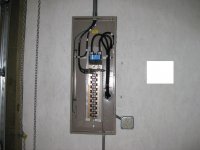
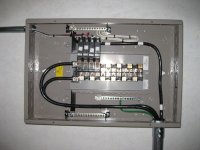
I just returned from inspecting the new trench for power feed to my new shop. Here are a couple of pictures.

The electricians wired my ground rods in series. The ground wire goes to the ground bar in the panel.

This is a separate service from the power company, not a sub panel from the house.

There's also a sub panel in the garage. The main panel has the ground and neutral connected together. The sub panel does NOT have them connected.
 

Attachments

  • img_0495.jpg
    img_0495.jpg
    151 KB · Views: 152
  • img_0472-edited.jpg
    img_0472-edited.jpg
    142.4 KB · Views: 172
  • img_0475.jpg
    img_0475.jpg
    135.6 KB · Views: 181
OP
W

W.I.P.

Member
Joined
Mar 4, 2010
Messages
22
Location
Twin Cities, MN
OK two grounding rods hooked in series 6 feet apart. Is there a certain type of wire I should be using? The bare stranded copper stuff ok?
 
To avoid these ads, REGISTER NOW!

Norcal

Well-known member
Joined
Mar 16, 2008
Messages
13,752
Is the subpanel mounted sideways? If in Canada it is OK, but is is not allowed by the NEC. (I am hoping the picture is just turned sideways).

Edit:

NEC section 240.81 states that when a breaker is mounted vertical, "ON" must be the "UP"
position.

Copy & paste from the 2008 NEC which is unchanged from the 2005 edition.

240.81 Indicating. Circuit breakers shall clearly indicate
whether they are in the open “off” or closed “on” position.
Where circuit breaker handles are operated vertically
rather than rotationally or horizontally, the “up” position of
the handle shall be the “on” position.
 
Last edited:

Norcal

Well-known member
Joined
Mar 16, 2008
Messages
13,752
2 ground rods are required unless one can prove 25 Ohms of resistance or less. Since it requires expensive testing equipment simply driving a second rod is much more economical.

Here is a copy & paste from the 2008 NEC.

250.56 Resistance of Rod, Pipe, and Plate Electrodes. A
single electrode consisting of a rod, pipe, or plate that does
not have a resistance to ground of 25 ohms or less shall be
augmented by one additional electrode of any of the types
specified by 250.52(A)(4) through (A)(8). Where multiple
rod, pipe, or plate electrodes are installed to meet the requirements
of this section, they shall not be less than 1.8 m
(6 ft) apart.
FPN: The paralleling efficiency of rods longer than 2.5 m
(8 ft) is improved by spacing greater than 1.8 m (6 ft).

This is unchanged from the 2005 edition.
 

hidollartoys

Well-known member
Joined
Jul 15, 2008
Messages
594
Location
K. C. Metro area
2 ground rods are required unless one can prove 25 Ohms of resistance or less. Since it requires expensive testing equipment simply driving a second rod is much more economical.


Please explain the process for determining this value. It has been stated numerous times on this forum without any additional explanation. Is there a test standard that you could site? Thanks.
 

walrus

Well-known member
Joined
Nov 12, 2008
Messages
11,675
Location
Maine
that been code for a very long time hasnt it?

I thought 2008 removed any ambiguity and flat out said you must. or at least thats the why I understood it in my 08 code update class. Maybe it was 4 wire instead of 3 wire I'm thinking of?
 

Norcal

Well-known member
Joined
Mar 16, 2008
Messages
13,752
I thought 2008 removed any ambiguity and flat out said you must. or at least thats the why I understood it in my 08 code update class. Maybe it was 4 wire instead of 3 wire I'm thinking of?

4-wire feeders became mandatory w/ the 2008, California is on the 2005.

One needs specialized testing equipment in order to prove/verify 25 Ohms or less, that is why I stated earlier that a 2nd rod is more cost effecive, if one is starting from the ground up on a new building then a Ufer (concrete encased electrode) is the best choice, then no need to drive any rods.
 

bondsman

Well-known member
Joined
Apr 20, 2010
Messages
81
The wire has to be continuous (what my inspector required) from the ground bar to the first ground rod then to the other ground rod 6' away. I used #6 bare copper.

In my panel there is the ground bar which is grounded to the panel and also there is the one wire going to the electrodes. The ground is the "equipment ground".
The neutral is isolated from the panel and the ground bar. Then your two hots.

Basically from the main panel in the house you run 4 wires - ground, neutral, hot, hot. Ground to the ground bar, neutral to the neutral bar, both hots to the main breaker in your subpanel. Have your electrodes (rods) run 6 feet apart and connected to the ground bar with the #6 bare copper. Connect the ground bar to the subpanel as well.
I am not an electrician but I did consult alot of them while figuring out my wiring. Seems they all had different approaches. I just ran them all by my inspector and when he okayed the least expensive, that is what I went with. I used 2-2-2-4 aluminum mobile home feeder inside 2" conduit, underground from box to box.
 

bradleys

Well-known member
Joined
Jan 23, 2009
Messages
69
Location
Seattle / Blaine / Port McNeill
WIP,

They used solid wire for the ground. I would think that stranded is more subject to corrosion, with all the extra surface area.

Norcal,

No, the panel isn't sideways. The software I use to display pictures automatically rotates, but the forum doesn't.

___________________

The electricians told me they always install two ground rods. They mentioned the test, but said "what's the point?", when the ground rod and clamp together cost less than ten dollars.

In Washington state, electrical inspections are done by the state, rather than the county. They specify NEC 2008.
 

Salem747

Well-known member
Joined
Apr 16, 2010
Messages
95
Location
Prince George, BC
In Canada the sub-panel does not use another ground rod. You must wire the ground back to the panel. Having 2 distant grounding points on the system can cause "issues", which is why the NEC specifies that the 2 grounding rods must be within 6 feet. There can be a different potential at the 2 distant ground rods, therefore, there can be a voltage between the 2 grounds.

I still find it weird that when a new NEC comes out it can take years for various states to adopt it. In Canada the CSA issues a new code and you have a short grace period (30 or 90 days?) for projects that have a permit pulled, then after that any inspections are to the new standard.
 

mrb

Well-known member
Joined
Dec 31, 2008
Messages
3,734
In Canada the sub-panel does not use another ground rod. You must wire the ground back to the panel. Having 2 distant grounding points on the system can cause "issues", which is why the NEC specifies that the 2 grounding rods must be within 6 feet. There can be a different potential at the 2 distant ground rods, therefore, there can be a voltage between the 2 grounds.

I still find it weird that when a new NEC comes out it can take years for various states to adopt it. In Canada the CSA issues a new code and you have a short grace period (30 or 90 days?) for projects that have a permit pulled, then after that any inspections are to the new standard.

in the US, the subpanel only gets a ground rod if its on a detached structure. It must ALSO be connected back to the ground in the panel supplying the subpanel.
 

BillGalbraith

Well-known member
Joined
Dec 19, 2009
Messages
270
I got burned by an inspector recently during a detached garage build. I didn't look it up myself, but I guess the inspector "interpreted" the code to mean that my detached garage needed to either be grounded to the footer steel (which it wasn't), or I needed 2 ground rods and a 1'x2' steel grounding plate 30 inches in the dirt. I only had one ground rod.

My builder swears that in 20 years of building, he's never had to do this for a detached garage. The builder said that the code reads that that is required at the point of service, which would be on the house, since that is where the meter is, and the garage is just a subpanel off of that.

It was cheaper to install the additional ground rod and steel plate and keep on schedule, than to argue with the inspector and possibly lose several days of schedule.
 

bondsman

Well-known member
Joined
Apr 20, 2010
Messages
81
Never argue with an inspector..... They can make your life hell... I just play dumb and ask their advice on everything and find out what they look for. I had no problems with my garage inspections...
 

mrb

Well-known member
Joined
Dec 31, 2008
Messages
3,734
I got burned by an inspector recently during a detached garage build. I didn't look it up myself, but I guess the inspector "interpreted" the code to mean that my detached garage needed to either be grounded to the footer steel (which it wasn't), or I needed 2 ground rods and a 1'x2' steel grounding plate 30 inches in the dirt. I only had one ground rod.

My builder swears that in 20 years of building, he's never had to do this for a detached garage. The builder said that the code reads that that is required at the point of service, which would be on the house, since that is where the meter is, and the garage is just a subpanel off of that.

It was cheaper to install the additional ground rod and steel plate and keep on schedule, than to argue with the inspector and possibly lose several days of schedule.

the <25 ohms or 2 electrodes is fairly new, sounds like your builder could use a bit of continuing education.

You are lucky you didnt have to break up the slab to bond the rebar. Code says if a Ufer ground (rebar encased in concrete) is present then you HAVE to use / bond it. People have had to chip out a chunk of newly poured footing to expose rebar then cadweld a gec to it.
 
To avoid these ads, REGISTER NOW!
Top Bottom