

munkey
Well-known member
Hey guys,
This forum was incredibly useful to me as I re-did my (crappy) garage's floor over the past month or so. I took a bunch of pics and hope that some of you find them interesting. No comments on how lame my garage is (especially the walls, which need repainting badly!)
My garage is a small, unattached 1-car garage. The house is from around 1950; I don't know anything about the garage in particular, except that the floor was in bad shape and had been repaired sub-optimally (understatement) in the past. I've seen pics of a number of similar garages on here.
After moving stuff out and cleaning the floor with Behr concrete cleaner:

I actually was doing my mother-in-law's garage at the same time (a much more modern 2-car attached garage that came out nicely; those pics some other time) so I rented the Edco grinder I've seen recommended here.

After I ground the floor with it, which went fairly smoothly, I rinsed the dust out and noticed a ton of spots that just didn't dry out like they should have. I was horrified to discover the reason for this: pits in the floor that had been filled with some sort of MULCH (!!!!) and then skim coated with some sort of concrete. I'm guessing some previous owner needed a cosmetic fix for water/salt damage that would last just long enough to sell the house.

As soon as I started tapping around with a hammer, I began uncovering dozens and dozens of such pits. Many of them were several inches long and almost an inch deep. Here's a pic early into the discovery process:

Some of the pits were filled with what seemed to be a brittle coal-like material, perhaps some form of asphalt. I was unable to completely remove that stuff, but other holes were stuffed with this:

Pits:


After a lot of grueling work just to prep these pits, I got to work using EpoxyShield Concrete Patch, which is a 100% solids epoxy filler. I highly recommend this product, since it works well, cures hard, and is probably locally available. I needed between 1 and 2 kits @ about $20 each. Mostly patched:

As it turned out, the Edco grinder wasn't sufficiently aggressive to prep the other garage I was working on, and I wanted to grind the edges better anyways, so I rented the standard Bosch 1773AK concrete grinder that I've heard about on here. It did such a good job that I ended up doing the entirety of both floors with it by hand. In retrospect, the Edco grinder was unnecessary (and very heavy to lift!) and I shouldn't have even bothered with it. The Bosch tool did an amazing job. After hand-grinding, repatching a few bad spots, and then re-grinding those spots:

The rest of the pics will follow soon -- I have a few things to do today before I finish the write up.
This forum was incredibly useful to me as I re-did my (crappy) garage's floor over the past month or so. I took a bunch of pics and hope that some of you find them interesting. No comments on how lame my garage is (especially the walls, which need repainting badly!)
My garage is a small, unattached 1-car garage. The house is from around 1950; I don't know anything about the garage in particular, except that the floor was in bad shape and had been repaired sub-optimally (understatement) in the past. I've seen pics of a number of similar garages on here.
After moving stuff out and cleaning the floor with Behr concrete cleaner:
I actually was doing my mother-in-law's garage at the same time (a much more modern 2-car attached garage that came out nicely; those pics some other time) so I rented the Edco grinder I've seen recommended here.
After I ground the floor with it, which went fairly smoothly, I rinsed the dust out and noticed a ton of spots that just didn't dry out like they should have. I was horrified to discover the reason for this: pits in the floor that had been filled with some sort of MULCH (!!!!) and then skim coated with some sort of concrete. I'm guessing some previous owner needed a cosmetic fix for water/salt damage that would last just long enough to sell the house.
As soon as I started tapping around with a hammer, I began uncovering dozens and dozens of such pits. Many of them were several inches long and almost an inch deep. Here's a pic early into the discovery process:
Some of the pits were filled with what seemed to be a brittle coal-like material, perhaps some form of asphalt. I was unable to completely remove that stuff, but other holes were stuffed with this:
Pits:
After a lot of grueling work just to prep these pits, I got to work using EpoxyShield Concrete Patch, which is a 100% solids epoxy filler. I highly recommend this product, since it works well, cures hard, and is probably locally available. I needed between 1 and 2 kits @ about $20 each. Mostly patched:
As it turned out, the Edco grinder wasn't sufficiently aggressive to prep the other garage I was working on, and I wanted to grind the edges better anyways, so I rented the standard Bosch 1773AK concrete grinder that I've heard about on here. It did such a good job that I ended up doing the entirety of both floors with it by hand. In retrospect, the Edco grinder was unnecessary (and very heavy to lift!) and I shouldn't have even bothered with it. The Bosch tool did an amazing job. After hand-grinding, repatching a few bad spots, and then re-grinding those spots:
The rest of the pics will follow soon -- I have a few things to do today before I finish the write up.


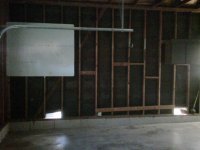
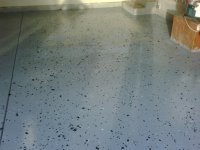
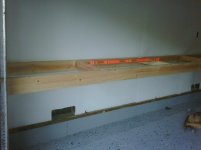
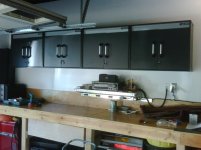
 The floor is holding up great... when clean, it's the same as the day I put it down. There are no scratches, tire marks, or other defects. So far, I am very pleased with the results.