To avoid these ads, REGISTER NOW!

help me fix some framing

DeadSock

Well-known member
Joined
Sep 17, 2006
Messages
161
Location
Sterling, AK
Let me describe what I've uncovered so far ...

This is an attached garage 20x20, with 2 gable walls.
One gable is fully attached to the house.
The other gable is a full exterior wall.
Ridge is a single 2x6.
One eave wall is half attached to a 2 story addition to the house (the other half exterior wall with a 3x3 window).
The other eave is an exterior 16x7 garage door opening.
The rafters are 2x6 at 2'oc.
No collar ties.
Walls are 2x4, sheathed with the 60's equivalent of T111.

I stripped the interior ... sheetrock for the interior sided walls and the severely deteriorating particle board for the exterior sided walls. (only insulation exists currently on the interior sides). There was some (sagging) particle board haphazardly spanning the ceiling "joists" (see below) that has been extracted.

Now for the good (actually bad!) parts.

The gable to gable span is a single 2x8 (looks like leftover TG flooring) to act as a "beam". As a plus, it's not even sitting on the top plate, but is instead notched to fit bellow it, and then supported by 2x4 blocks nailed to the side walls. There are 3 braces nailed to this "beam" running vertically to support? the ridge. Probably should mention, not like it's a surprise, this "beam" is sagging from some cracks that have developed. The ridge has a minor hogs back from this sagging (perhaps 2" over the 20' span)

It gets better (or worse as the case may be).

The ceiling "joists" are simply 12' 2x4 spanning the 10' distance, resting on the "beam" and nailed together to make the 20' span. Oh, and it's not like these are also at 2'oc like the rafters, they are only every other (aka 3 of these at 4'oc). It almost looks like someone cut the intermediate ones away (WTF?). The PO also had stored Xmas decorations and also a 40 pound box of leftover VAT tile up there (and yes, I know where the VAT was installed and will "encapsulate" it since I didn't want to pull it from a slab anyway).

So, think I should address some of this? (tongue firmly in cheek).

I'm thinking of replacing the beam with 2 2x12's sitting on the top plate (with a 4x4 to carry the load to the slab). Then running 2x6 at 2'oc resting on top of the beam to tie in the rafters. I'd run 3 4x4 braces from the beam to the ridge too. Should I consider a steel beam (for a trolley?) instead?

Can't be worse than what's been (barely?) holding the pace up for 40+ years right?

Some questions tho ...

Sound like a plan?

Any ideas on how to temporarily support the "structure" while I replace stuff? In order to get a new beam in place, the 3 ceiling "joists" from eave to eave need to come out. Would temporary posts supporting the ridge be sufficient to hold everything up while I fit a new beam/joists/braces?

This was an "as-is" foreclosure we've remodeled and recently moved into. I knew that "beam" was an issue going in, some of the rest has been a surprise tho.

Other than a poorly framed window opening in the kitchen (that has now been properly done), this is the only real "WTF we're they thinking" aspect we've come across.

P.S. I'll get some pics up tonight if possible.
 
To avoid these ads, REGISTER NOW!

framer

Active member
Joined
Feb 14, 2010
Messages
29
Can you screw three 2x6x16' above ceiling to rafters keep the building from spreading. It probably wouldn't spread much any way. Remove when finished. Good luck
 

bigdav160

Well-known member
Joined
Apr 14, 2007
Messages
2,027
Location
Deep in the heart of Texas
No idea where you live, so it's hard to recommend improvements. Do you get snow? Wind? Earthquakes?

I'm not sure from your description if the "beam" you've suggested would do anything.

I've seen many garages, down south, from the '60's that are framed similarly
 

irishtom

Well-known member
Joined
Nov 27, 2010
Messages
59
Location
Guilford, Connecticut
Any photographs?

Sometimes it's more cost effective to tear structure down and rebuild from scratch instead of killing yourself screwing around with making a bad structure a little better. I learned this from experience and won't make the mistake again. How is the electrical, lighting, sill plate condition, etc?
 

bczygan

Well-known member
Joined
Nov 4, 2009
Messages
22,002
Location
DETROIT! Arsenal of Scrappers
Let me describe what I've uncovered so far ...

This is an attached garage 20x20, with 2 gable walls.
One gable is fully attached to the house.
The other gable is a full exterior wall.
Ridge is a single 2x6.
One eave wall is half attached to a 2 story addition to the house (the other half exterior wall with a 3x3 window).
The other eave is an exterior 16x7 garage door opening.
The rafters are 2x6 at 2'oc.
No collar ties.
Walls are 2x4, sheathed with the 60's equivalent of T111.

I stripped the interior ... sheetrock for the interior sided walls and the severely deteriorating particle board for the exterior sided walls. (only insulation exists currently on the interior sides). There was some (sagging) particle board haphazardly spanning the ceiling "joists" (see below) that has been extracted.

Now for the good (actually bad!) parts.

The gable to gable span is a single 2x8 (looks like leftover TG flooring) to act as a "beam". As a plus, it's not even sitting on the top plate, but is instead notched to fit bellow it, and then supported by 2x4 blocks nailed to the side walls. There are 3 braces nailed to this "beam" running vertically to support? the ridge. Probably should mention, not like it's a surprise, this "beam" is sagging from some cracks that have developed. The ridge has a minor hogs back from this sagging (perhaps 2" over the 20' span)

It gets better (or worse as the case may be).

The ceiling "joists" are simply 12' 2x4 spanning the 10' distance, resting on the "beam" and nailed together to make the 20' span. Oh, and it's not like these are also at 2'oc like the rafters, they are only every other (aka 3 of these at 4'oc). It almost looks like someone cut the intermediate ones away (WTF?). The PO also had stored Xmas decorations and also a 40 pound box of leftover VAT tile up there (and yes, I know where the VAT was installed and will "encapsulate" it since I didn't want to pull it from a slab anyway).

So, think I should address some of this? (tongue firmly in cheek).

I'm thinking of replacing the beam with 2 2x12's sitting on the top plate (with a 4x4 to carry the load to the slab). Then running 2x6 at 2'oc resting on top of the beam to tie in the rafters. I'd run 3 4x4 braces from the beam to the ridge too. Should I consider a steel beam (for a trolley?) instead?

Can't be worse than what's been (barely?) holding the pace up for 40+ years right?

Some questions tho ...

Sound like a plan?

Any ideas on how to temporarily support the "structure" while I replace stuff? In order to get a new beam in place, the 3 ceiling "joists" from eave to eave need to come out. Would temporary posts supporting the ridge be sufficient to hold everything up while I fit a new beam/joists/braces?

This was an "as-is" foreclosure we've remodeled and recently moved into. I knew that "beam" was an issue going in, some of the rest has been a surprise tho.

Other than a poorly framed window opening in the kitchen (that has now been properly done), this is the only real "WTF we're they thinking" aspect we've come across.

P.S. I'll get some pics up tonight if possible.
Really need the photos and some more description.
You have a ridge "Board" rather than a ridge "Beam". That is the 2x6. The rafters (Also 2x6) are sized to support the roof load. It is typical in old construction to tie the walls together with 2x ceiling joists at 4' o.c. Is there any bowing out of the walls? Sagging of the ridge would indicate this. Check the eave wall to eave wall dimensions. In the old days members were fastened with nails and not metal straps or brackets. If not carefully fastened the joints can separate with the load from the rafters pushing out on the walls. Look at the connections of the ceiling joists at the eaves, but more particularly at the connection of the 2 10' joists to each other in the middle. If you find bowing of the walls in conjunction with sagging of the roof then the following will remedy the problem.
First, the best time to do this is when the roofing is going to be replaced. Do a total strip off to work with a lessened load on the structure. Secure the side walls with steel cables from side to side. Adequately tighten them to pull the walls parallel. Provide enough cables to safely and uniformly do this. Fasten them securely to the walls. Outside, 2x4 bracing placed diagonally from the top of the wall to the ground and spaced 4' o.c. can aid in this. With the walls secured, the ceiling joists can be removed. The ridge should also have straightened up somewhat. Your beam sounds like a glue lam beam. It may not be properly sized to clear span the 20' AND support point loads of posts supporting the ridge board. I would recommend you replace it with a microlam beam properly sized. Then when installing new ceiling joists, I would recommend 2x6's at 2' o.co if light storage or 2x8's at 16" o.c. if heavier storage is proposed for above the ceiling. If the new beam is still needed to support the ridge board (If it still sags), size the micro lam depending on the loads from that and the proposed storage. As you mentioned, don't forget to carry the beam loads down to the slab. The important thing in this is how well you tie the eave walls together. They are load bearing and try to kick out from the rafter tails pushing out. The ceiling joists triangulate the rafters and create a simple truss, so connections are all important. Use metal connectors for the joists and rafters at the walls and at the joists where they connect to the micro lam or each other. I would be tempted to leave a permanent cable or 3.
One other thing to look at is the beam over the garage door opening. That is on an eave or bearing wall as well. If it is under sized then the deflection will be larger which also will allow the rafter tails to sag or push out there as well.
Garages have historically been a place where structure was skimped on. They were typically left unfinished so larger deflections of structural members were OK. Rule of thumb construction by builders with no engineering left them under designed. The problems you have can be even worse in a hip roofed design. I have lots of examples in my own neighborhood built in the 40's. Saddle back roofs with bowed out walls, tilting structures that didn't have adequate foundations, binding garage doors and even collapsed garages.

Bill
Architectural Designer in Detroit
 
OP
D

DeadSock

Well-known member
Joined
Sep 17, 2006
Messages
161
Location
Sterling, AK
Attached are some pics (a bit grainy since my wife has the good camera).

A few notes ...
Located in Redding CA. Snow loads at 30 psf (per building dept, but rare to get anything more than an inch that lasts only half a day). Is a seismic area (like all of CA).

The roof has a very slight saddle back, and the wals are only slightly out of plumb. For the age (and level of construction) it's not in bad shape, but while I've got it open I feel I should correct some of the deficiencies.

regarding the pics ...
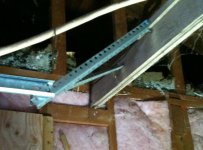
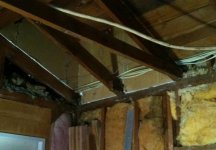
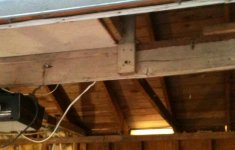
beam-center-cropped.JPG shows the center "beam" and one of the braces up to the ridge.you can see a knot that has a crack running from it, and a bit of deflection.

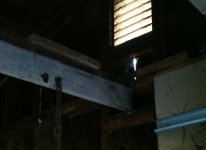
exterior-gable-cropped.JPG shows the exterior gable end of the beam (sry it's a bit dark). The chain bolted on is NOT mine!

interior-gable-cropped.JPG shows a bit better how the beam terminates at the other gable. As you can see, it's simply a 2x8 tongue and groove subfloor board notched to fit below the top plate and resting on 2x4 nailed between 2 studs.

interior-corner-cropped.JPG shows a corner of the eave and one of the ceiling joists.
 

Attachments

  • beam-center-cropped.JPG
    beam-center-cropped.JPG
    121.5 KB · Views: 135
  • exterior-gable-cropped.JPG
    exterior-gable-cropped.JPG
    93 KB · Views: 118
  • interior-gable-cropped.jpg
    interior-gable-cropped.jpg
    141.9 KB · Views: 120
  • interior-corner-cropped.jpg
    interior-corner-cropped.jpg
    146.6 KB · Views: 124

MoonRise

Well-known member
Joined
Nov 5, 2010
Messages
4,028
Location
NJ
Sometimes, the building codes and standards came about because folks realized or found out (the hard way, sometimes) that TheOldWay of doing things was really not a GoodWay of doing things.

Old (historic site type of old) farmhouse with 2x4 (old stuff so it really -was- 2x4 and not 1.5x3.5, but still) floor joists. The floor was so bouncy and sagging that you could see the sag from the room and a marble on the floor would roll to the middle of the room (quite fast actually) from anywhere and not make it out of the center 'hollow'. And it really wasn't all that big of a room either. Maybe 12 ft or so in the biggest 'across' dimension. I don't remember what the underneath support framing/structure was like, but it was obviously not a very well supported structure.

+1 on it might just be faster and easier and cheaper to knock the old inadequate structure down and rebuild it. Hmmm, well, with current Cali seismic codes maybe not cheaper. But still better.

The wall studs/framing might be alright, but the roof/ridge/'beam' and such is pretty much all NG. Inadequately sized all around.

Like Bill the Detroit architect mentioned, if the wall framing is OK, then you could brace up the walls well and then completely strip off the roof (covering, sheathing, framing, and all) and then build a 'real' roof. Complete with the appropriately sized ridge beam and collar ties and roof rafters (or trusses or whatever) and so on. Oh and put the appropriate headers across any wall openings (windows, doors, etc) while you are at it.

IMNSHO.
 
OP
D

DeadSock

Well-known member
Joined
Sep 17, 2006
Messages
161
Location
Sterling, AK
How about this for supporting the structure while replacing the beam and ceiling joists ...

1) put 3 4x4 posts under the existing beam and the three ridge braces.
2) jack and shim posts until ridge is back to level and minimal deflection
at this point there should be no spreading forces to the eave walls ...
3) remove existing 3 ceiling joists
4) install new beam above top plate (old beam still underneath)
5) install new ridge braces
6) persuade out of plumb walls back with a come-a-long (if necessary)
7) install new ceiling joists
at this point load is completely carried by the new beam/joists/braces ...
8) remove 4x4 posts and old beam

I think that should be safe and sufficient, but still need to size the replacement bits.

I don't plan on any "storage" above the ceiling joists, but will insulate, hang lights, drywall or metal covering ... I would surmise that 2x6 joists at 2'oc should be plenty (and definitely more than what's there today).

As for the beam ... I can't seem to locate a relevant sizing guide.
It seems to me that this is really only to keep the ceiling joists from deflecting. The rafters and ceiling joists form that "simple truss" and so support the load of the roof right?
 
OP
D

DeadSock

Well-known member
Joined
Sep 17, 2006
Messages
161
Location
Sterling, AK
Like Bill the Detroit architect mentioned, if the wall framing is OK, then you could brace up the walls well and then completely strip off the roof (covering, sheathing, framing, and all) and then build a 'real' roof. Complete with the appropriately sized ridge beam and collar ties and roof rafters (or trusses or whatever) and so on. Oh and put the appropriate headers across any wall openings (windows, doors, etc) while you are at it.

IMNSHO.

Well, a rip down is *not* going to happen.

If the walls were bowed or rotted sills or sevely sagging ridge ... then yea, a re build might be in order ...

If there was room to expand the size to make it a true 2 car garage, then yea, a re build might be in order ...


From what I can tell, the walls and rafters are perfectly sufficient. The 3tab roofing is only about 5-10 years old, so just want to ensure the structure can survive another 20+ years.

So, 20 odd 2x6 12' footers and an appropriate LVL should be sufficient to address the deficiencies.

The only other option would be do nothing and hope for the best ...
 
To avoid these ads, REGISTER NOW!

MoonRise

Well-known member
Joined
Nov 5, 2010
Messages
4,028
Location
NJ
re: relevent beam or joist sizing guide

Lumber yard (not a BigBox store) or the local building department will (or should) have that info for you.

You need the beam, the ridge, and the ceiling joists to all work together with the roof rafters to (as you surmise) make the structure. Collar ties spanning rafter-to-to-rafter help the structure as well.

Maybe take some decent pictures and make some dimensioned sketches and then do a consult with a local PE or architect or structural engineer. Even if you don't have them go through a full set of plans, you can or should be able to get some actual better numbers and sizing of the structural members that are required or recommended.
 

Thruxton

Well-known member
Joined
Dec 30, 2010
Messages
767
Location
Virginia
Let me describe what I've uncovered so far ...

This is an attached garage 20x20, with 2 gable walls.
One gable is fully attached to the house.
The other gable is a full exterior wall.
Ridge is a single 2x6.
One eave wall is half attached to a 2 story addition to the house (the other half exterior wall with a 3x3 window).
The other eave is an exterior 16x7 garage door opening.
The rafters are 2x6 at 2'oc.
No collar ties....

I had to go out and look to make sure you hadn't moved in to my garage, sounded so much like mine. I'm currently in the middle of rebuilding (will post a thread on it in a few days), and although my problems are similar, they are not quite the same.

First, layout is basically the same - 20X20. Rafters are 2X6 16OC, and there are two (only!) solid 2X8 beams that tie the eave walls together. No sag on the ridge board, amazingly.

The ceiling height under those two beams is 7'2", so to create a stronger structure and increase ceiling height I will put in joists in a collar-tie configuration to get a ceiling height of 9' approx, because i want to be able to install a small car lift. I am trying to decide whether to put these joists in every other rafter or each- weight vs strength is the issue that I perceive, although maybe strength is the decider. I'll end up with a slightly hipped finished ceiling, an idea I got here a few days ago (and if I could find the thread I would ref it, I am beholden to its author!).

I am also very appreciative of the comments by bczygan (Bill) about the importance of tying the rafters to the eave wall plates well, and about the importance of the load carrying beam over the garage door opening.

This is only my second post, I learned of this forum through another forum - Rennlist (yep, another Porsche guy here), and I'll try to contribute what I can with my project. I've spent all fall and early winter scratching my head and my **** coming up with plans to utilize this VERY small space (20X20 for woodworking, metalworking, and automotive) and hope some might find my comments useful, amusing, or best, both! And thanks for your thread, very helpful.:beer:

Martin
 

bczygan

Well-known member
Joined
Nov 4, 2009
Messages
22,002
Location
DETROIT! Arsenal of Scrappers
OK,
I took some time to analyze this and have done some calculations based on some assumptions of using the attic space for substantial storage. See below:

Here is an analysis and recommendations for this garage:
As mentioned before, this design is a ridge board with rafters and a few ceiling joists. In this design the roof loads are transferred directly from the rafters to the side walls. The ridge beam plays no part in this. The out thrust from the rafter tails horizontally on the top of the walls is resisted by the ceiling joists in tension. Since full span ceiling joists would need to be deeper, their span has been cut in half by placing a beam across the midpoint. In this kind of design it is important that the connections between these half span joists at the midpoint be adequate. Also the fastening method of the ceiling joists to the wall must resist the outward movement created by the rafters.
In this design connections are all important. Any movement in any part of the structure will effect the other parts. In this case there is evidence that the rafters have begun pushing out the side walls, causing the ridge board to deflect excessively. Close examination and measurement will show these conditions. At some point braces from the transverse beam up to, and supporting the ridge board were installed. This took some of the load of the rafters and transferred them to the beam, overloading it and causing it to crack at a weak point.

There are 3 ways to remedy this situation.The first is to repair the deficiencies in the existing rafter and ridge board design. The second is to create a ridge beam design to lessen the lateral loads on the side walls. The third method is to use a combination of the first two methods.

The first method is the cheapest but it will be difficult to reset rafters that are loaded with the weight of shingles and decking to their original position and secure them properly. The ridge board's deflection will resist this and in any case the rafters will have to be raised by some combination of jacking and drawing the walls together to their proper position. At this point the ceiling joists must be adequately secured to each other and the walls. Using this method, the only thing resisting the lateral spread of the walls is the ceiling joists. The transverse beam will have to be replaced as well.

The second method solves the problem of lateral force by supporting the rafters at the ridge and reducing the load by 1/2 that creates the lateral thrust. This load, now supported by the ridge beam must be transferred down to the ground by columns at each end of the beam. This reduces the horizontal load on the ceiling joists, but we still need to have the walls brought in, the joists raised to their proper position and the joists adequately fastened. Since the transverse beam has been damaged, it needs to be replaced in any case.

The third method does a couple of things. By placing a series of ceiling joists in addition to the ridge beam and replacing the transverse beam, In addition to reducing the load on the ceiling joists, it allows an attic space to be created that is useful for storage.

I believe the third method is the best choice to provide the most reinforcement of the existing structure and gives added storage capability at little additional cost. Additionally the Ridge beam also reduces the load on the garage door header, helping to resist rafter loads there.

The first task is to relocate the existing structural elements to their proper locations. This will involve jacking the rafters up and drawing the walls in with cables. Bring them just past their intended locations to allow for proper placement once jacks and cables are removed.
Next, remove the damaged existing beam and ceiling joists as well as the ridge board supports.
A new beam and columns, ceiling joists and ridge beam and columns may now be installed.
Next, and critical is that all the connections be adequately secured before the jacks and cables are removed.

Transverse beam placement:
There are some choices to be made regarding the placement of the new transverse beam.
Raising and replacing the beam up to on top of the top plates will give you more headroom and a flat ceiling when you drywall. It will, however, be taller than the 2x6 joists and create a little barrier if you put down plywood flooring in the attic storage space. You could also choose to make it flat with the top of the joists, in which case it would hang down into the garage and interrupt the ceiling plane. Either way, the joists will hang from either side of it with joist hangers. The problem with this is that the joists don't connect with each other on either side of the beam, to resist in tension, the out thrust of the rafters on the walls. One solution is to lower it and let the joists sit on top of it as the present beam does. That would make to beam intrude even further into the garage space as the replacement beam will be deeper than the present one. Another solution is to place it above the joists and let them hang from the bottom of the beam. This is, I think, the best solution. Attic access for storage can be provided on both sides of this beam. Care should be taken in the fastening of the joists both where they overlap each other in the middle as well as at the walls. Choose a double joist hanger that will suspend them below the beam and provide solid blocking at 1/3 points.

Sizing:
Sizing was done with span tables from the following location:
http://www.awc.org/technical/spantables/index.html

Ridge beam L/240 deflection
Span 20'
Load 10' x 30#LL + 10#DL = 400#/LF
Use 3 1/2 x 16 LVL with a 1.9E
Use min 2 2x4's columns resting on the transverse beam.

Transverse Beam L/240 deflection
Note: Since ridge beam supports rafters above, and is in turn supported by columns at each end, No other supports are required from the transverse beam up to the ridge beam, and the existing ones may be eliminated.
Span 20'
Load 10' x 40#LL + 12#DL = 520#/LF
Use 3 1/2 x 18 LVL with a 1.9E
Use min 2 2x4's columns at each end resting on floor.

Ceiling Joists L/360 deflection
Span 10'
Load 10' x 40#LL + 10#DL = 50#TL
From the Joist tables

Use 2x6's @ 16"o.c. E=1.7

This gives you a storage attic with very good capacity. If you want more insulation value use 2" blue board on bottom of joists before drywall.

Also check capacity of garage door header.
Load 925#/LF (Total of roof and attic floor loads)
Use 3 1/2 x 16 LVL with a 1.9E


Bill
 
Last edited:

Kevin54

MEMBER EMERITUS
Joined
Jan 12, 2005
Messages
29,341
Location
Urbana, Ohio
Your rafters will hold the walls in place. If you only have three ceiling joist, I would scab a couple 4x4;s and screw a couple of 2xs to it and run it up to the ridge beam temporarily for added support if you feel it needs be. But the only reason the 2x4x10 are scabbed together as a ceiling joist is either they felt a need to have something to tie the walls together ie. pulled in to each other which I believe is the case, or to have something to toss a sheet of plywood on to store items out of the road. You could probably just run a ratchet strap from wall to wall, tighten it up, and knock the three ceiling joist out. As for the bow in the ceiling, if you can get one or two long 4x4's, and either a hydraulic jack, house jack, or even a telepost (some call it a cellar post) and push the bow up to where it needs to be or a red one over straight. Use OSB triangles on each side of the rafter to make collar ties. Then like you stated, you will need a new ridge beam to support the existing ridge beam.
For the size, it's really not anything that couldn't be fixed in a long weekend.
 
OP
D

DeadSock

Well-known member
Joined
Sep 17, 2006
Messages
161
Location
Sterling, AK
I had to go out and look to make sure you hadn't moved in to my garage, sounded so much like mine. I'm currently in the middle of rebuilding (will post a thread on it in a few days), and although my problems are similar, they are not quite the same.

First, layout is basically the same - 20X20. Rafters are 2X6 16OC, and there are two (only!) solid 2X8 beams that tie the eave walls together. No sag on the ridge board, amazingly.

The ceiling height under those two beams is 7'2", so to create a stronger structure and increase ceiling height I will put in joists in a collar-tie configuration to get a ceiling height of 9' approx, because i want to be able to install a small car lift. I am trying to decide whether to put these joists in every other rafter or each- weight vs strength is the issue that I perceive, although maybe strength is the decider. I'll end up with a slightly hipped finished ceiling, an idea I got here a few days ago (and if I could find the thread I would ref it, I am beholden to its author!).

I am also very appreciative of the comments by bczygan (Bill) about the importance of tying the rafters to the eave wall plates well, and about the importance of the load carrying beam over the garage door opening.
Martin
Yup, pretty close ... mine is 24'oc rafters and single 2x8 ridge board and single 2x8 below the ceiling joists. The problem beam is roughly 8' above the "slab on grade" so a little more height ...

OK, I took some time to analyze this and have done some calculations based on some assumptions of using the attic space for substantial storage. See below:
I really appreciate the time to do some analysis for me! ... But, I have no need/reason for using the attic space for storage.

Here is an analysis and recommendations for this garage:
As mentioned before, this design is a ridge board with rafters and a few ceiling joists. In this design the roof loads are transferred directly from the rafters to the side walls. The ridge beam plays no part in this. The out thrust from the rafter tails horizontally on the top of the walls is resisted by the ceiling joists in tension. Since full span ceiling joists would need to be deeper, their span has been cut in half by placing a beam across the midpoint. In this kind of design it is important that the connections between these half span joists at the midpoint be adequate. Also the fastening method of the ceiling joists to the wall must resist the outward movement created by the rafters.
In this design connections are all important. Any movement in any part of the structure will effect the other parts.
Yup that is an accurate evaluation. But, I'm thinking I may just "polish this turd" and keep a similar structure ... very similar to the plan Thruxton is looking to do.

In this case there is evidence that the rafters have begun pushing out the side walls, causing the ridge board to deflect excessively. Close examination and measurement will show these conditions. At some point braces from the transverse beam up to, and supporting the ridge board were installed. This took some of the load of the rafters and transferred them to the beam, overloading it and causing it to crack at a weak point.
"rafters have begun pushing out" and "ridge board to deflect excessively" isn't quite accurate. Yes, just "eyeball" shows the ridge board deflecting some, and the walls aren't perfectly plumb. I'll get some measurements here in a few ...

There are 3 ways to remedy this situation.The first is to repair the deficiencies in the existing rafter and ridge board design. The second is to create a ridge beam design to lessen the lateral loads on the side walls. The third method is to use a combination of the first two methods.
Method 1 is what I pretty much need to go with. The others are probably a "better" solution, but just don't meet a cost/benefit analysis for me ...


The first method is the cheapest but it will be difficult to reset rafters that are loaded with the weight of shingles and decking to their original position and secure them properly. The ridge board's deflection will resist this and in any case the rafters will have to be raised by some combination of jacking and drawing the walls together to their proper position. At this point the ceiling joists must be adequately secured to each other and the walls. Using this method, the only thing resisting the lateral spread of the walls is the ceiling joists. The transverse beam will have to be replaced as well.
Pretty much the way I think I need to go ...

The first task is to relocate the existing structural elements to their proper locations. This will involve jacking the rafters up and drawing the walls in with cables. Bring them just past their intended locations to allow for proper placement once jacks and cables are removed.
Next, remove the damaged existing beam and ceiling joists as well as the ridge board supports.
Will my idea of temporary 4x4's under the old beam and braces (plus cables/ties for security/adjusting sound good?

A new beam and columns, ceiling joists and ridge beam and columns may now be installed.
Next, and critical is that all the connections be adequately secured before the jacks and cables are removed.
I can handle this (but won't be replacing the ridge ...)

Transverse beam placement:
There are some choices to be made regarding the placement of the new transverse beam.
Raising and replacing the beam up to on top of the top plates will give you more headroom and a flat ceiling when you drywall. ,snip. . Another solution is to place it above the joists and let them hang from the bottom of the beam. This is, I think, the best solution. Attic access for storage can be provided on both sides of this beam. Care should be taken in the fastening of the joists both where they overlap each other in the middle as well as at the walls. Choose a double joist hanger that will suspend them below the beam and provide solid blocking at 1/3 points.
Yea, kinda how I was thinking of going ... The "attic" isn;t going to be used for storage. Only thing going up there will be insulation. It's only a 4 in twelve pitch, so top plate to ridge board is 3'. add the beam and 2x6 joists on top of that ... why bother

Sizing:
Sizing was done with span tables from the following location:
http://www.awc.org/technical/spantables/index.html
Thanks for the link, I'll look it over with respect to going with "method 1" and "joists above support beam". Since I don't intend for "storage" up there L/360 should be fine (correct?)

Also check capacity of garage door header.
Load 925#/LF (Total of roof and attic floor loads)
Use 3 1/2 x 16 LVL with a 1.9E
Currently the header is a double 2x12 (spanning 16' :headscrat ) ... I'm planning on putting in a 12x7 (could even go to 10x7). So will be adding some additional framing at that eave.

Again, appreciate the evealuation and professional insight!

Rob
 

bczygan

Well-known member
Joined
Nov 4, 2009
Messages
22,002
Location
DETROIT! Arsenal of Scrappers
Yup, pretty close ... mine is 24'oc rafters and single 2x8 ridge board and single 2x8 below the ceiling joists. The problem beam is roughly 8' above the "slab on grade" so a little more height ...


I really appreciate the time to do some analysis for me! ... But, I have no need/reason for using the attic space for storage.


Yup that is an accurate evaluation. But, I'm thinking I may just "polish this turd" and keep a similar structure ... very similar to the plan Thruxton is looking to do.


"rafters have begun pushing out" and "ridge board to deflect excessively" isn't quite accurate. Yes, just "eyeball" shows the ridge board deflecting some, and the walls aren't perfectly plumb. I'll get some measurements here in a few ...


Method 1 is what I pretty much need to go with. The others are probably a "better" solution, but just don't meet a cost/benefit analysis for me ...


Pretty much the way I think I need to go ...


Will my idea of temporary 4x4's under the old beam and braces (plus cables/ties for security/adjusting sound good?


I can handle this (but won't be replacing the ridge ...)


Yea, kinda how I was thinking of going ... The "attic" isn;t going to be used for storage. Only thing going up there will be insulation. It's only a 4 in twelve pitch, so top plate to ridge board is 3'. add the beam and 2x6 joists on top of that ... why bother


Thanks for the link, I'll look it over with respect to going with "method 1" and "joists above support beam". Since I don't intend for "storage" up there L/360 should be fine (correct?)


Currently the header is a double 2x12 (spanning 16' :headscrat ) ... I'm planning on putting in a 12x7 (could even go to 10x7). So will be adding some additional framing at that eave.


Again, appreciate the evaluation and professional insight!

Rob

Based on what you say above:
L/360 is more stringent. L/240 is less demanding (Allows more deflection)
The fastening of the ceiling joists to each other and to the exterior walls is even more critical if you don't use a ridge beam. The calculations below are based on elimination of anything but very light storage in the attic space. You could even go 32"o.c. with the joists and put 5/8" ply in just some areas for storage. Best place will be near the beam where height is the best.

Working on it............
 
OP
D

DeadSock

Well-known member
Joined
Sep 17, 2006
Messages
161
Location
Sterling, AK
Based on what you say above:
L/360 is more stringent. L/240 is less demanding (Allows more deflection)
The fastening of the ceiling joists to each other and to the exterior walls is even more critical if you don't use a ridge beam. The calculations below are based on elimination of anything but very light storage in the attic space. You could even go 32"o.c. with the joists and put 5/8" ply in just some areas for storage. Best place will be near the beam where height is the best.

Working on it............

doh, yea, got it backward ... meant a L/240.

At this point I'm convinced I can get the 2x6 ceiling joists secured to each rafter, and then tie them together. They would then rest on the new transverse beam (and would have ties to that as well).

Just curious about options for that transverse beam. Sistering 2x lumber would be *my* first choice.

I'm working on finding the amount of deflection in the ridge board, and what (if any) splaying is happening at the eaves ...
 
Last edited:
OP
D

DeadSock

Well-known member
Joined
Sep 17, 2006
Messages
161
Location
Sterling, AK
One side of the garage door opening "splays" out about 1/8" over the 8'. The other side is nearly dead on (if anything perhaps a teenth leaning in).

On the other eave, one corner is "attached" and the unattached one appears to splay out the same 1/8" over 8'.

IMO, that's almost nothing! My eye can sure spot it, but one come-a-long near the offending corners, and I can probably get them dead plumb!

The crappy interior must've been playing games on my eyes to think it was more like 1/4" per 4' ...

Will check the ridge tonight. I'm guessing it's 1/2" low on the one gable (hence the 1/8 out at the corresponding eaves), and probably sagging another 1/2" near the center (since the existing transverse "beam" is probably sagging about that). Some settling at the attached end of ridge (which continues on another 40' for the house) would explain the minor inward lean of that the one edge of the garage door header.

Very convinced the deficiencies can be addressed well and cheaply now.
 
Last edited:

bczygan

Well-known member
Joined
Nov 4, 2009
Messages
22,002
Location
DETROIT! Arsenal of Scrappers
The best way to connect the joists is to pass them past each other and bolt them together. Then hang them from below the transverse beam at the middle of the garage. Better connection to make them continuous. 2x6 @ 24"o.c. Do not support the ridge board or rafters with supports on this beam.
1x6 collar ties 1/3 down from the peak will help the rafters once jacked into place.
 
To avoid these ads, REGISTER NOW!
Top Bottom