The Offer
One of the neat things about internet message boards are the interesting people you meet. Back in February, I received a private message here on Garage Journal from a member who has asked to remain nameless. He said that he had read my DoAll rebuild and wanted to know if I was interested in a broken Cincinnati Bickford 3' x 9" Super Service radial drill in need of a new home. Certainly! I said.
During a later telephone conversation the GJ member stated that it had a broken quill feed mechanism and cracked spindle housing, but the machine was otherwise intact and complete. He told me that he purchased the machine several years ago off Ebay and later found it was not in operable condition. After making this determination, he purchased a second radial drill, exactly the same as the broken machine, but in excellent condition. Thus, the broken machine was just taking up valuable shop space and he would rather see it put to use than scrapped.
The GJ member was nice enough to take a number of photos of the machine internals so I could make a decision as to what it would take to repair. I determined it would require extensive, but not unapproachable repairs. Even though the GJ member lives quite a long distance from me, he offered the machine and delivery for free! Obviously, this would make it easier to bear the cost associated with repairing the machine.
We reached an agreement that:
1) He would deliver the machine to me for free on the understanding that I would make an effort to rebuild the machine as I did with the my DoAll band saw.
2) I would post the rebuild here on Garage Journal.
3) If the drill turned out to be irreparable, I could use the drill as a parts machine or worst case scrap the machine.
4) I would not reveal the member's identity.
5) The least I could do was offer to pay for his fuel and take him out for a good lunch. He agreed to lunch, but refused to accept payment for his fuel!
With an agreement reached, we waited for better weather and that brings us to today!
Delivery
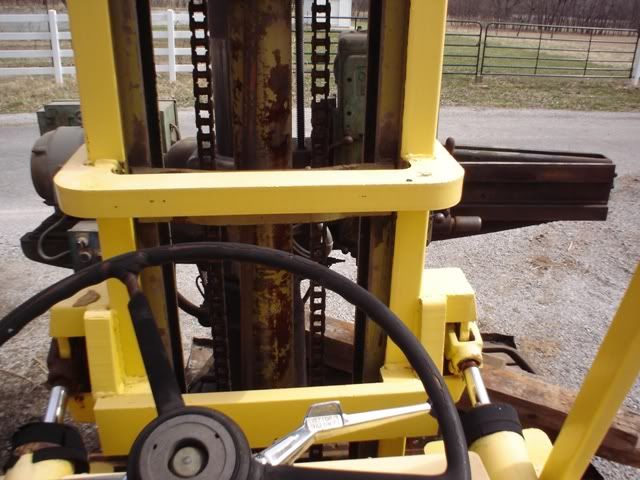
Around noon today, the GJ member showed up with about 2.5 tons of new iron for my shop:

Here it is after removing it from the truck:
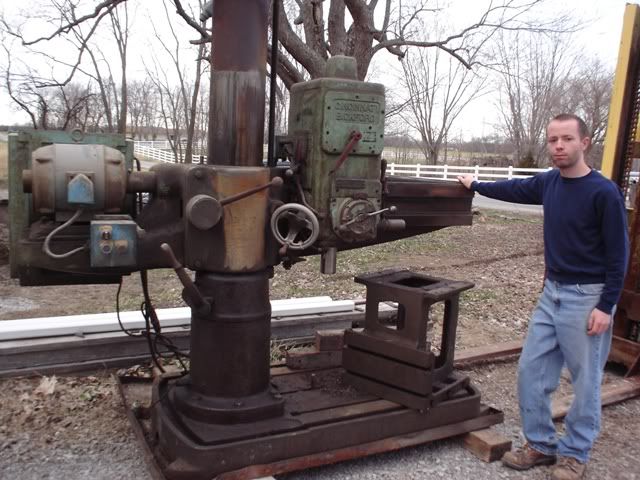
A photo with me for a scale reference. Yes, it's true, I never smile for photos.
Back side of the machine:

A cool lubrication data plate on the machine:

A photo of the head:
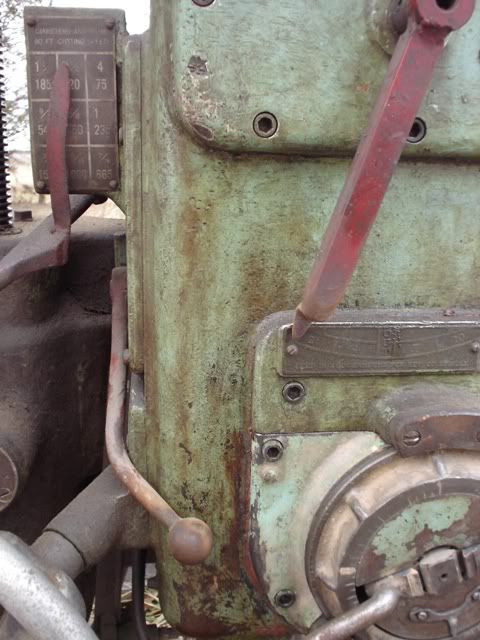
The drive end:

Some specs on the machine:
Catalog Size: 3' arm by 9" column
Weight: About 4,000 lbs +-
Power: 3HP
Spindle: #4 Morse Taper
Spindle Speeds: 75 RPM to 1,500 RPM.
Rated capacity: 2" in iron
Year Built: Unknown, I can't find the serial number, but suspect 40's or 50's.
The Damage
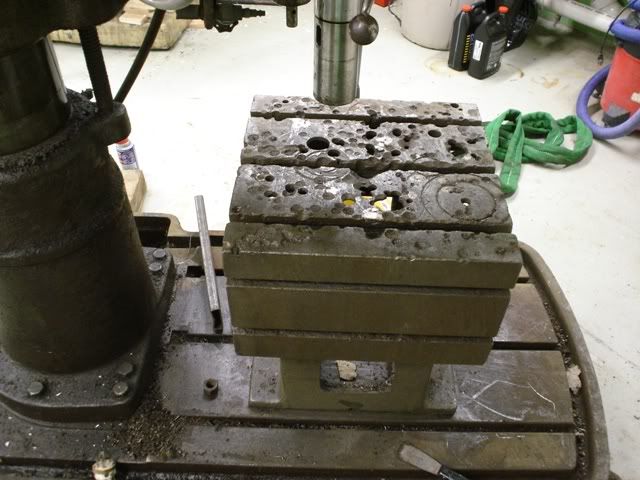
The machine has several problems, the worst of which is internal to the head. Sometime in the not too distant past the machine was owned by a person or people who have no business owning machine tools, as the top of the box table screams:

One thing about machine tools, especially old ones, is the power feed overrun stops tend to be unreliable. In this case, somebody extended the machine's quill to almost full travel, then engaged the power feed. Eventually, the quill fed to the end of its travel and the feed pinion jammed on the end of the quill rack. The resulting forces broke the spindle housing inside the main head casting as shown here:
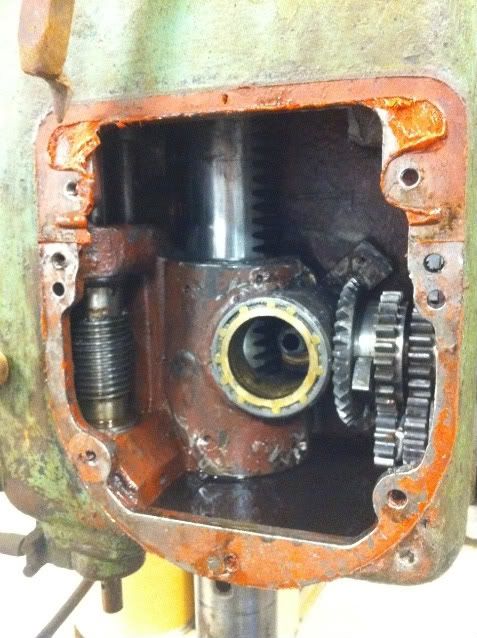
A repair was effected and the machine was put back into use. However, the quill mechanism is extremely tight and binds once per revolution of the feed pinion as it has a bent tooth, the red one in this photo.

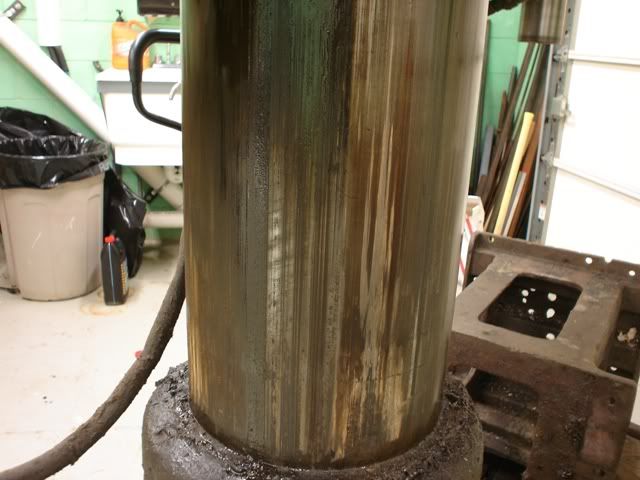
Finally, the column is heavily scored. This is fairly common for radials of this age:

While the machine will be a challenging rebuild, thus far I can't find anything which is damaged so much that it is beyond my capabilities to properly repair. Of course, that could change once I get into the machine.
Rebuilding this machine offers a few interesting opportunities, including my first full restoration of a machine's geometry and a complete spindle and quill rebuild. I have already formulated repairs for the machine spindle and the column which will make the machine perform better than new.
While these extensive repairs would not be financially possible if I purchased a machine in this condition, the fact that the machine was given to me free of charge makes this rebuild a viable project. Other American-made radial drills of this size are available. However, many suffer the same or similar damage as this machine and cost substantially more than scrap value. Newer American-made radial drills are outside my budget.
It is my intent to rebuild this machine to as-new condition, barring any fatal flaws which I have not yet uncovered. Failing that, this was a very common machine, little changed from the 1940's. It could be used to supply parts for a machine in better condition.
A version of this machine is still built-to-order by Giddings and Lewis who now owns the Bickford division of Cincinnati at a new cost of around $40,000. I expect to end up with an as-new machine for substantially less.

One of the neat things about internet message boards are the interesting people you meet. Back in February, I received a private message here on Garage Journal from a member who has asked to remain nameless. He said that he had read my DoAll rebuild and wanted to know if I was interested in a broken Cincinnati Bickford 3' x 9" Super Service radial drill in need of a new home. Certainly! I said.
During a later telephone conversation the GJ member stated that it had a broken quill feed mechanism and cracked spindle housing, but the machine was otherwise intact and complete. He told me that he purchased the machine several years ago off Ebay and later found it was not in operable condition. After making this determination, he purchased a second radial drill, exactly the same as the broken machine, but in excellent condition. Thus, the broken machine was just taking up valuable shop space and he would rather see it put to use than scrapped.
The GJ member was nice enough to take a number of photos of the machine internals so I could make a decision as to what it would take to repair. I determined it would require extensive, but not unapproachable repairs. Even though the GJ member lives quite a long distance from me, he offered the machine and delivery for free! Obviously, this would make it easier to bear the cost associated with repairing the machine.
We reached an agreement that:
1) He would deliver the machine to me for free on the understanding that I would make an effort to rebuild the machine as I did with the my DoAll band saw.
2) I would post the rebuild here on Garage Journal.
3) If the drill turned out to be irreparable, I could use the drill as a parts machine or worst case scrap the machine.
4) I would not reveal the member's identity.
5) The least I could do was offer to pay for his fuel and take him out for a good lunch. He agreed to lunch, but refused to accept payment for his fuel!
With an agreement reached, we waited for better weather and that brings us to today!
Delivery
Around noon today, the GJ member showed up with about 2.5 tons of new iron for my shop:
Here it is after removing it from the truck:
A photo with me for a scale reference. Yes, it's true, I never smile for photos.
Back side of the machine:
A cool lubrication data plate on the machine:
A photo of the head:
The drive end:
Some specs on the machine:
Catalog Size: 3' arm by 9" column
Weight: About 4,000 lbs +-
Power: 3HP
Spindle: #4 Morse Taper
Spindle Speeds: 75 RPM to 1,500 RPM.
Rated capacity: 2" in iron
Year Built: Unknown, I can't find the serial number, but suspect 40's or 50's.
The Damage
The machine has several problems, the worst of which is internal to the head. Sometime in the not too distant past the machine was owned by a person or people who have no business owning machine tools, as the top of the box table screams:
One thing about machine tools, especially old ones, is the power feed overrun stops tend to be unreliable. In this case, somebody extended the machine's quill to almost full travel, then engaged the power feed. Eventually, the quill fed to the end of its travel and the feed pinion jammed on the end of the quill rack. The resulting forces broke the spindle housing inside the main head casting as shown here:
A repair was effected and the machine was put back into use. However, the quill mechanism is extremely tight and binds once per revolution of the feed pinion as it has a bent tooth, the red one in this photo.
Finally, the column is heavily scored. This is fairly common for radials of this age:
While the machine will be a challenging rebuild, thus far I can't find anything which is damaged so much that it is beyond my capabilities to properly repair. Of course, that could change once I get into the machine.
Rebuilding this machine offers a few interesting opportunities, including my first full restoration of a machine's geometry and a complete spindle and quill rebuild. I have already formulated repairs for the machine spindle and the column which will make the machine perform better than new.
While these extensive repairs would not be financially possible if I purchased a machine in this condition, the fact that the machine was given to me free of charge makes this rebuild a viable project. Other American-made radial drills of this size are available. However, many suffer the same or similar damage as this machine and cost substantially more than scrap value. Newer American-made radial drills are outside my budget.
It is my intent to rebuild this machine to as-new condition, barring any fatal flaws which I have not yet uncovered. Failing that, this was a very common machine, little changed from the 1940's. It could be used to supply parts for a machine in better condition.
A version of this machine is still built-to-order by Giddings and Lewis who now owns the Bickford division of Cincinnati at a new cost of around $40,000. I expect to end up with an as-new machine for substantially less.
Last edited: