I have been reading everyone's very informative discussions now for about a month, and every day I'm convinced to take a different path for my garage floor based on the +'s and -'s that everyone has provided. I originally planned on putting down beige or tan VCT, but now I'm 90% sure that I'm going to go with the H&C concrete stain. Everyone has a different practical use for their garage floor, but the common thread that I see (no pun intended) is that most people want a good working floor that's easy to maintain and not cost prohibitive to install and maintain (e.g., replacing tiles, re-coating with epoxy.)
First off I'm in the midwest/rust belt, so my garage although heated and insulated, will get cold in the winter. I just finished installing additional 18' 2' x 8' joists in my ceiling and hanging 10' and 12' sections of 5/8" type X. The wife did all of the taping, mudding, and painting (isn't that nice of her in sort of an ironic way, considering she may be off limits to my room of work and solitude once complete). We want to complete the entire project by the work of just us.
Here's what I've gleaned from the month of reading all the valuable information everyone has provided, and changing my mind over a dozen times on what to do:
VCT is relatively inexpensive and looks good, but you need to have something to put your jack/jack stands on to prevent damaging, standing water on the tiles is an issue, and in cold climates the tiles may shrink and expose the seams and/or curl the ends. Motorcycle kickstands will damage it, too. A lot of additional "barriers" needed for certain circumstances to keep from getting hacked up. The floor surface needs to be smooth within 1/16" so expansion joints need to be filled, cracks filled, etc. in preparation.
Epoxy coating looks great and keeps the concrete surface basically intact to work on, but even with dedicated surface prep, you can't be completely sure that you'll get the coverage you expect. Plus, even if you don't get lift from hot tires (which many people do even with proper preparation and even with solvent based), the paint will need to be touched up periodically due to typical gouging and scratching from tools.
Floor tiles (e.g. Race Deck) make for a nice looking garage but are expensive, kind of noisy unless you use some form of underlayment on your substrate, can be damaged from jacking, hot slag, etc. Good option for a "light" working garage but not for more heavy duty use.
Rubber mats (e.g. g-floor) - nice to catch fluids or debris from reaching the actual garage floor, but not practical for the actual floor itself. Any mat that lays on the floor will gather up when compressed, such as when the wheels are turned when a car is not moving. Also can be damaged from hot metal, kickstands, etc.
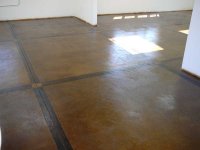
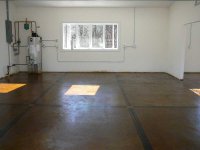
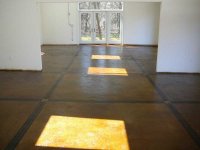
Which brings me to what I think is the best compromise of all flooring, but doesn't get much coverage in these boards, and I don't know why, and that's concrete stain. It's inexpensive; 4 gallons for just over $100 will provide two full coats for a 450 sq. ft. (2 1/2 car) garage. It isn't paint so it isn't subject to the pulling up like epoxy paints. It has to be touched up like epoxy paints, but this is easier with stain. The concrete surface is maintained, so you can roll a floor jack over it, use jackstands, lower your motorcycle kickstand etc. without leaving a lasting impression. It will of course wear when scraped continuously, but touching it up is easy; even re-staining every other year would be cheap and easy (base is already there; 1 gal. per 250 sq. ft. or so would be all that's needed). You still need to prepare/etch the floor, but since the stain penetrates the surface and doesn't sit on top like epoxy paint does even properly bonded, the preparation isn't as critical.
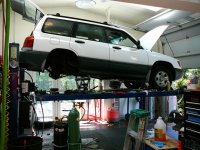
I like the R&C Silicone Acrylic Sealer. Look at ScrewTheMan's and RayJay's floor and how can you possibly beat that for durability, ease of touch up, low cost, and good looks? For the working garage doesn't it seem everything else is a compromise? But everyone has done so much research and there isn't that many threads on concrete stain that I am missing something? Again thanks to everyone's input, in the end it's all good. I mean HotRodGarage, how cool is that garage, I surely would be in there 24/7.
First off I'm in the midwest/rust belt, so my garage although heated and insulated, will get cold in the winter. I just finished installing additional 18' 2' x 8' joists in my ceiling and hanging 10' and 12' sections of 5/8" type X. The wife did all of the taping, mudding, and painting (isn't that nice of her in sort of an ironic way, considering she may be off limits to my room of work and solitude once complete). We want to complete the entire project by the work of just us.
Here's what I've gleaned from the month of reading all the valuable information everyone has provided, and changing my mind over a dozen times on what to do:
VCT is relatively inexpensive and looks good, but you need to have something to put your jack/jack stands on to prevent damaging, standing water on the tiles is an issue, and in cold climates the tiles may shrink and expose the seams and/or curl the ends. Motorcycle kickstands will damage it, too. A lot of additional "barriers" needed for certain circumstances to keep from getting hacked up. The floor surface needs to be smooth within 1/16" so expansion joints need to be filled, cracks filled, etc. in preparation.
Epoxy coating looks great and keeps the concrete surface basically intact to work on, but even with dedicated surface prep, you can't be completely sure that you'll get the coverage you expect. Plus, even if you don't get lift from hot tires (which many people do even with proper preparation and even with solvent based), the paint will need to be touched up periodically due to typical gouging and scratching from tools.
Floor tiles (e.g. Race Deck) make for a nice looking garage but are expensive, kind of noisy unless you use some form of underlayment on your substrate, can be damaged from jacking, hot slag, etc. Good option for a "light" working garage but not for more heavy duty use.
Rubber mats (e.g. g-floor) - nice to catch fluids or debris from reaching the actual garage floor, but not practical for the actual floor itself. Any mat that lays on the floor will gather up when compressed, such as when the wheels are turned when a car is not moving. Also can be damaged from hot metal, kickstands, etc.
Which brings me to what I think is the best compromise of all flooring, but doesn't get much coverage in these boards, and I don't know why, and that's concrete stain. It's inexpensive; 4 gallons for just over $100 will provide two full coats for a 450 sq. ft. (2 1/2 car) garage. It isn't paint so it isn't subject to the pulling up like epoxy paints. It has to be touched up like epoxy paints, but this is easier with stain. The concrete surface is maintained, so you can roll a floor jack over it, use jackstands, lower your motorcycle kickstand etc. without leaving a lasting impression. It will of course wear when scraped continuously, but touching it up is easy; even re-staining every other year would be cheap and easy (base is already there; 1 gal. per 250 sq. ft. or so would be all that's needed). You still need to prepare/etch the floor, but since the stain penetrates the surface and doesn't sit on top like epoxy paint does even properly bonded, the preparation isn't as critical.
I like the R&C Silicone Acrylic Sealer. Look at ScrewTheMan's and RayJay's floor and how can you possibly beat that for durability, ease of touch up, low cost, and good looks? For the working garage doesn't it seem everything else is a compromise? But everyone has done so much research and there isn't that many threads on concrete stain that I am missing something? Again thanks to everyone's input, in the end it's all good. I mean HotRodGarage, how cool is that garage, I surely would be in there 24/7.