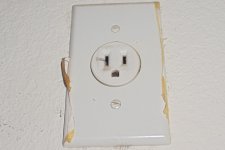
Do I calculate this outlet at 20 amps or 15? The panel has a 15a breaker but the outlet says 20a (125v). Also, is there any reason that this would have been installed instead of a double outlet? It's 8' off the floor too, so it's got me scratching my head.

You are using an out of date browser. It may not display this or other websites correctly.
You should upgrade or use an alternative browser.
You should upgrade or use an alternative browser.
20 amp outlet on a 15 amp circuit?
- Thread starter pds0006
- Start date
snorky18
Well-known member
Someone that knows more than me about electrical should be along shortly, but I believe that is a 240Volt Outlet, which would explain why it is not a "double" outlet.
Aside from trying to run a 240 Volt appliance from on only 15 amps, which is possible, I'm not sure why there would be a 15 amp breaker.
Any idea what size wire goes to it?
Aside from trying to run a 240 Volt appliance from on only 15 amps, which is possible, I'm not sure why there would be a 15 amp breaker.
Any idea what size wire goes to it?
Todd.Brock
Well-known member
A duplex recepticle does not equal 240v. As it states its a 20a 125v. There are times when you only need a single recepticle instead of a duplex. The sump pump in my basement is a single recepticle. I assume to make sure that you dont plug a bunch of other stuff in and possibly overload the circuit and the pump fails when you need it most. You could always put a tri-tap or extension cord on it, but thats besides the point.
The load should match the breaker. If its a 20a circuit with a 20a breaker, then it should be at least 12gauge wire. The slot to the leftand right is for a true 20a plug that has the left prog turned sideways to prevent being put into a 15a recepticle.
The load should match the breaker. If its a 20a circuit with a 20a breaker, then it should be at least 12gauge wire. The slot to the leftand right is for a true 20a plug that has the left prog turned sideways to prevent being put into a 15a recepticle.
Last edited:
I haven't had the chance to pull the outlet and check the wire yet but that's on my list. It does have a tri-tap on it and is running a Verizon box, a sprinkler system and my shop vac (occassionally). My hope is that I can move this outlet to waist level and use it to run the above as well as my compressor. I don't use it often but it gets old running an extension cord anytime I want to use it so the move is purely convenience.
Can I change the breaker to 20a to gain a little more wiggle room on that circuit?
Can I change the breaker to 20a to gain a little more wiggle room on that circuit?
If the wire is rated for 20a will it say 20a or something else? Showing my ignorance but it's better than burning the house down.
It will likely have the markings 10, 12, or 14 AWG on it. Additionally, you'll want to determine if it's cu or al wire. From there, you have to correspond with charts in the NEC and your local jurisdiction.
csp
Well-known member
Someone that knows more than me about electrical should be along shortly, but I believe that is a 240Volt Outlet, which would explain why it is not a "double" outlet.
No it isn't 240v. Its marked right on it 120v.
Could be that its original intent was for one item only and it may not be GFI protected. My old house had the sprinkler timer on a single outlet like that and it wasn't GFI protected. Having only one outlet kept me from plugging something else into it and getting shocked was the intent I'm sure.
Scott P
Well-known member
I have an outlet in my garage that high and it is meant for a lawn sprinkler system.
electrodude
Well-known member
#12 wire is good for 20A in a residence. 20A outlets were designed for high amp draw devices so that people wouldn't plug them into smaller circuits, causing nuisance tripping and generally being a pain in the ****. You can change the breaker to 20A IF the wire is #12 all the way through to the outlet, don't assume that it is, check for junction boxes and check as best you can to verify that it is.
acamato
Well-known member
the outlet is deisgned for a standard 15A plug (NEMA 5-15P) or a plug with one vert and one horz element (NEMA 5-20P) rated for 20A.
See this for more info: http://www.generatorjoe.net/html/web/outlet/quailplug.html
You can have a 240V circuit with a 15A breaker. It depends upon what your are feeding. For example a 15A circuit @ 240V can provide 3600W. It would take 30A @ 120V to provide the same power.
P=IV
P is power in watts
I is current in Amps
V is voltage
if you have the option, it is cheaper to wire an appliance in 240V vs 120v because you can use a smaller gauge wire in the circuit due to the lower current required. The power to the appliance will be the same.
See this for more info: http://www.generatorjoe.net/html/web/outlet/quailplug.html
You can have a 240V circuit with a 15A breaker. It depends upon what your are feeding. For example a 15A circuit @ 240V can provide 3600W. It would take 30A @ 120V to provide the same power.
P=IV
P is power in watts
I is current in Amps
V is voltage
if you have the option, it is cheaper to wire an appliance in 240V vs 120v because you can use a smaller gauge wire in the circuit due to the lower current required. The power to the appliance will be the same.
Last edited:
You can have a 240V circuit with a 15A breaker. It depends upon what your are feeding. For example a 15A circuit @ 240V can provide 3600W. It would take 30A @ 120V to provide the same power.
So does that mean that I can carry more than the 1440 watts (80% capacity) that I'm assuming for a 15a circuit?
Charles (in GA)
Well-known member
First, determine if the wire used in ALL of that circuit (does it supply any other receptacles or lights?) is AWG12. If you stumble into even one section of AWG14 then it cannot be changed to 20 amp. If the ENTIRE circuit is AWG12, and the receptacle is (as is apparent) a 20 amp receptacle, then the breaker should be 20 amp.
If this is the ONLY receptacle on the circuit, it is not legal to have a 20 amp rated receptacle on a 15 amp rated circuit. It is quite unusual to find a device with a NEMA 5-20 plug that requires that receptacle.
Charles
If this is the ONLY receptacle on the circuit, it is not legal to have a 20 amp rated receptacle on a 15 amp rated circuit. It is quite unusual to find a device with a NEMA 5-20 plug that requires that receptacle.
Charles
RAPID49
Well-known member
In order to have a plug for an ac unit that was not gfic it had to be a singe like that . My electrician told me unless it was a single it could not be considered dedecated therefore would not pass code.
electrodude
Well-known member
So does that mean that I can carry more than the 1440 watts (80% capacity) that I'm assuming for a 15a circuit?
Don't worry about watts, just concentrate on amps, that's what everything is sized for.
Two more questions rather than starting new threads:
1) I'm putting up french cleats for modular storage. Can I screw into the studs flanking my panel?
2) See below pic of said panel. Do I have 5 slots left, 10 slots or 1? I see 5 breakouts that look like they could each fit 2 slim breakers but at least 1 regular but then I noticed the blank spot at the bottom of the right hand side.
1) I'm putting up french cleats for modular storage. Can I screw into the studs flanking my panel?
2) See below pic of said panel. Do I have 5 slots left, 10 slots or 1? I see 5 breakouts that look like they could each fit 2 slim breakers but at least 1 regular but then I noticed the blank spot at the bottom of the right hand side.
Attachments

electrodude
Well-known member
the outlet is deisgned for a standard 15A plug (NEMA 5-15P) or a plug with one vert and one horz element (NEMA 5-20P) rated for 20A.
See this for more info: http://www.generatorjoe.net/html/web/outlet/quailplug.html
You can have a 240V circuit with a 15A breaker. It depends upon what your are feeding. For example a 15A circuit @ 240V can provide 3600W. It would take 30A @ 120V to provide the same power.
P=IV
P is power in watts
I is current in Amps
V is voltage
if you have the option, it is cheaper to wire an appliance in 240V vs 120v because you can use a smaller gauge wire in the circuit due to the lower current required. The power to the appliance will be the same.
Just keep in mind, in a residence:
#14 AWG for 15A
#12 AWG for 20A
#10 AWG for 30A
Next dumb question. You mention 240v wiring and I assume this is in reference to things like my tablesaw and bandsaw having 110/220 specs, right? If I switch those to 220 can they still be powered from the same outlets they currently use?
electrodude
Well-known member
Next dumb question. You mention 240v wiring and I assume this is in reference to things like my tablesaw and bandsaw having 110/220 specs, right? If I switch those to 220 can they still be powered from the same outlets they currently use?
No. A 220V plug should be used in place of the 120V plug when changing voltages.
Why? Because:
*Imagine having a 120V outlet wired up for 220V... someone comes along and needs an outlet, plugs their 120V device in and...

*Undervolting a 220V motor by putting 120V to it is likely to burn the motor out or greatly decrease its life, not to mention the thrill of possibly setting a fire!
*...and it's code. If, God forbid, you experienced a fire in your home and when the fire inspector checked your wiring found you had wired a 120V circuit up for 220V, your insurance company would breathe a big sigh of relief. If someone got hurt in that fire, even if it wasn't your fault, people like Tom Henry would come along and crucify you on the Electricians Cross from the witnesses chair at your trial.
Wow, this electricity stuff is complicated and dangerous. Based on what you're saying I think I'm going to wait on the 220v until I can pay for an electrician to do it right. In an earlier post I had a question about my panel and screwing french cleats into the studs on either side of it. Is that a bad idea as well or is it something that I just need to be cautious about when I do it?
Todd.Brock
Well-known member
Smart move on calling the professional. Screwing in around the box is tricky without know whats back there.
electrodude
Well-known member
Wow, this electricity stuff is complicated and dangerous. Based on what you're saying I think I'm going to wait on the 220v until I can pay for an electrician to do it right. In an earlier post I had a question about my panel and screwing french cleats into the studs on either side of it. Is that a bad idea as well or is it something that I just need to be cautious about when I do it?
As long as you don't run the screws through the box I'd think you'd be just fine

I hope you're serious about at least conferring with an electrician, a good understanding of what you are up against will help you make a solid, educated decision you'll feel comfortable with!
Absolutely serious. I like tinkering and doing stuff on my own but I've already paid $700 to fix a plumbing mistake I made while tinkering. Make the same kind of mistake with electricity and I'm dead.
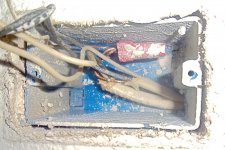
So I pulled the outlet to try and figure out if it's #12 or #14 wire. Couldn't pull enough to find the label but I took pictures. Is there a visible difference between 12 and 14 and if so, what is it? Also, isn't it a no-no to put two wires on one terminal?
So I pulled the outlet to try and figure out if it's #12 or #14 wire. Couldn't pull enough to find the label but I took pictures. Is there a visible difference between 12 and 14 and if so, what is it? Also, isn't it a no-no to put two wires on one terminal?
Attachments

MrMark
Well-known member
Yeah, that's some jacked up **** work there. All around **** job. You need to pigtail that. Nut the two blacks together with another 8" (I use) piece of 12 gauge and take the pigtail to the terminal. Whoever did that didn't know what they were doing.
As for how to tell, best for a beginner is just to have some of each handy to compare with what is in that box.
Strip the blacks and whites back one inch or a little more, take lineman pliers and twist the wires together by grabbing the very end; pull as you twist. Cut the very end you grabbed off leaving 5/8's or so of twisted ends. Apply nut.
Also, notice how the wire loops are installed the wrong way. They have to be wrapped clockwise, the same direction as tightening the screw or they will work loose.
A real numbnuts did that job. I hope it wasn't you!
As for how to tell, best for a beginner is just to have some of each handy to compare with what is in that box.
Strip the blacks and whites back one inch or a little more, take lineman pliers and twist the wires together by grabbing the very end; pull as you twist. Cut the very end you grabbed off leaving 5/8's or so of twisted ends. Apply nut.
Also, notice how the wire loops are installed the wrong way. They have to be wrapped clockwise, the same direction as tightening the screw or they will work loose.
A real numbnuts did that job. I hope it wasn't you!
Last edited:
MrMark
Well-known member
At least you now know it goes somewhere else. It's not the end of a run or a dedicated circuit; which I believe it may have been at one time. My guess is that someone unschooled tapped into that.
Charles (in GA)
Well-known member
As far as shelving around the breaker panel, code requires that the panel be in an area that is at minimum 30 inches wide, clear and nothing else in that area. The panel doesn't have to be centered in the 30 inches, but there needs to be 30 inches clear that the panels sits fully within. In addition, the area from floor to 2 meters high (about 6 ft 7 in) must be clear and nothing in this area at all, the full 30 inches wide. Also, that 30 inch wide area, that is 6 ft 7 in high, needs to extend out from the face of the panel, 36 inches, all totally clear of obstructions.
Charles
Charles
Charles (in GA)
Well-known member

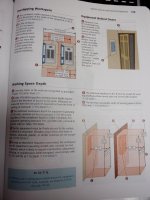

The third picture seems most germaine to me. Nothing within that area up to the ceiling and the ceiling is really where I'm concerned. I need the studs that flank the panel because they're at the extremes of my cleats from each end. But I guess if code and common sense say otherwise I should just eat another 32" and be glad I'm still breathing.
electrodude
Well-known member
If you're using the cleats to put some shelves INSIDE the wall, which is what I thought you were doing, then it's fine. Thinking about it now, yeah, that's kinda unusual. That 30" clearance is TOTAL, so you need 15" from the center out both ways. If you need the studs for your cleats you could put the cleats in that area, you just can't extend the shelves into there.
The truth of the matter is that if you get a little closer than that, well, you're doing better than a lot of homeowners I've come across. One lady actually hung a cabinet OVER his panel! She wasn't real pleased when I had to tear it out... , but them's the breaks I suppose.
Mark's dead on with the pigtails, gotta do that right. The only thing I want to add is that when you get your wires together under a wire nut, give them a good tug individually, just to make sure they're all snug and tight under there.
That 30" clearance is TOTAL, so you need 15" from the center out both ways. If you need the studs for your cleats you could put the cleats in that area, you just can't extend the shelves into there.The truth of the matter is that if you get a little closer than that, well, you're doing better than a lot of homeowners I've come across. One lady actually hung a cabinet OVER his panel! She wasn't real pleased when I had to tear it out...
, but them's the breaks I suppose.Mark's dead on with the pigtails, gotta do that right. The only thing I want to add is that when you get your wires together under a wire nut, give them a good tug individually, just to make sure they're all snug and tight under there.
The cleats are 3/4" plywood screwed to the studs through the drywall; about 3" down. It's actually for modular storage rather than shelves and will most likely be cabinets and clamp racks.
Like I said, I can **** it up and just eat 16" on either side of the panel to get to the next stud. Like you said, them's the breaks.
Yep, fixing that outlet's wiring along with another in the chain is, at least, within my skills.
Like I said, I can **** it up and just eat 16" on either side of the panel to get to the next stud. Like you said, them's the breaks.
Yep, fixing that outlet's wiring along with another in the chain is, at least, within my skills.