To avoid these ads, REGISTER NOW!

60000 BTU for 24 x 28

werdegast

Member
Joined
Aug 28, 2019
Messages
6
Location
Southeast Missouri
Would a 60000 BTU LP Infrared/Radiant heater be too large for an uninsulated shop that is 24 x 28 with gable ceilings that are 12' tall in the center?

The lower 4' are block with 4' frame walls on top. The ceiling peaks at 12' with joists at 9'. A roll up door 9' wide is in the south wall. The heat would be off unless I am working so I am thinking a forced air heater would be too slow for my needs.
 
To avoid these ads, REGISTER NOW!

finn

Well-known member
Joined
Mar 27, 2005
Messages
16,652
Location
The UP, God's country
Seems overkill for your relatively mild climate. 50k is more common for that small space. Insulation would be a better investment, both financially and comfort wise than an oversized heater.
 
OP
W

werdegast

Member
Joined
Aug 28, 2019
Messages
6
Location
Southeast Missouri
finn - I was thinking that myself. The next size is 40k. Unless I used a blown in product insulation would be difficult since the walls have plywood on the inside.

Jim greengo - My wood stove needs replacing and although it was handy it took some time to warm up the space. I tested a 95% high-efficiency furnace but it was slow to warm the space.
 

Jackfre

Well-known member
Joined
Dec 26, 2010
Messages
4,435
Location
N CA
I think a 60 is to large wether insulated or not. If you plan to insulate in the future I'd get a 40. If you don't plan to insulate get a 50
 
To avoid these ads, REGISTER NOW!
OP
W

werdegast

Member
Joined
Aug 28, 2019
Messages
6
Location
Southeast Missouri
I installed the 60k since I had it already. So far it has been fine but it is adjustable to 50k if necessary.

The primary on the transformer was bad and needed a replacement.

I would like to have it higher but the clearance from the top is 40". Does anyone have an opinion concerning using cement board as a heat shield for the ceiling?
 

isb cornbinder

Well-known member
Joined
Nov 3, 2010
Messages
7,072
Location
Pacific South West, BC, Canada
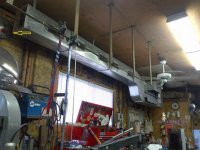
If the heater has a thermostat, it will operate only when the temperature drops. One of the best things I did for my shop is to add two ceiling fans. This keeps the air in motion and prevents stratification of the hot air up and the cooler air down.
I found my ceiling fans on Craigslist. One was free and the bigger and better one was $20.
 

Attachments

  • FURNACE SHOP.jpg
    FURNACE SHOP.jpg
    132.1 KB · Views: 44
  • CEILING FAN cl.jpg
    CEILING FAN cl.jpg
    72.6 KB · Views: 30
OP
W

werdegast

Member
Joined
Aug 28, 2019
Messages
6
Location
Southeast Missouri
I installed a White-Rodgers line voltage thermostat made for baseboard heaters and have 56" industrial ceiling fan on opposite end of the building.

If the heater has a thermostat, it will operate only when the temperature drops. One of the best things I did for my shop is to add two ceiling fans. This keeps the air in motion and prevents stratification of the hot air up and the cooler air down.
I found my ceiling fans on Craigslist. One was free and the bigger and better one was $20.
 

LS6 Tommy

Well-known member
Joined
Dec 27, 2013
Messages
26,162
Location
Northern NJ
I installed the 60k since I had it already. So far it has been fine but it is adjustable to 50k if necessary.

The primary on the transformer was bad and needed a replacement.

I would like to have it higher but the clearance from the top is 40". Does anyone have an opinion concerning using cement board as a heat shield for the ceiling?

Check local codes. You may need fire rated above the unit.

Tommy
 
OP
W

werdegast

Member
Joined
Aug 28, 2019
Messages
6
Location
Southeast Missouri
I live in a rural area with no codes so I look around to see what would the best solution. The NEC is handy and the local electric cooperative is always ready to answer questions..

I installed 1/2" Durock cement boards in a 9 x 5 area above the heater. After it ran for about an hour the board was reading about 170 directly over the heater. Above the cement board the temp was about 110 on average.
 

That1Guy

Well-known member
Joined
May 9, 2014
Messages
76
Location
Mid Michigan
finn - I was thinking that myself. The next size is 40k. Unless I used a blown in product insulation would be difficult since the walls have plywood on the inside.

Years ago I had a similar setup. I bit the bullet and carefully remove the wall sheathing, filled between the studs with batt insulation and replaced the sheathing. I wasn't nearly as careful removing it as I should have been and it showed - lol. But WOW! the difference was AMAZING! And this was with no ceiling and zero insulation in the roof. Absolutely worth the cost and the effort to do it! After seeing the benefits of the wall insulation, I eventually decided to do something with the open ceiling too.

Since I kept things stored on top of the roof joists, I didn't want to seal the attic off so I took the minimal approach and stapled some heavy mil plastic to the bottoms of the roof rafters. No insulation - just heavy plastic. And DOUBLE WOW! I couldn't believe the difference AGAIN. Even without adding insulation (hey - I was broke. Don't judge me :( lol) it was a huge improvement. I went from spending most of my shop time stuffing the wood stove, to barely ever adding wood after the first stoveful. And then rigging up a fan to circulate the brutally hot attic air back down to ground level made it a t-shirt only zone!

Now years later, while building my pole barn, I am concentrating on insulation. It's worth every penny and every bit of work! If I was you I would either insulate and/or slap some heavy plastic on your rafters to keep as much of that heat in as possible. Plus, I like your idea about the cement board above the heater. It could work as both a protective barrier as well as a heat mass. I'd worry about it drying up or becoming brittle and then raining down on you though - I'm not sure about how that stuff works with heat. Maybe a sheet of corrugated roofing steel? Pictures would certainly allow for more and better advice when it comes to a unique setup like you've described - just sayin.

Glad to hear that you got it up and running.
Best of luck on the shop. Keep us posted as to how it works out in the future.
:thumbup:
 
OP
W

werdegast

Member
Joined
Aug 28, 2019
Messages
6
Location
Southeast Missouri
Thanks for the input. So far it is great. That is a great idea about the plastic.

I would love insulate the walls. It would take forever since they are all covered with cabinets and shelves!! The industrial ceiling fan in the front and a squirrel cage fan from an old furnace high in the ceiling really circulate the heat. I usually turn off the furnace fan after an hour of so and drop the ceiling fan to the lowest setting.


Years ago I had a similar setup. I bit the bullet and carefully remove the wall sheathing, filled between the studs with batt insulation and replaced the sheathing. I wasn't nearly as careful removing it as I should have been and it showed - lol. But WOW! the difference was AMAZING! And this was with no ceiling and zero insulation in the roof. Absolutely worth the cost and the effort to do it! After seeing the benefits of the wall insulation, I eventually decided to do something with the open ceiling too.

Since I kept things stored on top of the roof joists, I didn't want to seal the attic off so I took the minimal approach and stapled some heavy mil plastic to the bottoms of the roof rafters. No insulation - just heavy plastic. And DOUBLE WOW! I couldn't believe the difference AGAIN. Even without adding insulation (hey - I was broke. Don't judge me :( lol) it was a huge improvement. I went from spending most of my shop time stuffing the wood stove, to barely ever adding wood after the first stoveful. And then rigging up a fan to circulate the brutally hot attic air back down to ground level made it a t-shirt only zone!

Now years later, while building my pole barn, I am concentrating on insulation. It's worth every penny and every bit of work! If I was you I would either insulate and/or slap some heavy plastic on your rafters to keep as much of that heat in as possible. Plus, I like your idea about the cement board above the heater. It could work as both a protective barrier as well as a heat mass. I'd worry about it drying up or becoming brittle and then raining down on you though - I'm not sure about how that stuff works with heat. Maybe a sheet of corrugated roofing steel? Pictures would certainly allow for more and better advice when it comes to a unique setup like you've described - just sayin.

Glad to hear that you got it up and running.
Best of luck on the shop. Keep us posted as to how it works out in the future.
:thumbup:
 
To avoid these ads, REGISTER NOW!
Top Bottom