To avoid these ads, REGISTER NOW!

Any appliance technicians here?

rust in the eye

Well-known member
Joined
Oct 2, 2017
Messages
2,875
Location
Chicagoland
Seems I've screwed the pooch here.
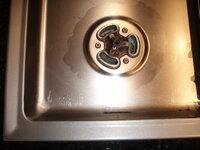
Our (wife's precious) cooktop/range had some burned on oil just around and under the gas burners on the stainless steel surface. It is a very fine "brushed" surface that cleans up very easily. I didn't want to use any abrasive so tried oven cleaner in a tiny spot under one of the burners. It removed the brown stain successfully so I widened my cleaning area to include the area just around the burner which had a bit of stain too.
There seems to be a coating of some sort on the surface which I've now removed in a circle around one of the burners.
Can anyone tell me what may have been factory (Gaggenau) applied to that surface and if it can be field serviced. Pretty sure I already know the answer but have hope for a miracle.
Thanks
 

Attachments

  • P1010068.JPG
    P1010068.JPG
    801.4 KB · Views: 71
To avoid these ads, REGISTER NOW!

BillK

Well-known member
Joined
Aug 24, 2006
Messages
9,414
Location
Beautiful Southern Maryland
Are you sure it isn't just discolored ? What does the owners manual say about using oven cleaner ? I imagine there is a grate that goes on to support the pan or pot and once its on you wont notice it.

I would get in touch with Gaggenau ?
 

djbmw

Well-known member
Joined
Jun 20, 2013
Messages
1,213
Location
Ottawa, Ontario, Canada
Acid on stainless steel = the result you have. I did a similar thing with our stainless steel sink and it now has the same discolouration around the drain that your range has on that stainless section. Aside from acid etching the rest of it,... or sanding it all down ... not much else you can do.
 
OP
R

rust in the eye

Well-known member
Joined
Oct 2, 2017
Messages
2,875
Location
Chicagoland
I have worked for an appliance manufacturer before and am 100% sure their customer care team will know exactly what to do. (These folks are trained specifically in these situations and have access to other tech materials that we can't see.) https://www.gaggenau.com/us/for-owners/customer-care
Early on (and ever since) it has been problematic so have I have dealt with them before. To say it was exasperating would be an understatement. I suspect your position in the industry allows you some special courtesy not extended to us paying customers. I would never buy one their products again.
Your suggestion does make sense though so I will see what they have to say. I won't be looking for anything that will cost them this time so perhaps a simple answer won't be too big an ask.
Any idea what that coating is?
 
OP
R

rust in the eye

Well-known member
Joined
Oct 2, 2017
Messages
2,875
Location
Chicagoland
Acid on stainless steel = the result you have. I did a similar thing with our stainless steel sink and it now has the same discolouration around the drain that your range has on that stainless section. Aside from acid etching the rest of it,... or sanding it all down ... not much else you can do.
Yeah, I know.
We decided to see if the newly exposed bare metal area is difficult to clean. If not my plan is to do the entire surface.
Still curious as to what was factory applied. Going to contact Gaggenau and see what they say. I suspect the same as you've already stated.
GRRRRRRRRR
 

MoonRise

Well-known member
Joined
Nov 5, 2010
Messages
4,043
Location
NJ
"Oven cleaner" is typically NOT acid, but a strong alkaline cleaner (old school used to be lye in a spray can, can't get much more alkaline than lye). Since you didn't specify what 'oven cleaner' you used, we don't know.

AFAIK, the stainless steel on cooktops is just bare stainless steel with no coating. A coating would just burn off from the heat of cooking. The strong (alkaline) cleaner probably removed ALL the surface grease and oil and thus you see a difference.

Pending what the OEM says, you are probably going to have to gently wipe down and clean the surface with the same chemical you used and thus even out the appearance.

Use PPE with lye!!!!!

Let us know what the OEM says and what/how you do to 'fix' things. :beer:
 

snyder

Well-known member
Joined
Dec 18, 2008
Messages
545
Location
Baltimore md.
The oven cleaner probably acted as a cheap way of passivation. Might want to try some barkeepers friend on the whole top to blend..
 

MoonRise

Well-known member
Joined
Nov 5, 2010
Messages
4,043
Location
NJ
The oven cleaner probably acted as a cheap way of passivation. Might want to try some barkeepers friend on the whole top to blend..

Passivation of stainless steel is typically done using acids (usually strong acids but NOT hydrochloric acid aka muriatic acid, as the chloride in that acid is typically corrosive to stainless steels), not alkaline chemicals. The necessary pre-passivation cleaning of the parts may be done using alkaline cleaners (strong detergents and/or sodium hydroxide, aka lye, cleaning).
 
To avoid these ads, REGISTER NOW!
OP
R

rust in the eye

Well-known member
Joined
Oct 2, 2017
Messages
2,875
Location
Chicagoland
The cleaner used was Easy Off, sodium hydroxide (lye) being the active ingredient.
Perhaps I've added, or removed passivation. I'm convinced the surface had some sort of treatment as it is uniform and remains everywhere else even on areas that never see any grease or heat.
I had never heard of passivation before* and am wonder if or how it changes apearance.
Haven't spoken to the mfr yet. Depending on what they have to say I may experiment with citric acid to see how/if it changes the appearance.

* educated here once again
 

RPH

Well-known member
Joined
Dec 17, 2006
Messages
4,190
Location
Michigan Thumb
Check this site for info on it.

How Does Passivation Work?​

Stainless steel is an iron-based alloy, typically composed of iron, nickel and chromium. Stainless steel derives its corrosion-resistant properties from the chromium content. Chromium, when exposed to oxygen (air), forms a thin film of chromium oxide that covers the stainless steel surface and protects the underlying iron from rusting. The purpose of passivation is to augment and optimize formation of the chromium oxide layer.

Immersion of stainless steel in an acid bath dissolves free iron from the surface while leaving the chromium intact. The acid chemically removes the free iron, leaving behind a uniform surface with a higher proportion of chromium than the underlying material.

Upon exposure to oxygen in the air after the acid bath, the stainless steel forms the chromic oxide layer over the next 24 to 48 hours. The higher proportion of chromium at the surface allows for the formation of a thicker, more protective chromium oxide layer. Removal of free iron from the surface removes opportunities for corrosion to start.

The resulting passive layer provides a chemically non-reactive surface that protects against rust.”

IMG_4659.png
 

Zeke

Well-known member
Joined
Aug 13, 2009
Messages
17,176
Location
Long Beach CA, the sewer by the sea.
Before you go to any great lengths, use some SOS pads gently on this. I marvel how you can get down hard and dirty with SOS on chrome. I have an old Wolf range with SS on the front panel and oven door. It was a bit mess up when I got it used. I straightened out the brushed look with Scotchgard pads. I used medium grit. Gray won't dig in much just for reference.
 

duneslider

Well-known member
Joined
Jan 20, 2013
Messages
2,296
Location
Riverton, Utah
Not that this will help at the moment...but they specifically say in the manual not to use oven cleaners on the stainless.

However, they sell a probably over priced stainless steel cleaner for those hard to remove deposits. They call it a HOB cleaner, which is a term I am not familiar with but there are other brands of Hob cleaners for this purpose.

Anyway, I also doubt there would be a coating on the stainless under there and the oven cleaner probably just cleaned off the "oxidation" and left it with a fresh surface which will probably eventually even out.
 

wssix99

Well-known member
Joined
Mar 2, 2011
Messages
5,167
Location
Chicago, IL
Your suggestion does make sense though so I will see what they have to say. I won't be looking for anything that will cost them this time so perhaps a simple answer won't be too big an ask.
Any idea what that coating is?
Please let us know what they say.

Sorry for coming back into this late. Lots of good info above. I also don't think your cooktop has a coating. In addition to the reasons above, cooktops are high-heat environments - a really bad place for coatings.

The DeLoren example above is a good one. All metals corrode, including Stainless. Your picture is really good and it looks to me that you essentially polished part of the cooktop.

Here's my list of stuff to use: (ordered from light duty to harsh duty - when I have stains, I start on the lighter end and move my way up)
- Aerosol Stainless Steel cleaners - I find these are usually weak but OK for light grease, fingerprints, etc.
- Affresh - https://www.affresh.com/products/stainless-steel-brightener/ - I believe Whirlpool makes this line of products. I haven't seen any other brands put out similar items, but these are my go-to products for front-line cleaning. I use them to clean everything and they do a great job. (Dishwashers, washing machines, cooking appliances, etc.)
- Bar Keepers Friend
- Baking Soda mixed with a little bit of water to make a polishing paste (this is great for soot and what I use to clean stainless exhaust tips on the car)
- Scotch Brite pads
 

wssix99

Well-known member
Joined
Mar 2, 2011
Messages
5,167
Location
Chicago, IL
To avoid these ads, REGISTER NOW!
Top Bottom