To avoid these ads, REGISTER NOW!

Attic Insulation

Will67

Well-known member
Joined
Nov 17, 2006
Messages
852
Location
Hell's half acre
I am in the process of getting my Building Permit to construct my "dream garage" and have a question regarding insulation/ventilation.

I will have 2x6 rafters (on a 6/12 pitch) on 16-inch on center spacing, with R-19 insulation between then 1/2" drywall covering the insulation. The county building dept. says I must have a 1-inch space beneath the "roof deck" and the insulation. I say why? They reply its code! They county wants 2x8 rafters to get the R-19 and ventilation spacing.

I Google attic insulation (not ceiling insulation) and I see varying opinions on the need for ventilation. I recently read an article in Taunton's Fine Homebuilding May 2008 about old buildings being retrofitted with R-40 to R-60 insulation in the attic area. To accomplish these high R-values they used spray foam and rigid foam boards. In all their accompanying "side-bar" drawings, not one showed a space for ventilation between roof sheathing and insulation. The spray foam is directly sprayed to the underside of the roof sheathing and rafters to fill in the space between, and then rigid foam is placed over the spray foam.

Where I live it gets into the +100* during the summer months with very low humidity (15-25%) and I would like to install the highest R-value per inch in the rafters. The second floor of my garage will be my workshop area. What would you suggest bite the bullet and pay for the 2x8 rafters to get the minimum R-value required (R-19) and ventilation space of 1” or?????
 
To avoid these ads, REGISTER NOW!

ddawg16

Well-known member
Joined
Jul 11, 2008
Messages
21,005
Location
S. California
Moisture!

If I'm understanding you correctly, you basically want to drywall the attic ceiling. Thats ok...BUT...think about it...if moisture gets into the space between the roof and ceiling, where is it going to go? It is going to go into the mould that will soon start to grow.

The 1" space allows air to flow up and out taking moisture with it.

That is why attics have to have x amount of soffet ventilation...want an example? Put yourself in a big plastic bag and see what happens.

Not only do you want at least 1" of space, the top and bottom needs vents to allow air to circulate up...

Believe it or not, most of those codes have reall good reasons behind them.
 

GSSFC

Well-known member
Joined
Apr 13, 2008
Messages
423
Location
Wolfeboro, NH
Attics have ventilation because traditional insulation is not effective. Fiberglass only slows that transmission of air. The warm air will pass through and if it contacts the cold roof deck it will condense and moisture problems will result. The ventilation is to wash the warm moist air away before it has a chance to condense (as ddawg16 stated). If you go with foam, the ventilation is not necessary as the foam is so dense and seals so well to the rafters that the warm air does not have an opportunity to reach the cold roof deck. The foam creates a thermal barrier between the two temperature differentials and condensation cannot occur.

Tim
 
OP
W

Will67

Well-known member
Joined
Nov 17, 2006
Messages
852
Location
Hell's half acre
As GSSFC stated:

"If you go with foam, the ventilation is not necessary as the foam is so dense and seals so well to the rafters that the warm air does not have an opportunity to reach the cold roof deck. The foam creates a thermal barrier between the two temperature differentials and condensation cannot occur."


This is what i want to do, but all I get from the County is it's not code! period end of story.


Dream scenario is 7/16 OSB radiant barrier for roof sheathing, with 2x6 rafters filled with Sprayed Polyurethane Foam (SPF) insulation (at ~R-5.7 per inch) and then vapor barrier(?) and then finally sheetrock.
 

Stuart in MN

Well-known member
Joined
Sep 8, 2005
Messages
23,009
Location
Minneapolis
It's the old 'hot roof' versus 'cold roof' debate. There's been a lot of discussion about this on the Fine Homebuilding magazine website, and the general concensus is that a hot roof (with foam insulation right against the bottom side of the roof deck) is probably the best method, but as you've found out it's not allowed by all local codes.
 

Steve in Mi

Well-known member
Joined
Mar 13, 2007
Messages
1,042
Location
Mid Michigan
Moisture!

If I'm understanding you correctly, you basically want to drywall the attic ceiling. Thats ok...BUT...think about it...if moisture gets into the space between the roof and ceiling, where is it going to go? It is going to go into the mould that will soon start to grow.

If you use a moisture barrier (poly) between the drywall and 2 X 6's and there is a roof on the outside presumably over tar paper/felt and maybe some ice dam (maybe not in Ca.) plus perhaps house wrap (why not house wrap?). Please tell me where this moisture is going to come from to feed mold. Unless you have a leaky roof the moisture that jepordizes the insulation comes from within and the poly stops that.


The county building dept. says I must have a 1-inch space beneath the "roof deck" and the insulation. I say why? They reply its code! They county wants 2x8 rafters to get the R-19 and ventilation spacing. ?????

I'm sure glad I didn't bump up against such "code" when I built in 1982. My shop heats to efficiently for there to be any water in the insulation.
 

blkhonda1991

Well-known member
Joined
May 20, 2008
Messages
608
Location
Connecticut
I am in the process of getting my Building Permit to construct my "dream garage" and have a question regarding insulation/ventilation.

I will have 2x6 rafters (on a 6/12 pitch) on 16-inch on center spacing, with R-19 insulation between then 1/2" drywall covering the insulation. The county building dept. says I must have a 1-inch space beneath the "roof deck" and the insulation. I say why? They reply its code! They county wants 2x8 rafters to get the R-19 and ventilation spacing.

I Google attic insulation (not ceiling insulation) and I see varying opinions on the need for ventilation. I recently read an article in Taunton's Fine Homebuilding May 2008 about old buildings being retrofitted with R-40 to R-60 insulation in the attic area. To accomplish these high R-values they used spray foam and rigid foam boards. In all their accompanying "side-bar" drawings, not one showed a space for ventilation between roof sheathing and insulation. The spray foam is directly sprayed to the underside of the roof sheathing and rafters to fill in the space between, and then rigid foam is placed over the spray foam.

Where I live it gets into the +100* during the summer months with very low humidity (15-25%) and I would like to install the highest R-value per inch in the rafters. The second floor of my garage will be my workshop area. What would you suggest bite the bullet and pay for the 2x8 rafters to get the minimum R-value required (R-19) and ventilation space of 1” or?????

how big of a space are you spanning with 2x6 rafters? cant hurt to go up to 2x8 and get more space for insulation no matter what way you do it :)
 
OP
W

Will67

Well-known member
Joined
Nov 17, 2006
Messages
852
Location
Hell's half acre
Blkhonda1991:
Garage footprint is 24' x 40' with 6/12 pitch with 24" overhang, second floor will have 6' foot walls.
 

carguy123

Well-known member
Joined
Oct 6, 2006
Messages
308
Location
DFW
Talk to a foam installer he can give you chapter and verse of why it is allowed under the code.
 
To avoid these ads, REGISTER NOW!

BooUrns!

Well-known member
Joined
Mar 16, 2008
Messages
477
Location
Edmonton, Alberta, Canada
Talk to a foam installer he can give you chapter and verse of why it is allowed under the code.

Of course the installer is going to tell you it's ok. He wants to sell his product. Most building codes only make reference to R value, not installed material. Instead of focusing on if the sprayfoam will work under code, check with your roofing tile supplier to see if the product you are going to use can withstand the heat buildup that your sprayfoamed roof deck will be undergoing in your climate. Certain roofing products will fail if subjected to extreme heat, that's one of the reasons why roofs need the ventilation space in the first place.

2x6's seem a bit undersized for that span to me

I'm assuming you're going to be stick framing this roof as the building dept would have simply requested your engineered roof plans that would be supplied by your truss manufacturer. What I can't figure out is how your building dept. is making a fuss over the rafter size yet has apparently glazed over the room upstairs with it's 6' walls. Are you building a properly reinforced floor? How much space in the roof will be used as living area?

The 6/12 pitch seems too low for you to even have usuable space inside the roof. Is it a 6/12 w/ gable ends on the long side or is it going to be a hipped roof? The span length will obviously have to be posted in places to cover that distance, perhaps by the interior walls. You'd get more use out of a mansard or gambrel roof design.

When it comes down to it, if your building dept. requires it, you're going to have to do it. There's no way of wiggling out of their basic constraints. It isn't personal with them, they have certain standards to uphold. It comes down to a simple pass or fail.
The ventilation issue may just be a leftover from the past, depending on when your local codes were last reviewed. It might also be a consideration for the person that may end up re-roofing that garage sometime in the future, that person being unaware of your sprayfoamed roof and the product limitations resulting from your install.

You're building this garage for the future, do it right the first time.
 

Steve in Mi

Well-known member
Joined
Mar 13, 2007
Messages
1,042
Location
Mid Michigan
Garage footprint is 24' x 40' with 6/12 pitch with 24" overhang, second floor will have 6' foot walls.

I read in one of your earlier posts that you have a common wall with your home (30% of the 40') so that probably (no doubt) dictates the design to 'fit' in with the home style particularly on the second level. Can you post a sketch of your proposed build so we can get a feel for structure. My shop second floor is my woodshop and I wanted to maximize the space under the roof so I built as shown here;
http://img.photobucket.com/albums/v19/ceethese/Shop%20Photos/Woodshopupstairs1A.jpg

It is a separate 28' X 48' building but I had a height restriction to meet, thus the low pitch roof. The inside finished height at the knee wall/ceiling intersection is 7'.

Upgrading to the 2 X 8's won't be a big deal cost-wise and I'd swallow that if it meant getting it done. Consider adding an inch of Dow foam on the inside of your R-19, poly and the sheetrock.
 
Last edited:
OP
W

Will67

Well-known member
Joined
Nov 17, 2006
Messages
852
Location
Hell's half acre
As per your request Steve in MI

end-view.jpg


GarageFront-carport.jpg
 

bcubed

Active member
Joined
Mar 14, 2008
Messages
25
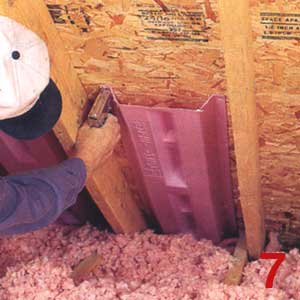
I remember on This Old House them using something like this, to retain air space between the roof and insulation, Attic Baffle

atticinsulationrafve.jpg


attics-08.jpg
 

Steve in Mi

Well-known member
Joined
Mar 13, 2007
Messages
1,042
Location
Mid Michigan
Thanks for the photos that helps clarify things. Just some comments; If your not restricted on height, would there be a problem of adding to the 5' knee walls to give you more head room? Why use a different roof slope on the windows versus the carport? I think it might be interesting to see how a prebuilt truss company would accommodate the 8" requirement in the insulated portion of the rafters. I also wonder if you could satisfy all concerned if you simply glued and screwed (scabbed) 2" strips to the inside edges of the rafters to fit the R-19 and vent space for the approximately five and half feet. In any case the 2 X 8's will get you the venting required and maybe improve the connection at the knee wall (deeper birdsmouth perhaps).

What will you use your workshop for?
 

larry4406

Well-known member
Joined
Jan 27, 2006
Messages
19,057
Location
Northern Virginia
I think it might be interesting to see how a prebuilt truss company would accommodate the 8" requirement in the insulated portion of the rafters. I also wonder if you could satisfy all concerned if you simply glued and screwed (scabbed) 2" strips to the inside edges of the rafters to fit the R-19 and vent space for the approximately five and half feet.

Scabbing a 2x member to the underside of the top chord is exactly what a competent truss manufacturer does in the clipped ceiling portion of an attic truss in order to get adequate depth for insulation.
 

Jaguar Fan

Well-known member
Joined
Mar 13, 2008
Messages
5,507
Location
Park City for Ski Season; Las Vegas for Poker Seas
With the heat in the Sacramento area, and with PG&E's 5 tiers of pricing for electricity, I'm kinda surprised you'd only want to go with R19 in the ceiling. I have a home being built in Las Vegas (way hotter, way dryer) which has much lower electricity costs (near Hoover Dam) yet the developer (40 semi custom homes) is putting in R-48 minimum everywhere.
 

rsanter

Well-known member
Joined
Dec 22, 2007
Messages
18,492
Location
visalia ca
what if you did rigid foam insulation between the rafters that will still allow the airgap they require.
there is a benifit to having airflow. if you have eve vents and ridge vents then you will have the hot air escaping and bieng replaced with cooler air

bob
 

mpraddict

Well-known member
Joined
Jan 28, 2007
Messages
269
Location
Central Ohio
With the heat in the Sacramento area, and with PG&E's 5 tiers of pricing for electricity, I'm kinda surprised you'd only want to go with R19 in the ceiling. I have a home being built in Las Vegas (way hotter, way dryer) which has much lower electricity costs (near Hoover Dam) yet the developer (40 semi custom homes) is putting in R-48 minimum everywhere.

I agree with Jaguar Fan

Regardless of vented or non-vented, with only R-19 in your location, you're either going to have a VERY warm space or VERY high cooling bills.

As far as non-vented attics, the codes are starting to change to accept the spray foam insulation applied directly to the underside of the sheathing. It's basically the same concept as SIPs (structural insulated panels) that've been around for a long time now. Most shingle manufacturer's still will not warranty their shingles for the non-vented situation though.

Knowing what I know, and having worked in the industry for close to 20 years, I'm venting the attic on the garage I'm currently building....
 
OP
W

Will67

Well-known member
Joined
Nov 17, 2006
Messages
852
Location
Hell's half acre
From DOE:

Fiberglass blanket or batt 2.9 to 3.8 (avg. 3.2)

High performance fiber glass blanket or batt 3.7 to 4.3 (avg. 3.8)

Loose-fill fiber glass 2.3 to 2.7 (avg. 2.5)

Loose-fill rock wool 2.7 to 3.0 (avg. 2.8)

Loose-fill cellulose 3.4 to 3.7 (avg. 3.5)

Perlite or vermiculite 2.4 to 3.7 (avg. 2.7)

Expanded polystyrene board 3.6 to 4 (avg. 3.8)

Extruded polystyrene board 4.5 to 5 (avg. 4.8)

Polyisocyanurate board, unfaced 5.6 to 6.3 (avg. 5.8)

Polyisocyanurate board, foil-faced 7

Spray polyurethane foam 5.6 to 6.3 (avg. 5.9)


Yes I do want to go way above R-19 and that led me to the thought of using Spray Foam which seems to have the largest R-value per inch.

When I contacted the County the where not going to allow foam in direct contact with the roof-deck...must have 1" air space.


Steve in MI... What will you use your workshop for?

Downstairs will be for automotive ( I have a 67 camaro aka money-pit) and metal fab, while upstairs will be wood working.
 

6768rogues

Banned
Joined
Nov 28, 2007
Messages
4,524
Location
Western NY
Check with the spray foam manufacturer or distributor. Most good alternative products have a Certificate of Acceptability or something similar to that. It shows that the product has been tested and is approved as an alternate to prescriptive code methods and which code writing entities accept it. If it is acceptable to ICC (International Code Council) it is likely accepted by your local code. Others are SBCC (Southern Building Code Council), ICBO (International Council of Building Officials) or BOCA (Building Officials and Code Administrators).
 
Last edited:

GSSFC

Well-known member
Joined
Apr 13, 2008
Messages
423
Location
Wolfeboro, NH
Check with the spray foam manufacturer or distributor. Most good alternative products have a Certificate of Acceptability or something similar to that. It shows that the product has been tested and is approved as an alternate to prescriptive code methods and which code writing entities accept it. If it is acceptable to ICC (International Code Council) it is likely accepted by your local code. Others are SBCC (Southern Building Code Council), ICBO (International Council of Building Officials) or BOCA (Building Officials and Code Administrators).


Thst is correct. I own a spray foam insulation company, and the hot roof method is approved. It is up to the code inspector to allow it, and he can certainly do so based on test data which supports it. Ventilation will not help or hinder foam insulation, but is a needless added expense. I could rant for hours on this topic!

Tim
 
To avoid these ads, REGISTER NOW!
Top Bottom