To avoid these ads, REGISTER NOW!

Basic garage requirements?

Alistair

Member
Joined
Jan 11, 2006
Messages
20
Location
Herndon, VA
Hey all, I'm new to this garage thing (bought my house a little over a year ago). I should have some time and money to do a "build out" of the garage this summer, so right now I'm trying to figure out what I need, want, etc. And what order to do the work. Etc. The house is in Northern VA (near DC).

It's a standard attached 2-car (20x20ish?). The shared wall is drywalled, as is the ceiling (not open rafters). The other walls are unfinished and uninsulated. The attic space is also uninsulated.

I don't have pictures, but I'm currently using cheap free-standing shelving from HD/Lowes to hold all my camping gear, sports stuff, etc. And a cheap rolling cabinet for my hand tools. It works, but is ugly.

I've gotten used to parking both cars inside (and Laura isn't going to give up her sport without a fight), so using the garage as a "hang-out room" is out of the question.

On to my questions and concerns...
1. What electrical do I need (other than more standard outlets)? I think most smaller welders, fridges, etc will work on standard outlets, as long as I have enough circuits/capacity? Do I need a permit, or inspection if I do the work myself?

2. What lighting is prefered? Do most people use long flourescent lights? Or lots of recessed lamps? Or other options? I currently have two "kitchen" flourescent lights and they are not adequate (especially in the evening).

3. Insulation - regular insulation on the walls, covered with vapor barrier and drywall? What about the attic space - is there "loose" insulation I can blow in (crawl space is limited due to rafter layout)?

4. Air lines - is it common to build hard lines into the walls (covered)? Or leave them exposed? Or through the attic space? I think I'd want at least one air outlet on each side of the garage, and maybe one on the back wall?

5. I'd like a compressor that is large enough to support spraying and grinding (I had a smaller one at a previous house and it constantly ran out of air on longer jobs). What size tank and capacity compressor?

6. I've seen a few pictures of hanging storage solutions - are there commercial/retail solutions, or homemade? Ceiling height is standard, not much space, but would work for smaller, infrequently used items.

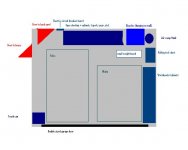
I've attached a simple layout... any suggestions, warnings, comments? I think I can manage to keep two car parking, tools accessible with cars parked, and have a decent layout for weekend projects with one or both cars outside.

 

Attachments

  • DSCN0316.JPG
    DSCN0316.JPG
    165 KB · Views: 406
  • garage-layout.JPG
    garage-layout.JPG
    24.2 KB · Views: 444
To avoid these ads, REGISTER NOW!

Der Bugmeister

Well-known member
Joined
Dec 29, 2005
Messages
445
I think I'd be inclined to exchange the positioning of your workbench and the bicycles/open shelving. With your current setup, accessing the workbench looks like it means moving the Miata out of the garage. Which would you use more frequently - the shelves or the workbench?

Is there room for the bicycles on the wall to the left, near the trashcan?
 

EricVonHa

Well-known member
Joined
Oct 30, 2005
Messages
167
Location
Eastern Pa
Permits--- depends on the local gestapo in your area... plus, think of this.. your homeowner's policy may have an exclusion for "no pay" on a claim which involves non-permitted/inspected work. If your place burns down, and no one inspected it, then you may be on your own. Personally, if you're a good electrician, what the heck, go for it.

Air lines- Personal choice. I'd leave them exposed if it were me due to the ease of troubleshooting any type of leak. Corrosion is a powerful thing over a many year period and I wouldn't want to start tearing apart walls to find a leak.

Air Compressor- I've found that the smallest 220v models are adequate (or the largest 120vac) if you're a weekend automotive hobbyist or use an air gun to blow out the garage or driveway. If you think you're going to do some painting with the compressor-- go with the largest your wallet can buy. Pressure deviations while painting are no bueno.

Also, think on trying to tuck that compressor in a small outbuilding/shed abutted up to the garage. Your peace of mind from not hearing the rumble is worth it!
 
OP
A

Alistair

Member
Joined
Jan 11, 2006
Messages
20
Location
Herndon, VA
The garage is so tight that I've pretty much accepted moving the cars to do any work. As long as I can access my handtools and the most frequently used sports gear, I should be ok. Stuff on the workbench is usually car related, so I probably don't need access when both cars are parked.

Small sacrifice to getting garage-to-garage commuting for both drivers in winter time. In summer, when I'm more likely to have a project underway, leaving the cars outside isn't a big deal.

There's probably room for one or two bikes by the trashcan, I'd just need to make sure the driver has room to open the Volvo's door.

I'll be building a 10x10 (HOA limit, otherwise I'd go larger) or so shed in the backyard for gardening/lawn supplies and mower. I'll probably spring for a power run out to the shed so it will be usable for small yard projects. That will clear out 1/4 of the stuff I have crammed into the garage right now.

I probably won't be doing any high-quality painting - just the occasional beater car body panel.
 

byrdman

Well-known member
Joined
Jan 15, 2005
Messages
308
Location
NC
1. The more the merrier I always say! Your breaker box is in the garage so that'll help. Sounds like you know to watch the total amperage. Figure out what tools you want to run, that'll tell you how many circuits of what capacity you'll need. When you think you have it figured out, add a healthy fudge factor. In most places the homeowner can pull his own wires without a permit. If it was me I'd do it by code to limit potential problems with insurance or resell inspections. To jump ahead to #5, most good compressors are going to require 220. Don't let that scare you, it's no big deal if your box is up to it.

2. You'll get lots of opinions on this one. One thing most folks will agree on is that you should install a LOT. Do some searches, there's been plenty of discussion on this already.

3. I used OSB for durability, but in your situation, I'd use sheetrock. The roll insulation will have the vapor barrier built into it. Select the thickness that matches the depth of your walls, put the barriere towards the living space. Blowin is available for the attic space. You can rent the equipment, or sometimes hstores will loan it to you when you purchse the insulation. It's messy work, some will hire this out. Is this garage heated?

4. I've seen this go both ways. If it's tough to access the attic space, you might consider exposed just for ease of installation. I had good access to my attic space and still chose exposed for ease of access. I think it looks industrious, like it means business! 3 outlets in a 20x20 sounds like a lot, but if you want it, it's not too much!

5. Figure out what tools you want to run first. Based on the CFM requirements of these tools, you can then figure out how much compressor you'll need. "sanding and grinding" is a fairly broad statement. Warning, die grinders and many HVLP guns are air-hungry. If this is what you're after I doubt you'll be happy with a 110V model. When it comes time to pick out a compressor, use CFM@PSI as your primary statistic. Get that right and the other stats will fall into place. There are other features you can mull over obviously, but CFM should be a primary consideration. Big gallon size is false economy if CFM's aren't there. HP figures can easily be inflated.
 
OP
A

Alistair

Member
Joined
Jan 11, 2006
Messages
20
Location
Herndon, VA
byrdman said:
put the barriere towards the living space.

Do you mean the vapor-barrier should face the garage interior? The one shared wall is already insulated/drywalled.

3 outlets in a 20x20 sounds like a lot, but if you want it, it's not too much!

Yeah, it's overkill, but that's half the fun, right?
 
To avoid these ads, REGISTER NOW!

byrdman

Well-known member
Joined
Jan 15, 2005
Messages
308
Location
NC
Overkill, what's that? People said I was crazy for installing 200 amp service in a 1000 sq ft shop. Screw em!

You aren't planning on insulating the shared wall again somehow, are you? When you do the other walls, yes- place the barrier facing the garage interior.
 

JMURiz

Well-known member
Joined
Dec 6, 2005
Messages
1,483
Location
NoVA
I thought you were supposed to figure in the outlets you need...then double them. Looks a whole lot better not having extension chords running all over a garage. I'd say at least one on each side wall (2 prefered) and 2 or more on the back (3 prefered).
I guess this doesn't include the garage door opener etc, right?

I also agree on wiring a 220, I plan on doing this with my new garage, just because it's easier to do it now. Never know if I'll get a welder or lift.
 

oldgoat

Well-known member
Joined
Feb 7, 2006
Messages
4,529
Location
Wichita Kansas
You can't have too many outlets. I put 3 on each side wall and 4 across the front of mine and am thinking that I might have skimped out on that.
 
OP
A

Alistair

Member
Joined
Jan 11, 2006
Messages
20
Location
Herndon, VA
The "three outlets is overkill" comment was in regards to air line, not electrical. I'll def. install two or three outlets per wall and at least one 220v.
 

BowtieNut

Well-known member
Joined
Oct 31, 2005
Messages
138
Location
MN
In my last garage, a 24x28, I put in 5 outlets on each side wall (the 28' walls), and 8 outlets on the back wall by the benches. Oh, and 3 in the ceiling for door opener and retractable extension cords/trouble lights. I definitely don't feel like that was overkill. I only put in one 220V outlet, and later regretted that. I was always having to switch between the compressor and the welder. I originally started with a 110V welder, but that just didn't cut it for me, so I ended up getting a 220 welder. If you think there's any chance that you might some day have both, just put in two 220V now. In my new garage, I put in 3 220V outlets. One for the compressor, one for the welder up by the benches, and one close to the garage door in case I ever need to do some welding out in the driveway.
 
To avoid these ads, REGISTER NOW!
Top Bottom