To avoid these ads, REGISTER NOW!

conduit or not

dragginbalz

Well-known member
Joined
Sep 19, 2005
Messages
197
Location
Illinois
I am hoping to get some opinions on whether or not I should have exposed conduit or enclose the wiring behind the drywall.

Right now the walls and ceiling are bare(insulation only) so either one is an option. My garage is a "working garage" that I want nice , for working on projects but practical! I like the idea of conduit so if I need to add an outlet for something later I can do it with minimal effort. I don't mind the look of the conduit either.

I would just like to hear some pros and cons of each that maybe I haven't thought of.

Thanks in advance

t
 
To avoid these ads, REGISTER NOW!

rodnok1

Well-known member
Joined
Jan 27, 2005
Messages
853
Location
NC
I would put the wiring behind drywall, except for heavy duty single use outlets, like for air compressor or welder. That way you can move those if needed. Conduit gets in the way of cabinets, shelving and wall storage. I would just put in a bunch of outlets now.
 
OP
D

dragginbalz

Well-known member
Joined
Sep 19, 2005
Messages
197
Location
Illinois
This is how many I am planning (now)

click here, layout

I thought about the cabinets, and I think I can work around those pretty easily.

This may be stupid, but I live in an old house. Most of the outlets in the house are very loose from plugging things and unplugging things over the years. Since it is going to be in a workshop, that is bound to happend a lot (pluggin and unplugging) I would hate for the boxes to be loose and not have a good way to re attach them without tearing up the drywall

Then again maybe that is just the crappy wiring in my house

Thanks for the reply

t
 

ron thompson

Member
Joined
Dec 8, 2005
Messages
23
Location
Indiana
I have a block shop with the interior walls drywalled. All of my plugs and switches are inside the walls and all you see is the cover plates. Very clean and neat. Nothing like conduit to collect dust. If I want to add something in the future, I may have to add a piece of conduit or two, but that beats dust collecting conduit everwhere. I think it's a matter of fast and easy or a little more difficult and clean and professional looking. I'd go with wiring in the wall and no exposed conduit.
 

Paradise Ridge

Well-known member
Joined
Dec 8, 2005
Messages
90
Location
North Idaho
I'm paneling my walls with stained t-11 for the bottom 8', so I can unscrew any 4' panel when needed to change/modify the wiring down the road.
Drill a coupe of extra wire run holes in your studs before you button everything up. Makes it a LOT easier to run new romex later if needed.

My nickels worth,

Scott
 

Charles (in GA)

Well-known member
Joined
Jan 11, 2006
Messages
12,489
Location
50 mi south of Atlanta
For a stud wall building that you plan to sheetrock or cover the walls, I'd wire the daylights out of the walls, double boxes everywhere, split circuits and be done with it. Conduit has become expensive with the price of steel going up, and Romex is readily available cheaper than wire on reels that you use with conduit, and the whole thing is a lot less work than bending up conduit and pulling wires.

I have a metal building and I used conduit, did a nice job, but if I had stud walls I'd use romex and passed on the conduit.

Charles
 

bmwpower

Super Moderator
Staff member
Joined
Apr 24, 2005
Messages
12,578
Location
NJ
Behind the drywall. Conduit is more expensive and more work to install. If you absolutely need to add another circuit down the road and you don't want to cut into the walls, use conduit then, but only then.
 

tubeman

Well-known member
Joined
Nov 22, 2005
Messages
144
Location
Houston
I vote for conduit. Its just plain cool looking if done right. Its not that hard to do if you have the benders. I did all mine in 1/2 and 3/4".
 
OP
D

dragginbalz

Well-known member
Joined
Sep 19, 2005
Messages
197
Location
Illinois
well I appreciate all of the comments

I think I am going to stick with the conduit route. I maybe sick, but I like working with it. Something about metal working I can't get enough! It's also good for hanging light stuff from for painting(ceiling).

I am going to plumb exposed piping for the air lines too. so I think with both I may paint the conduit and air lines to add some spice to the otherwise boring white (reflective purposes of course)I plan for the garage.

I should start hanging drywall this weekend and probably won't start the electric for a few weeks. I will certainly post pictures when I get some work done.

Thanks for the info

t
 
To avoid these ads, REGISTER NOW!

Charles (in GA)

Well-known member
Joined
Jan 11, 2006
Messages
12,489
Location
50 mi south of Atlanta
dragginbalz said:
well I appreciate all of the comments

I think I am going to stick with the conduit route. I maybe sick, but I like working with it. Something about metal working I can't get enough! It's also good for hanging light stuff from for painting(ceiling).

I am going to plumb exposed piping for the air lines too. so I think with both I may paint the conduit and air lines to add some spice to the otherwise boring white (reflective purposes of course)I plan for the garage.t

Conduit is galvanize In think. You may have problems getting the paint to stick if not well prepped. I suspect you will quickly become bored trying to paint every inch of the conduit, get it half done, and never finish it. I haven't seen that happen with conduit, but have seen it happen with prulins and red iron in a neighbors building. He got part done painting it white and quit..........

I suspect that after bending up (and wasting a few pieces) of conduit at a couple of bucks a section, plus fittings and steel boxes, plus pulling lube, spools of different wires, kinks in the wire if you don't have someone feeding it, etc. you will get part done and regret not having just nailed the romex to the studs and been finished.......... but I won't say "I told you so" until you are finished........

Charles
 

W-Cummins

Well-known member
Joined
Jan 9, 2006
Messages
1,639
Location
Iowa
If your going to run conduit make sure that you get a surface mounted sub panel to run them out of. If you don't you will have a pain in the *** getting the conduit into the subsurface box. I would get a can w/o the knockouts in it and punch them where needed. Some thing else to watch is that you can't fill the conduit with more than 3 current carring conductors per run w/o de-rating the wires running in it.

William....
 

Charles (in GA)

Well-known member
Joined
Jan 11, 2006
Messages
12,489
Location
50 mi south of Atlanta
W-Cummins said:
Some thing else to watch is that you can't fill the conduit with more than 3 current carring conductors per run w/o de-rating the wires running in it.

William....

I hate to object, but this is a rather blanket statement that doesn't tell the whole story. True, four or more conductors in a single conduit require derating of the wires. It is commonly accepted that #12 wire is 20 amp. well, it is, sorta, because the max Overlload Current Protection Device allowed is 20 amp. However, the wire commonly used in conduit is THHN and that is a 90 degree C rated wire and #12 THHN wire is rated for 30 amps, thus, you have to have more than 9 current carrying wires in a single conduit to cause that #12 THHN wire to be derated to less than 20 amps. Since we were using a 20 amp breaker anyhow (the rule mentioned above on the use of 20 amp breaker on #12 wire), the derating of the wire, in this case hasn't caused us any grief.

For that matter, you also need to derate the wire for "high ambient temp". If the maximinum ambient temperature that the wire will see is greater than 86F degrees, then you also have to start derating for temperature.

Example: We put between 7 and 9 current carrying wires in a conduit. we have sized the conduit so that we meet the fill limits of it. All of the wires are #12 THHN being run for various receptacle circuits in our shop. A #12 THHN wire is rated at 30 amps, derated by mutiplying by .7 (70%) gives us 21 amps. We live in a moderate climate and the temps exceed 86F but do not exceed 95F, so we derate by .96 for the high temps, giving us 20.16 amps. We still protect this circuit with a 20 amp breaker. If we lived in a hotter climate the temp derating would cause us to use 15 amp breakers to protect the circuit.

How does the electrician get away with running open romex wires in the hot attic of your house? Well, even lowly romex #12 wire is rated at 25 amps, and we can go up to 122F before our temp derating takes us below 20 amps.

Again, the best thing to do is have a whole bookshelf of good reference books and the current NEC, when doing any sort of complex wiring job.

Confused? Ask ten electricians the same question and you will get a dozen different answers!

Charles
 

W-Cummins

Well-known member
Joined
Jan 9, 2006
Messages
1,639
Location
Iowa
No objection needed, my statement stands and it totally correct. I'm well aware of the restrictions, (requiring a lower, {less than the wires true current carring capacity} over current protection device on a non table 240.4(g) exempt application circut) that are imposed on the lower (15-30) gauge wires. As well as diffrent ratings of the wire as required due to the various types insulation/jacketing/materals used on the wire. So like I said you HAVE to de-rate the wire if you use more than 3 current carring conductors in the conduit. This can effect you on the 4th wire on some circuts ie. a 8 gauge THHN wire @ 50 amp or on the 7th THWN 12 gauge wire on a 20 amp over current device.

William....
 

iiibdsiil

Well-known member
Joined
Jan 29, 2005
Messages
658
Location
Tampa, FL
Hey guys, can I get a Cliff notes version of that in English?

I vote for behind the drywall. I like clean walls. When you go to hang cabinets up, pictures, etc, you will probably wish you did it in the walls. I think it's just more of a finished look, instead of conduit which makes it look like an after-thought.
 

alankulwicki7

Active member
Joined
Mar 16, 2006
Messages
35
Location
Vadnais Heights, MN
Install it behind the drywall. Like other people have said: it's cleaner and easier to mount cabinets, etc.

I just finished my garage last fall and I hate having to find an outlet so I put one every 4 or 5 feet around the whole garage.

I just like the clean lines of the drywall.....

JMO
 

randii

Member
Joined
Jan 14, 2006
Messages
11
Location
Fair Oaks
Paradise Ridge said:
I'm paneling my walls with stained t-11 for the bottom 8', so I can unscrew any 4' panel when needed to change/modify the wiring down the road.
I'm using a similar approach, but running the 4x8s horizontally instead of vertically. I'm running another set of 4x8s horizontally above that, lipped up to the ceiling, with a gap between filled by a trim-board that hides a belt-line raceway. Can't do this on the house/garage firewall, but this makes everything pretty flexible around the outside of the garage.

Randii
 

Grim Reaper

Well-known member
Joined
Mar 1, 2006
Messages
47
Location
Atlanta
New construction before the dry wall is hung....HANDS DOWN put it in the wall.

From there it just depends on the situation.

My shop has inadequate power. My one garage outlet is shared with the kitchen of my my house. My wife fires up the microwave while I have something with a good power draw and we are popping the breaker. I'm about to drop a sub panel in to fix the problem.

I wish I could fish the stuff into the walls in my garage but its just to much hassle. Roof over the garage is too low to get around in the attic to get to the perimeter walls. So short of cutting a bunch of holes in the wall to get the drill in to get a hole in the top plate to fish the romex through I am just screwed. I really don't care for the exposed conduit....its just another nook and cranny for dirt to collect but I sure don't want to have to make 10 or more holes in the wall I have to patch so I can drill the top plate.
 

ovilla

Well-known member
Joined
Dec 18, 2005
Messages
2,342
Location
Plainfield, IL
Just my .02. Conduit is just plain safer. If your wires were to ever melt, the fire would at least be contained within the pipe and the pipe would never ignite your insulation. With conduit behind drywall you can also put nails/screws through your drywall without ever having to worry about hitting a LIVE wire. If you ever have a short in your wiring, the conduit is there to carry the current back to the circuit panel and then back to mother earth. If you ever have to open up walls a stud finder will also easily find the conduit behind the walls (good look finding romex). Running wires is made easy with the use of a fish tape so there's no need ever grease up your wires. Also, buying a conduit bender, a pipe cutter, and fish tape is not that expensive and you'll be ready for future projects. Plus, you have to admit that these are cool tools to own (don't you just love when people ask what in the heck a certain tool is for?) Finally, if your circuit panel box is in the garage and going to be covered by drywall, just go ahead and tap all of the openings on top of the panel and run a small piece of conduit into the garage attic. This will allow for easy expansion of your outlets down the road as you already have a connection to the panel box.
 

ureside

Well-known member
Joined
Feb 11, 2006
Messages
80
Location
Bedford, TX
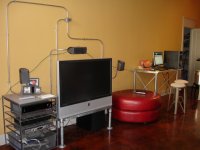
look what i did with my conduit :) I made that tv stand and the desk the computer is on too :)
 

Attachments

  • DSC01623.jpg
    DSC01623.jpg
    137 KB · Views: 100
  • DSC01629.jpg
    DSC01629.jpg
    146.8 KB · Views: 92

tubeman

Well-known member
Joined
Nov 22, 2005
Messages
144
Location
Houston
look what i did with my conduit I made that tv stand and the desk the computer is on too

Attached Images

__________________
I like it!
 

gdf_77

Well-known member
Joined
Mar 26, 2006
Messages
54
Location
farmersburg, iowa
when i get my shop built(hopefully) this year, i'll run everything in pvc. its easy to work with, no special tools, just some good planning and some glue. i'll run to runs along the wall, one slightly above work bench height and the other above cabinet height. a couple of runs on the ceiling for the lights. have a receptacle less than every 10' ( I think code maybe less than that) that way no couplers. have the lightswitches with waterproof covers, and the recepts with flip down covers that cover a cord when its plugged in. oversize everything, that way adding circuits, not just receptacles is easier. but thats just mo
 
To avoid these ads, REGISTER NOW!
Top Bottom