I am helping my mother-in-law with a few issues in her home, and when I opened up the electrical panel to shut off a circuit for a light fixture replacement, it was a mess.
Three things confused me, and I wanted to bounce my questions off the folks who do more electrical work than me.
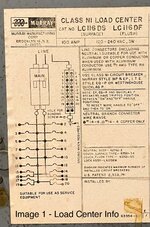
It's a surface mount single phase 100A Murray load center (model LC116DS). 16 spaces, 20 circuits. I'm attaching a photo of the panel info sheet as Image 1.
These are the things I did not understand:
1) Slot 1 contains a tandem 15A breaker. That seems like a problem since the panel electrical diagram shows that as a single breaker position.
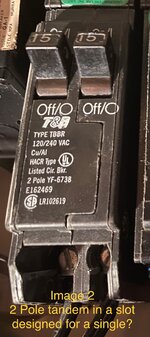
2) When I read the label on the tandem breaker in slot 1, it claims to be a 2-pole breaker? The breaker is a Thomas & Betts type TBBR and it lists "2 pole YF-6738" on the label. I attached a photo as Image 2. Both sides of this breaker feed separate 120V lighting and convenience outlet circuits in second floor bedrooms. If this is really a 2-pole breaker, I expected it to feed two hot legs to a 240V appliance or HVAC unit.
3) Slots 11 and 13/15 contain tandem 20A Bryant BRD breakers. The four attached wires (two red, two black) feed a single 240V in-wall A/C unit in her living room. Here again, slot 11 does not appear to be designed for a tandem. And I don't understand the use of two tandems to separately switch four hot wires instead of a standard 2-pole breaker and two hot wires. I am attaching a photo as Image 3.
Also, there are four slots in the panel (13/15, 17/19, 14/16 and 18/20)that are designed for tandem breakers, so the three tandems could have been accommodated in designated slots. Why would someone have put two of the tandems into slots that we not designed for them?
Is splitting a "2 pole" breaker and using the two hots separately a common thing (like they appeared to have done in Slot 1)?
What's up with the dual tandem breakers in slots 11 and 13/15? Shouldn't that just be a standard 2-pole breaker rated for the A/C unit?
I did successfully change the ceiling light fixture that I went there to do. Those of you with more electrical experience than me may say this is all normal. If so, great. If not, I want to know what I'm getting mom into when I call in an electrician.
Many thanks to anyone who can educate me on this. I appreciate your time and sharing of knowledge!
Tim
Three things confused me, and I wanted to bounce my questions off the folks who do more electrical work than me.
It's a surface mount single phase 100A Murray load center (model LC116DS). 16 spaces, 20 circuits. I'm attaching a photo of the panel info sheet as Image 1.
These are the things I did not understand:
1) Slot 1 contains a tandem 15A breaker. That seems like a problem since the panel electrical diagram shows that as a single breaker position.
2) When I read the label on the tandem breaker in slot 1, it claims to be a 2-pole breaker? The breaker is a Thomas & Betts type TBBR and it lists "2 pole YF-6738" on the label. I attached a photo as Image 2. Both sides of this breaker feed separate 120V lighting and convenience outlet circuits in second floor bedrooms. If this is really a 2-pole breaker, I expected it to feed two hot legs to a 240V appliance or HVAC unit.
3) Slots 11 and 13/15 contain tandem 20A Bryant BRD breakers. The four attached wires (two red, two black) feed a single 240V in-wall A/C unit in her living room. Here again, slot 11 does not appear to be designed for a tandem. And I don't understand the use of two tandems to separately switch four hot wires instead of a standard 2-pole breaker and two hot wires. I am attaching a photo as Image 3.
Also, there are four slots in the panel (13/15, 17/19, 14/16 and 18/20)that are designed for tandem breakers, so the three tandems could have been accommodated in designated slots. Why would someone have put two of the tandems into slots that we not designed for them?
Is splitting a "2 pole" breaker and using the two hots separately a common thing (like they appeared to have done in Slot 1)?
What's up with the dual tandem breakers in slots 11 and 13/15? Shouldn't that just be a standard 2-pole breaker rated for the A/C unit?
I did successfully change the ceiling light fixture that I went there to do. Those of you with more electrical experience than me may say this is all normal. If so, great. If not, I want to know what I'm getting mom into when I call in an electrician.
Many thanks to anyone who can educate me on this. I appreciate your time and sharing of knowledge!
Tim