To avoid these ads, REGISTER NOW!

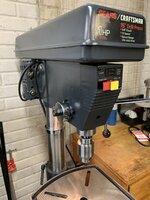
Craftsman 150 Drill Press, How to Correct Runout?

slowbutsure

New member
Joined
Oct 14, 2021
Messages
4
What is needed to correct runout in a Craftsman Floor Model No. 113.213150 Drill Press? Its a 1 HP, 15 inch, 12 speed model from the early 1990's. Drill bits have always wobbled, the larger the bit - the more the wobble. Using a dial indicator, the variance on the outside of the bottom of the spindle is .0005. Which seems to me to be quite good. The variance with the 30 year old 5/8ths inch chuck is .007 at 1 inch below the chuck. Bought a new Jacobs 34-33 1/2" chuck and the variance is .003 just below the chuck. However, when putting a larger bit in the new chuck, it wobbles as much as as a large bit in the old chuck. The drill press has always had a vibration - I should have dealt with it years ago, but wasn't doing anything more than drill wood at the time. Could the boring for the No 2 Morse taper be off? Has anyone dealt with this? Thanks.
 
To avoid these ads, REGISTER NOW!

Maui

Well-known member
Joined
Sep 16, 2012
Messages
2,918
Location
Upstate NY
It could be caused by worn bearings on the spindle shaft, an improper seating of the Jacobs taper in the end of the chuck, or some other factors. I would suggest measuring the runout on the spindle shaft itself, and then move forward from there.
 
OP
S

slowbutsure

New member
Joined
Oct 14, 2021
Messages
4
Thanks! Measured the runout on the JT33 end of the chuck arbor. It was .0005 on my Last Word while hand turning. When the chuck is put on and small or large drill bits are inserted, anything in the new Jacobs chuck goes to .007. Ordering new spindle bearings today.
Will put the dial indicator on the motor shaft and check pulleys for trueness and alignment as well. The machine has always had a vibration.
 

Davefr

Well-known member
Joined
Jan 7, 2010
Messages
11,901
Location
OR
The further down you measure from the spindle, the greater the runout. Can you index the chuck? (ie cancel out some of the overall runout by mounting the chuck so that the chucks normal runout cancels out some of the spindles normal runout). Pick the mounting position where you get the least runout if possible.

Using drill bit is not a good way to measure runout. Using quality drill blanks would be better.

Your number of .007 isn't that bad if measuring from a bit

As far as vibration, does your DP have the original belt? An old V belt can get a set and cause abnormal vibration. You might want to try a fresh cogged style V belt or maybe a link belt.
 
To avoid these ads, REGISTER NOW!

Maui

Well-known member
Joined
Sep 16, 2012
Messages
2,918
Location
Upstate NY
Instead of using a drill bit to check runout I would typically use a hardened ground pin. Exactly what is the method that you are you are using to attach the drill chuck to the spindle? If the chuck is not squarely seated in the Jacobs taper it will exhibit runout like you are describing.

If you have a vibration problem that can be caused by a wonky belt like Dave mentioned or by a pulley on the drive shaft of the motor that was shimmed incorrectly or is not properly balanced.
 
OP
S

slowbutsure

New member
Joined
Oct 14, 2021
Messages
4
Final report on 1991 Sears floor model drill press. After completing my project, the runout as measured on the machined surface of a forstner bit, 1 & 1/2” below the chuck was a somewhat astonishing and very satisfying .001”. This measured by both a Starrett dial indicator and my Starrett Last Word and by hand turning the spindle.
When I started, the machine had quite a bit of vibration. To my chagrin, some of this was caused by my failure to completely tighten the left sign thumbscrew on the belt tightener. Seems I’ve only been tightening the right side thumbscrew for about the last 20 years. Other sources of vibration were thought to be the belts, idler pulley mount, chuck, spindle bearings.
New Mitsubishi belts were installed along with a new Jacob’s 34-33c chuck and arbor with J-33 taper. New spindle bearings from Fremont Industrial Supply also installed. The idler pulley danced around quite a bit, but the pulley bearings looked to be ok. It turned out the hole in the drill press casting was not round - it was shimmed with a piece of .005” brass. The spindle pulley was shimmed up to align with the other two pulleys using a double thickness of tin-foil in between the pulley & the taper. In addition, the quill set screw was better adjusted & rubber washers were used on the machine screws for the belt guard assembly. The drill press is substantially more quiet than in the past.
 

Attachments

  • C5920BC8-8602-464F-ADC2-97513AC3FD5C.jpeg
    C5920BC8-8602-464F-ADC2-97513AC3FD5C.jpeg
    200.9 KB · Views: 45
  • 06139A76-E390-449C-84C6-A31105C62D36.jpeg
    06139A76-E390-449C-84C6-A31105C62D36.jpeg
    262.9 KB · Views: 44
  • C266D5EC-443E-4C54-9C14-E68A76B87F75.jpeg
    C266D5EC-443E-4C54-9C14-E68A76B87F75.jpeg
    304.2 KB · Views: 45
  • 6251E91A-F0A1-4557-B7DA-C88295F27389.jpeg
    6251E91A-F0A1-4557-B7DA-C88295F27389.jpeg
    271.3 KB · Views: 39

Jim C.

Well-known member
Joined
Jan 8, 2010
Messages
2,600
I guess the only thing I might add is to make sure all three jaws are tightened with approximately the same torque when inserting any drill bit into the chuck. Sometimes there‘s a tendency to insert the drill bit, tighten one jaw and start drilling. That can add to the wobble of a turning drill bit. I suspect that everyone here already knows that. I’ll admit that someone pointed it out to me once and it noticeably helped eliminate the wobble.

Jim C.
 

MShaw

Well-known member
Joined
Mar 2, 2015
Messages
1,016
Location
York, Pa.
I have the same drill press. The 5/8" chuck that came with it was absolute junk. I bought a new Jacobs 1/2" chuck that was much better.
 

RichGrim

New member
Joined
Sep 22, 2015
Messages
1
I have the same DP and am looking to do the same. Any reason for going with the new 1/2" over the 5/8" Jacobs ?
 
To avoid these ads, REGISTER NOW!
Top Bottom