
You are using an out of date browser. It may not display this or other websites correctly.
You should upgrade or use an alternative browser.
You should upgrade or use an alternative browser.
digital multimeter...........
- Thread starter joelee
- Start date
Basskiller
Well-known member
I use Fluke and uei
WSMC633
Well-known member
I've always like my Fluke's a lot.
GeorgiaHybrid
Well-known member
I use a Fluke 88V but I just got a new Snap-on Modis that might take over some of these duties when it is hooked up.
Teken
Well-known member
Fluke has set the standard for accuracy, safety, reliability, warranty, along with customer satisfaction . . .
I use the whole gammet from scope, to clamp-on meters . . . Now, price is all another matter . . .
I use the whole gammet from scope, to clamp-on meters . . . Now, price is all another matter . . .
oldwino
ALLIANCE MEMBER
fluke 85 here...you can depend on it!
Iroc-Z
Well-known member
I picked up a Matco one for 85 bucks. Great for everything I need it to do. I think Flukes are good but over priced due to there name.
wellstig1
Well-known member
If using one for a living such as auto diagnostic work go for this, nothing better.
http://www.etooldirect.com/manufact...it-automotive-meter-combo-kit-multimeter.html
If its occasional usage at home just get cheapie ~$40 multimeter
My most used tool for auto electric work is this
http://www.etooldirect.com/manufact...lt-in-voltmeter-power-probe-iii-pp319ftc.html
http://www.etooldirect.com/manufact...r-probe-master-gold-series-test-lead-set.html
http://www.etooldirect.com/manufact...it-automotive-meter-combo-kit-multimeter.html
If its occasional usage at home just get cheapie ~$40 multimeter
My most used tool for auto electric work is this
http://www.etooldirect.com/manufact...lt-in-voltmeter-power-probe-iii-pp319ftc.html
http://www.etooldirect.com/manufact...r-probe-master-gold-series-test-lead-set.html
rockchucker
Well-known member
I have used a Sears special for the last 15+ years. Works just fine for automotive small stuff. Still works. I have blown the fuse a number of times. That is why it is there. Every time I say "Won't do that again...". Wouldn't bet my life on it's accuracy but at 40 bucks 15+ years ago I think I have used it's worth. Bought it in HVAC School right out of High School. Heard about it from one of the best Old Dude Teachers I have known. Peter Martens.
OHM'ing an Injector for a Nissan 300ZX...

She gets used. I do keep an extra $20 one on hand in case she fails me though.
OHM'ing an Injector for a Nissan 300ZX...
She gets used. I do keep an extra $20 one on hand in case she fails me though.
Last edited:
Diesel_Crawler
Well-known member
Fluke here.
engineer2
Well-known member
Here is a cool video:
http://www.gossenmetrawatt.com/english/seiten/cautiondangerousmultimeters.htm
Apparently some multimeters are not safe for high voltage testing, something the average consumer is unlikely to encounter. The contacts on the rotary switch are too close and arc over at high voltages causing meltdown.
BTW I have an older Sperry DMM - horrible response time and short battery life. My $10 Sears DMM is better.
The advantage of Fluke is they make their own specialized IC chips for DMMs.
http://www.gossenmetrawatt.com/english/seiten/cautiondangerousmultimeters.htm
Apparently some multimeters are not safe for high voltage testing, something the average consumer is unlikely to encounter. The contacts on the rotary switch are too close and arc over at high voltages causing meltdown.
BTW I have an older Sperry DMM - horrible response time and short battery life. My $10 Sears DMM is better.
The advantage of Fluke is they make their own specialized IC chips for DMMs.
Last edited:
TheGrooveking
Well-known member
Have many, but my main go to is my old Beckman HD110, it's been dropped from 15 feet on to the concrete and has lived through it. It's waterproof and has taken a hell of a beating but it always works. Beckman is now Wavetek, they meters are as good as Fluke.
TheGrooveking
TheGrooveking
Gary S
Well-known member
Get yourself one good one like a Fluke, and then pick up a half dozen of the $3 Harbor Freight ones too. Put the Fluke in a safe place where it won't get broken and use it only if you need truly calibrated accuracy. Put one cheap one in each tool box and also in each vehicle you own so you have one available anywhere you might be.
Then when you are bored, compare the readings of the $3 one with the high priced one and you will most likely find them to be within 1% of each other.
Then when you are bored, compare the readings of the $3 one with the high priced one and you will most likely find them to be within 1% of each other.
crewchief888
Well-known member
fluke at work, OTC in the garage

Adam McLaughlin
Well-known member
Fluke 77 or 87; either one will do your Auto related things.
Adam
Adam
petty4243
Well-known member
i have a bluepoint mt586 at work and at home, both awsome, prior to that i used a sears craftsman i bought at kmart for 25 bucks.... nothing wrong with it, just got a great deal on the blue points and they have a lot more specialty functions..... if you are looking for pro use, fluke, ES and bluepoint top the list, for home, craftsman or radioshack will be more than adequate and i have a few i could offer up
tatra
Well-known member
remeber a salesman came into work and was trying to sell beckmans to the boss..........cheap old ******* that he was just about crapped when told the price........asked why on earth he would pay that much for a meter.........salesman winds up and chucks at a wall across a pit , it bounces off the waall, down into the pit....guy at the other end comes and chucks it back up on to the mezz and the salesman hands it to the boss and says now use it for a week and tell how many ya want......we bought ten or so later...........got an otc myself and the one thing i absolutly hate is having to remove screws to change out the battery.........fluke will probably be my next one...........
i own the fluke 87-V and i love it, other students at school wonder why i spent so much on it but if im going to be using it daily to make a living, to me its worth it for the quality, accuracy, and lifetime warranty. if you want the best get a fluke but if you want something that'll work and work good you could always get one of the meters off the trucks, matco, snap on, mac. one of my buddies has a matco he paid less than 150 bucks for
Steve from Socal
Well-known member
I have a Fluke 87 also but, for home hobby use on DC you could buy a far less complex meter. Just remember that many inexpensive meters are not what I would choose to stick into a 480V circuit to test live. For low voltage <120V and lower just about anything would work, read the specs on the meter to learn the accuracy, they are not all the same.
Steve
Steve
Fedwrench
ALLIANCE MEMBER
Fluke is good but, many other companies have gotten as good. Check out the meters from Electronic Specialties Inc or ESI. Excellent performance at a fraction of the cost.
We just bought a Snap on Hybrid DVOM at work and I'm disappointed in it. It's bulky. It shuts itself off quickly which is a pain when doing parasitic draw tests. The test leads are **** and were quickly replaced with Fluke versions. The meter itself is made in South Korea. I think the thing that pissed me off the most was that it came in a thin white cardboard box. There was no carrying case. Almost every other DVOM sold by any other tool truck comes with a protective plastic or nylon storage case.
We just bought a Snap on Hybrid DVOM at work and I'm disappointed in it. It's bulky. It shuts itself off quickly which is a pain when doing parasitic draw tests. The test leads are **** and were quickly replaced with Fluke versions. The meter itself is made in South Korea. I think the thing that pissed me off the most was that it came in a thin white cardboard box. There was no carrying case. Almost every other DVOM sold by any other tool truck comes with a protective plastic or nylon storage case.
bmxr4life87
Well-known member
I've got a matco mdtechplus that my dealer should have on monday I'm excited as it will do anything I've ever needed from a meter plus it comes with all the attatchments required such as temp probe and inductive pickup plus its supposed to come with a nylon pouch to keep it all together I've been told its a rebranded otc but regardless I'm excited about it cause it seemed less complicated than a fluke
Busted_Knuckles
Well-known member
I see the Fluke 87 is popular, not sure how I wound up with the 88 Model, I thought the 88 was the automotive meter from fluke? Anyhow, I bought mine new, use it weekly if not daily, and like it, Ive used other techs from time to time, and found that I really like mine after using others. This is what I found online about my meter:
The Fluke 88V has improved measurement functions, trouble-shooting features and accuracy to solve more problems on conventional and hybrid vehicles. The 88V is the most powerful automotive multimeter Fluke has ever offered. In addition to having all standard multimeter features like the ability to measure voltage, current, continuity, and resistance, the 88V can perform diode test and pulse width measurements.
This meter can take current measurements up to 20A for 30 seconds and 10A continuously. The optional magnetic hanger lets you attach the meter to almost any steel surface for easy set-up and viewing. The 88V is designed to be used in high energy environments like those found on hybrid vehicles.
The Fluke 88V has improved measurement functions, trouble-shooting features and accuracy to solve more problems on conventional and hybrid vehicles. The 88V is the most powerful automotive multimeter Fluke has ever offered. In addition to having all standard multimeter features like the ability to measure voltage, current, continuity, and resistance, the 88V can perform diode test and pulse width measurements.
This meter can take current measurements up to 20A for 30 seconds and 10A continuously. The optional magnetic hanger lets you attach the meter to almost any steel surface for easy set-up and viewing. The 88V is designed to be used in high energy environments like those found on hybrid vehicles.
I see the Fluke 87 is popular, not sure how I wound up with the 88 Model, I thought the 88 was the automotive meter from fluke?
The 88 series meter is for automotive. The 87 is an industrial meter.
Teken
Well-known member
The 88 series meter is for automotive. The 87 is an industrial meter.

caper
Well-known member
For some of you guys using Fluke meters,make sure yours isn't on the recall list:
http://ca.fluke.com/Fluke/caen/support/safety/default.htm
http://ca.fluke.com/Fluke/caen/support/safety/default.htm
Teken
Well-known member
For some of you guys using Fluke meters,make sure yours isn't on the recall list:
http://ca.fluke.com/Fluke/caen/support/safety/default.htm
You scared me with that recall link. Because I just bought a Fluke ACII line testor off of E-Bay!
Mine wasn't on the recall list as its the newer model with the heart beat etc. Thanks for the information regardless!
watsong
Member
Fluke 88V at work. Worth the price in my opinion; use it all the time and rely on it to be accurate. Cheap radio shack one around the house, if that ever craps out, i'll get a ESI. But the cheapie has been left out in the rain overnight and after taking the case apart and allowing to dry, turned on and is still ticking.
I'm still a tech. student, but for about 90% of things, I think you can get away with a good pocket meter. I've got this one,
http://buy1.snapon.com/catalog/item...&group_ID=1369&store=snapon-store&dir=catalog
Does anyone else like a good pocket meter? Or haven any experience with the Blue Point one?
I think it should also be mentioned that analog meters may still have a place in a toolbox. Analog meters respond instantly, with the smallest of needle deflection, and they more readily illustrate trends in a system.
http://buy1.snapon.com/catalog/item...&group_ID=1369&store=snapon-store&dir=catalog
Does anyone else like a good pocket meter? Or haven any experience with the Blue Point one?
I think it should also be mentioned that analog meters may still have a place in a toolbox. Analog meters respond instantly, with the smallest of needle deflection, and they more readily illustrate trends in a system.
HF has a nice automotive meter for $34 I'm tempted to buy with a 20% off coupon even though I have plenty of meters around. It has a large display with a tilt so its easy to read, and include a tach and temp probes. http://www.harborfreight.com/cpi/ctaf/displayitem.taf?Itemnumber=95670
I carried an old B&K for maybe twenty years, but about 6 months ago something in my tool bag slide the power switch to on and the stinking Kodak lithium 9v battery swelled up and broke the case as it discharged.
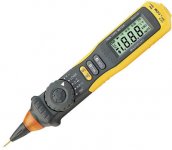
My most used currently is an older version MS3211D of this Mastech MS8211 pen dmm, http://www.amazon.com/dp/B000QE4EPW/?tag=atomicindus08-20
What ever you get, plan on spending some money for longer leads, bigger alligator clamps, and pins for back probing connectors.
I carried an old B&K for maybe twenty years, but about 6 months ago something in my tool bag slide the power switch to on and the stinking Kodak lithium 9v battery swelled up and broke the case as it discharged.
My most used currently is an older version MS3211D of this Mastech MS8211 pen dmm, http://www.amazon.com/dp/B000QE4EPW/?tag=atomicindus08-20
What ever you get, plan on spending some money for longer leads, bigger alligator clamps, and pins for back probing connectors.
Attachments
I'm still a tech. student, but for about 90% of things, I think you can get away with a good pocket meter. I've got this one,
http://buy1.snapon.com/catalog/item...&group_ID=1369&store=snapon-store&dir=catalog
Does anyone else like a good pocket meter? Or haven any experience with the Blue Point one?
I think it should also be mentioned that analog meters may still have a place in a toolbox. Analog meters respond instantly, with the smallest of needle deflection, and they more readily illustrate trends in a system.
IMO, Analog meters have been replaced by graphing multimeters or digital O-scopes. In fact, I picked up a second Snap-on Vantage (graphing meter) from ebay for what that pocket meter costs from snap-on. It'll do 99% of what a meter like a fluke 87 will do, and it can graph trends over time from 5ms to 20 hours.
Personally, I reach for one of three tools depending on the job. Quick simple checks like installing wiring, I use a powerprobe 3, which can also supply power/ground to a circut, along with checking continuity, voltage, ground, etc. If I'm getting into measurements, or need to check sensors, I pull out my Vantage (got one with v5 software for home use, and one with v6 software for the shop). For the real head scratchers, I've got a Vantage Pro, with all of the secondary ignition goodies, low amp probe, etc. Of course it's overkill for most uses, but when you see what you can do with it, you can't live without a scope of some sort.
After getting the Vantage units, and the Vantage Pro, my Fluke 179 sits unused in the bottom drawer of my toolbox as a loaner now...
Since I do industrial stuff for a living, Fluke 111 and T5-1000 for me. The 111 isn't Cat4 600V or Cat3 1000V rated, so it's my home shop meter now - replacing the $10 HF multimeter previously used for auto electrical testing and checking to see if an outlet is live 
Tim D.
Tim D.
Last edited:
I use a $30 Harbor Freight model. It is not any less accurate than any Fluke I have ever tried. What I usually do is take a 2 foot piece of 14 gauge wire and ohm it with both meters. Always get the same readings. Then I will cut the strands of wire in the center till there is just one tiny strand keeping the wire togather and I will re ohm the wire. I always get the same reading on both meters which is always the same reading I got on the wire before I cut it. If I ever find a meter that accurately shows that there is in fact more resistance when only one tiny strand of wire is holding it togather then I will upgrade.
Fubar
Well-known member
I use a Fluke 88V but I just got a new Snap-on Modis that might take over some of these duties when it is hooked up.
You'll like it. I went from the Vantage to the Modis, and now have the Verus. Same internal meter, but I've used it a lot.
caper
Well-known member
I'm still a tech. student, but for about 90% of things, I think you can get away with a good pocket meter.
The problem with pocket meters is that the leads are too short for easy use and most are hard wired in so they can't be easily replaced.Leads need to be a couple feet long.12" of lead is way too annoying to work with for any length of time.
I use a $30 Harbor Freight model. It is not any less accurate than any Fluke I have ever tried. What I usually do is take a 2 foot piece of 14 gauge wire and ohm it with both meters. Always get the same readings. Then I will cut the strands of wire in the center till there is just one tiny strand keeping the wire togather and I will re ohm the wire. I always get the same reading on both meters which is always the same reading I got on the wire before I cut it. If I ever find a meter that accurately shows that there is in fact more resistance when only one tiny strand of wire is holding it togather then I will upgrade.
Measuring low ohms can be tricky, contact resistance, or your own body if you use your fingers to hold the wires to the probes.
I use a $30 Harbor Freight model. It is not any less accurate than any Fluke I have ever tried. What I usually do is take a 2 foot piece of 14 gauge wire and ohm it with both meters. Always get the same readings. Then I will cut the strands of wire in the center till there is just one tiny strand keeping the wire togather and I will re ohm the wire. I always get the same reading on both meters which is always the same reading I got on the wire before I cut it. If I ever find a meter that accurately shows that there is in fact more resistance when only one tiny strand of wire is holding it togather then I will upgrade.
By cutting the strands, you aren't changing the resistance of the wire, just the ability of the wire to carry current. Your test will never show the difference you are looking for.