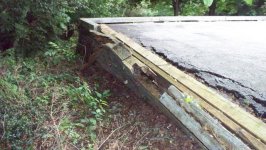
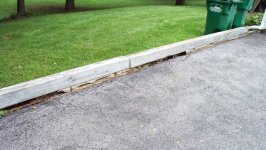
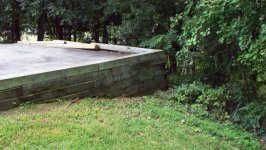
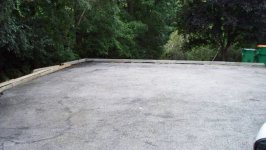
I have a wooden retaining wall that keeps my driveway together. The wood is rotting and I suspect the whole thing needs to be replaced - though I'd like to avoid redoing the driveway if possible. Can I just remove the wood and replace it with new 6x6's, or will the whole thing come crashing down? If I hire a pro - anybody have any guesses what it should cost?


You are using an out of date browser. It may not display this or other websites correctly.
You should upgrade or use an alternative browser.
You should upgrade or use an alternative browser.
Failing Retaining Wall
- Thread starter mikeatrpi
- Start date
dittle fart around
Well-known member
For the retaining wall to support the weight of the fill, the asphalt and the vehicle it should have been built with supports that go back into the fill under the driveway. You could support it from the outside of the 6X6's with a post cemented into the ground like a fence post every 8 feet or so. Use treated lumber or it's just going to rot out again.
NitroPress
Well-known member
Work fast so that there's no time for rain or soft fill to cause subsidence, maybe by sections unless you have all the materials on hand and some help, and brace the **** out of the new timbers from outside.
AR-Trvlr
Well-known member
Use treated lumber or it's just going to rot out again.
Treated wood just means it will take longer to rot out, but it will still rot.
To do it right will be expensive - you'd need to cut the asphalt back, over-excavate, and rebuild using a permanent material. If it were me I'd go with one of the unit-block walls (keystone or similar) but poured concrete or a CMU wall would work as well.
Your talking about a deadman from the inside to hold the wall from bowing out. The only way to keep the driveway from caving is to install a wall out and away from the driveway. Then back fill it with class 2 and pack in under the pavement as you work your way up to level with the wall. If you go tight to the driveway, you won't be able to backfill it.
ansehnlich1
Member
- Joined
- Jun 8, 2008
- Messages
- 20
Your talking about a deadman from the inside to hold the wall from bowing out. The only way to keep the driveway from caving is to install a wall out and away from the driveway. Then back fill it with class 2 and pack in under the pavement as you work your way up to level with the wall. If you go tight to the driveway, you won't be able to backfill it.
Yeah this is what I was thinking. Build the new retaining wall away from the exisiting retaining wall, then fill and patch. It appears if you remove that current lumber you'll compromise the driveway foundation.
No... I still suggest moving the old wall... You just can't remove the old wall and drive on that section of driveway until you pack it again. The new wall I would put in would be 8 inches taller than the height it is at now.
This is speaking as a professional landscaper.
This is speaking as a professional landscaper.
Do you have anybody in your area that does sea walls?
They repair them all the time.
In your case new wood held in place with long “dirt screws.”
(For lack of a better term. I don’t remember what they are called.)
They will replace the bottom row or three, drive the screws horizontally under the slab, finish building the wall, then bolt wood uprights or use large washers on the ends of the screws.
While they are there it wouldn’t hurt to have them go around the whole thing.
They repair them all the time.
In your case new wood held in place with long “dirt screws.”
(For lack of a better term. I don’t remember what they are called.)
They will replace the bottom row or three, drive the screws horizontally under the slab, finish building the wall, then bolt wood uprights or use large washers on the ends of the screws.
While they are there it wouldn’t hurt to have them go around the whole thing.
buening
Well-known member
To do it correct, I would agree that you'd remove the wall after excavating behind it. Just removing the wall and working quickly may or may not work depending on what material is behind the wall. If it is a dry sand, once you remove the wall it will likely just run out. Since the area is above the ground level you may not have much saturation in the sand. Think dry vs wet sand castles. A cohesive soil like clay would give you more time to work and would be self standing for a little while. You may need to do a test dig to determine the soil down there.
If you are on the cheap, you can build a wall in front of the existing wall in any material you like and it will still work fine. The new wall must be able to support the soil as if the existing wall was not in place. As mentioned above, a landscaping block wall or cinder block (CMU) wall would work well, but you could even get by with using the 6x6 as originally used as long as you use the proper staking. Stacking them in place without stakes/anchors will not work! Once the new wall is in place, just remove the top timbers that are bad of the existing wall put compacted aggregate down. If the top timber is still in good shape, still remove just that one so that you can add the aggregate....otherwise this timber will show and give the look of a double wall. You can then pave over the rock or just leave the rock as "trim" or a shoulder.
Leaving the existing wall does have potential risks, as further deterioration will cause settling in those areas. You may find yourself adding more rock or asphalt in these areas to build it back up every few years. Structurally, I see no risks in leaving the existing wall in place.
Also, from the pictures it appears like the tallest part of the wall is in good shape and the sides (shorter height) are the deteriorated part. You may be able to just replace those bad timbers on the side, since they don't have much retained height.
If you are on the cheap, you can build a wall in front of the existing wall in any material you like and it will still work fine. The new wall must be able to support the soil as if the existing wall was not in place. As mentioned above, a landscaping block wall or cinder block (CMU) wall would work well, but you could even get by with using the 6x6 as originally used as long as you use the proper staking. Stacking them in place without stakes/anchors will not work! Once the new wall is in place, just remove the top timbers that are bad of the existing wall put compacted aggregate down. If the top timber is still in good shape, still remove just that one so that you can add the aggregate....otherwise this timber will show and give the look of a double wall. You can then pave over the rock or just leave the rock as "trim" or a shoulder.
Leaving the existing wall does have potential risks, as further deterioration will cause settling in those areas. You may find yourself adding more rock or asphalt in these areas to build it back up every few years. Structurally, I see no risks in leaving the existing wall in place.
Also, from the pictures it appears like the tallest part of the wall is in good shape and the sides (shorter height) are the deteriorated part. You may be able to just replace those bad timbers on the side, since they don't have much retained height.
Ron Lombardo
Well-known member
See if anyone in your area has clean fill / dirt / soil and backfill all around and slope the grade from the driveway out and forget the wall ...
Ron
Ron
cyamaha2007
Well-known member
i would rip out what i could then back fill it. That is if you have room for a big burm.
I'd make sure you add some drainage behind it when you replace it.
gumbudah
Well-known member
One process you could use:
1. Remove top two courses of existing wall where it is in good shape. On the side that has fallen over, remove the entire wall.
2. Dig a 6 inch deep trench just ouside of the wall, or outside of where the old wall was.
3. Build your new wall with timbers outside of the old one taking care to pin each timber to the ones below.
4. Once you have your full height acheived, excavate 5' deep holes every 8' around the outside permiter large enough to place another 6x6 into vertically. Place the vertical 6x6s and pin them to the new wall.
5. on the inside of the new wall there shoudl be a 6" gap between it and the pavement where the old wall was. Fill it with gravel, and place a row of 8" wide patio block all the way arouund the permeter. On the side that has failed badly, I'd go back to good asphault with however many rows wide of pavers that are needed.
This plan doesn't address drainage behind the wall, but that could probably be accomplished by drilling some large enough holes in the base of the old wall before starting then stapling some landscape fabric over it, then drilling a new hole in the new wall in the same spot without hitting the fabric. Just a thought.
I guess the rough concept is build a new wall outside of the existing one, modify or remove the existing one, fill with compacted material and drainage as necessary then run a few rows of pavers around the perimeter to cover up the area that doesn't have asphault.
1. Remove top two courses of existing wall where it is in good shape. On the side that has fallen over, remove the entire wall.
2. Dig a 6 inch deep trench just ouside of the wall, or outside of where the old wall was.
3. Build your new wall with timbers outside of the old one taking care to pin each timber to the ones below.
4. Once you have your full height acheived, excavate 5' deep holes every 8' around the outside permiter large enough to place another 6x6 into vertically. Place the vertical 6x6s and pin them to the new wall.
5. on the inside of the new wall there shoudl be a 6" gap between it and the pavement where the old wall was. Fill it with gravel, and place a row of 8" wide patio block all the way arouund the permeter. On the side that has failed badly, I'd go back to good asphault with however many rows wide of pavers that are needed.
This plan doesn't address drainage behind the wall, but that could probably be accomplished by drilling some large enough holes in the base of the old wall before starting then stapling some landscape fabric over it, then drilling a new hole in the new wall in the same spot without hitting the fabric. Just a thought.
I guess the rough concept is build a new wall outside of the existing one, modify or remove the existing one, fill with compacted material and drainage as necessary then run a few rows of pavers around the perimeter to cover up the area that doesn't have asphault.