To avoid these ads, REGISTER NOW!

Garage Slab question

twostory

Well-known member
Joined
Dec 23, 2005
Messages
554
Location
Duluth, Georgia
I finally got a building permit for a 26x44 garage, YEA.

My question is: Do you pour footers under the slab where the garage door will be? I looked though the gallerys and can not tell what most of you did. My concern is that my slab will be floating on the gound, surrounded by the stem wall that supports the building, so if the slab goes over a "footing" at the garage door sill, this will put stress on the slab and make cracks.

Please let me know what you guys did under your garage door sill, my concrete book does not answer this quesiton.

Thanks,

Georgia Handyman & personal garage builder.
 
To avoid these ads, REGISTER NOW!

bmwpower

Super Moderator
Staff member
Joined
Apr 24, 2005
Messages
12,578
Location
NJ
I dug out the dirt at the door locations to get down to the wall of block that spaned each door. When we poured the floor, I just filled up that space. So the floor is physically in contact with the block foundation under the door.
 

W-Cummins

Well-known member
Joined
Jan 9, 2006
Messages
1,639
Location
Iowa
My building has a footer and frost walls. The frost walls are notched so the 6" slab at the door openings extends over the wall to the outer edge of the frost wall.
 

OldCarGuy

Well-known member
Joined
Nov 29, 2005
Messages
1,984
Location
Ohio
Local code in my area dictates that a foundation must be deeper than the frost line (42”) and placed all around the perimeter of a building,, including the garage doors. Disputed is how the concrete floor abates the foundation. Although the building department prefers to see the floor poured on top of the foundations using a notched block to tie the two together, that increases the likelihood that the floor will crack when things settle. My preference is that an expansion joint be placed around footer wall, leaving the floor to float. With the area over the garage door openings several inches thicker than the 6” floor. I was able to talk the inspectors to allow mine to be constructed that way.
 

snorvet

Well-known member
Joined
Oct 29, 2005
Messages
777
Location
Northern Illinois
My detached garage has no footing or foundation wall - just dug a trench around the perimeter about a foot deep. The concrete is a about a foot thick around the perimeter and 4-5" thick everywhere else. 5 years old and no cracks.

My attached garage has the 42" frost wall on a footing. The wall drops down about 8" where the garage doors are and the slab was poured over that part of the wall. It wasnt anchored to the wall anywhere. Minor cracks and a little bit of settling 1/2" to 1" at the front wall where the garage meets the house.

My house is in a sandy area and I used all sand for backfill. I didnt soak it enough and that cause the settling at the garage/house wall where the most excavation and fill was.
 

CoolNSX

New member
Joined
Jan 30, 2006
Messages
2
Location
The O.C.
Normally the area under the garage door is connected with a grade beam, the size is the same as the footing under the walls depending on the loading.
 

larry4406

Well-known member
Joined
Jan 27, 2006
Messages
19,055
Location
Northern Virginia
Garage Slab

Garage slabs are either slab on grade or structural.

Slabs on grade rely on adequate soil strength for bearing.

Structural slabs are used where the soil strength is compromised and is not adequate for bearing. When this occurs the perimeter walls have a ledge on them to support the edge of the slab and a network of reinforcing steel and grade beams are used to transfer the slab and vehicle weight into the walls. Grade beams are a trench dug out of the earth with reinforcement steel installed. When the concrete is poured, the earth acts as the mold and you end up with a cast concrete beam integral with the slab.

Other slab constructions are monolithic pours which basically means the slab, grade beams, and footing, are all poured in one shot. A monolithic pour can be used with either slab on grade or structural designs.

At the garage door opening, there is either a footing or wall to support your slab. Alternately, you can "turn down" the slab at the opening and pour your footing intergal with the slab pour. The amount of turn down/footing depth will be determined by your local code for frost protection. Here in Northern VA, we have to go 24 inches down in areas that are on grade for frost protection, and my company goes 30 inches down at the garage openings.

Hope this helps.
 
OP
T

twostory

Well-known member
Joined
Dec 23, 2005
Messages
554
Location
Duluth, Georgia
garage slab

Thanks for the info guy, your replies were very helpful.

What I plan on doing now is to have the "slab on grade" truly float. I will not have a seperate footer under the garage door. I will just pour the slab inside the perimeter of the stem wall, and pour it thicker where the garage door is. Sorta like a monoliithic slab pour, but the only thick area will be under the garage door area.

My frost line in Gerogia is only 8 inches, so I can make the garage slab 12 inches thick under the garage door and then 5 inches thick everywhere else. I also plan on using #4 rebar in a 18 inch grid in my slab

Georgia Handyman
 
To avoid these ads, REGISTER NOW!

sharage71

Well-known member
Joined
Nov 12, 2008
Messages
138
Location
Memphis, TN
Re: Garage Slab

Larry,
Great info on the slabs. I'm wanting to do as much work myself on the shop. I plan on doing a 24 x 30. Would do you think about me pouring three 24 x 10 sections? They would be connected by rebar and have an expansion joint between each one. I'm trying to make it easier to screed with just me and another person in addition to shelling out the whole chuck of change on the slab. Structurally speaking I don't see a problem. Will the inspector freak? Whatch think?
 

diiulio

Well-known member
Joined
Nov 14, 2008
Messages
136
Location
Saratoga Springs, NY
sharage71,
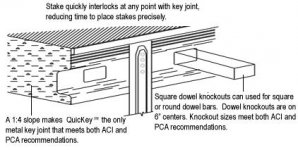
That is more of a construction joint if you connect the two with rebar. Do you plan on putting a key way in to tie the two slabs together? If you don't connect them with rebar it is an expansion joint and you would put in thin material (compressed board) between the two and then fill the top it in with sealant (silicone) type material.
I would connect it with rebar, either pour the middle first to use the ends to screed off of or pour the outside two and the middle will go quick and easy.
Jason
 

lh4x4

Well-known member
Joined
Nov 6, 2008
Messages
123
Location
Illinois
In 1969 I had Allexander Lumber Co. build a 24x30 garage on a floating slab. It was on a clay base where a slope had been graded flat so it was a virgin area that had no fill.

The slab was 10" thick concrete. I moved back to that area when I retired. The people that own the house had a yard sale and I got to look in the garage. After almost 40 years, there wasn't a crack. No area was over any footing. One block away the resident had the same garage built on fill. One end of the garage was settling badly. The exposed slab was showing as rain had washed away the fill and undermined the slab.
 

larry4406

Well-known member
Joined
Jan 27, 2006
Messages
19,055
Location
Northern Virginia
I would not put a keyed joint in and piece meal the slabs. The separate pours will expand and contract at different rates and the key ways will open and the "ears" become unsupported and can crack with heavy use (happened in our warehouse - granted we are running forklifts in there). If I had to break the slab into multiple pours, and wanted to use the keyways, then I would orient them front to back (depth of the garage direction) and place them between the garage bays so you won't drive vehicles over them.

If you have a structural slab, then I think you are SOL with the idea of separting the slab into multiple pours as it would not be integral with the grade beams.
 

diiulio

Well-known member
Joined
Nov 14, 2008
Messages
136
Location
Saratoga Springs, NY
In my experience there is no problem doing construction joints that are keyed if done properly and in the correct conditions. Keyed joints are typically done in slabs that are greater than 10", therefore in a residential garage application they are not recommended. I have done many keyed construction joints (California and NY) in pump stations, buildings, etc. All were industrial or heavy civil applications, approximately 10"-12" thick slabs. No problems with any of them. If concrete contracts enough that the key way is exposed then most likely the concrete was not cured correctly. Keyed joints do have a greater possibility of shear failure (crack in vertical as above post) when they are thin slabs or concrete was not cured properly.

You get the majority of concrete strength in 24 hours and full strength in 28 days, you need to properly cure the concrete after placement for at least 24 hours, covering with plastic, wet burlap material, etc. Keeping it moist is very important for green concrete.

It is not a matter of piece meal, but rather constructing it in a managable sections for the OP. There is nothing wrong with pouring it in three sections.

Typically a construction joint is planned and placed where a contraction joint will be placed. At 10' spacing per the OP, that is perfect. On non-reinforced slabs you would do joints at 10' spacing and reinforced you would do no more than 30', but obviously the less spacing the better chance of controlling cracking. We typically sawcut the following day joints into the concrete, but there are other ways if you don't have a saw. You can also finish in a joint in during the finishing or place a construction joint (cold joint).
 

sharage71

Well-known member
Joined
Nov 12, 2008
Messages
138
Location
Memphis, TN
Each pour will have 2 x 2 spacing of # 4 Rebar with # 5 in the footings. At each
"joint" will be turned down for strength between the 3 slabs. I dont have the experience to run the power trowel. I have a cement guy that is great on the bull float that looks great. I thought about having the pad polished before I build. I'll have to look at the cost obviously. On the driveway piece that I poured ( 20x25) I had trouble using the expansion joint tool. I left it a little crooked so I don't have much confindence in the larger job. That is mostly why I like the smaller pour in addition to not shelling out the full price of the concrete at once.
 
To avoid these ads, REGISTER NOW!
Top Bottom