 My concrete man was supposed to put a little cut-back between these poles so that, when the roll-door is down, water doesn't come under the door into the shop. Well, he forgot to do it. So he sent a worker out the next day with a diamond saw and did this...... He says he will come back and put "grout" in it. Is that going to stand up under forklift traffic? Thanks

You are using an out of date browser. It may not display this or other websites correctly.
You should upgrade or use an alternative browser.
You should upgrade or use an alternative browser.
"Grout"?
- Thread starter 3Dsigns
- Start date
Wow don't know what he means by grout or how that is going to prevent water from coming in but doubt it will stand up to daily forklift use. How heavy is the forklift and what kind of wheels/tires are on it? Maybe look into a heavy rubber threshold that can be inset into the gap but filled with concrete? Rubber threshold would need some sort of a lip above slab surface to prevent water from coming in. Not sure how that works with a forklift.
jack stand
Well-known member
The chipped out area, is that part of the building slab or the driveway?
To achieve a recess it needs to be towards the inside of the building around 3" inside of the posts.
Overhead doors are usually fastened to a 2x6 attached flat to the inside of the framing to accommodate the door track. Your ohd will end up protruding inside of the face of the track. 4" should be safe unless you have some interior finishing that will/can move the door further to the inside.
Sorry about this screw up for you and your concrete guy. **** happens accidentally also.
In less words, the sawcut needs to be back towards the interior 3 +/-" beyond the posts/track mount.
To achieve a recess it needs to be towards the inside of the building around 3" inside of the posts.
Overhead doors are usually fastened to a 2x6 attached flat to the inside of the framing to accommodate the door track. Your ohd will end up protruding inside of the face of the track. 4" should be safe unless you have some interior finishing that will/can move the door further to the inside.
Sorry about this screw up for you and your concrete guy. **** happens accidentally also.
In less words, the sawcut needs to be back towards the interior 3 +/-" beyond the posts/track mount.
Wow don't know what he means by grout or how that is going to prevent water from coming in but doubt it will stand up to daily forklift use. How heavy is the forklift and what kind of wheels/tires are on it? Maybe look into a heavy rubber threshold that can be inset into the gap but filled with concrete? Rubber threshold would need some sort of a lip above slab surface to prevent water from coming in. Not sure how that works with a forklift.
Attachments
strutaeng
Well-known member
A repair mortar or cement will be fine, as long as he meets the minimum thickness requirements and follows specific instructions.
I've designed numerous repairs to concrete structures and chipping and "scarifying" is specified to get bite into the hardened concrete. In this case this is good even if doweling with rebar on the larger areas.
Cement All from Rapid set is a commonly available product that's pretty good. That one has no minimum thickness requirement IIRC, but I would probably recommend a 1/2" "shoulder". Mortar Mix by same manufacturer is another one.
Otherwise Sika products (there's a plethora of those for various applications) is what I've specified when doing structural repair drawings. If you read the data sheets, the specs are pretty impressive of these high performance cement/mortar products.
I've designed numerous repairs to concrete structures and chipping and "scarifying" is specified to get bite into the hardened concrete. In this case this is good even if doweling with rebar on the larger areas.
Cement All from Rapid set is a commonly available product that's pretty good. That one has no minimum thickness requirement IIRC, but I would probably recommend a 1/2" "shoulder". Mortar Mix by same manufacturer is another one.
Otherwise Sika products (there's a plethora of those for various applications) is what I've specified when doing structural repair drawings. If you read the data sheets, the specs are pretty impressive of these high performance cement/mortar products.
Well, at this point, I'm going to get those products and do it myself. This guy promised to come back the next day (Tuesday). never showed. Gave him a call Friday and he said "I'll be there tomorrow"(never showed then either). I figure if someone is that untrustworthy, It's a high probability he'll use something cheap and crappy to do the repair, if he ever shows. I have tools, I can do it. But when I have the other half of the barn poured, I'm hiring someone else. Thanks for the help!A repair mortar or cement will be fine, as long as he meets the minimum thickness requirements and follows specific instructions.
I've designed numerous repairs to concrete structures and chipping and "scarifying" is specified to get bite into the hardened concrete. In this case this is good even if doweling with rebar on the larger areas.
Cement All from Rapid set is a commonly available product that's pretty good. That one has no minimum thickness requirement IIRC, but I would probably recommend a 1/2" "shoulder". Mortar Mix by same manufacturer is another one.
Otherwise Sika products (there's a plethora of those for various applications) is what I've specified when doing structural repair drawings. If you read the data sheets, the specs are pretty impressive of these high performance cement/mortar products.
strutaeng
Well-known member
Sorry to hear that.Well, at this point, I'm going to get those products and do it myself. This guy promised to come back the next day (Tuesday). never showed. Gave him a call Friday and he said "I'll be there tomorrow"(never showed then either). I figure if someone is that untrustworthy, It's a high probability he'll use something cheap and crappy to do the repair, if he ever shows. I have tools, I can do it. But when I have the other half of the barn poured, I'm hiring someone else. Thanks for the help!
Here's the technical data sheet for that product. https://cdn.mediavalet.com/usca/cts...g/Original/CEMENT_ALL_Datasheet_DS_024_EN.pdf
Follow at the instruction exactly down to mixing water volume, mixing, wetting the concrete to SSD, etc.
When I meant "shoulder" earlier, I'm talking about the edges should be about 1/2"-3/4". Some products, like this one, allow "featheredging" which means you can vary the thickness down to nothing. But in practice, you'll may get some cracking at the feathered edge.
These products set up really fast, so you have to work quickly. I've had contractors doing concrete parking garages doing sizeable topping slab repairs in the Texas summer heat struggle placing the concrete. Usually they have to do the work early in the morning and have extra laborers, a team mixing in buckets and another team placing and yet other guys screeding and finishing. There's no bleed water like in regular concrete finishing: you finish trowel immediately after screeding.
Good luck!
mike93lx
ALLIANCE MEMBER
Need to make sure to keep it separate from the building slab, as far as I know. Maybe a piece of flashing slid into the existing gap will be sufficient
BillK
Well-known member
Not sure if I understand what you are going to accomplish ? If you fill it completely with grout then it is going to be level with the slab and gain nothing. If you only partially fill it there will be a "ditch" there to collect water and make your life miserable not to mention forklifts usually do not like going over stuff like that.
At this point I would fill it back level and straight and dont worry about it. I have two 12 x 14 bay doors here at the shop and they just sit flat on the floor and never leak a drop in even the hardest rain storms. If you use a good seal it wont be a problem. Same with my doors at home.
At this point I would fill it back level and straight and dont worry about it. I have two 12 x 14 bay doors here at the shop and they just sit flat on the floor and never leak a drop in even the hardest rain storms. If you use a good seal it wont be a problem. Same with my doors at home.
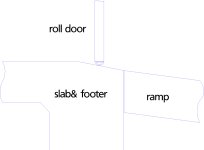
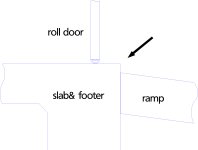
That's what I thought too but OP's drawing shows its actually sloped up to slab.Not sure if I understand what you are going to accomplish ? If you fill it completely with grout then it is going to be level with the slab and gain nothing. If you only partially fill it there will be a "ditch" there to collect water and make your life miserable not to mention forklifts usually do not like going over stuff like that.
At this point I would fill it back level and straight and dont worry about it. I have two 12 x 14 bay doors here at the shop and they just sit flat on the floor and never leak a drop in even the hardest rain storms. If you use a good seal it wont be a problem. Same with my doors at home.
Not sure if I understand what you are going to accomplish ? If you fill it completely with grout then it is going to be level with the slab and gain nothing. If you only partially fill it there will be a "ditch" there to collect water and make your life miserable not to mention forklifts usually do not like going over stuff like that.
At this point I would fill it back level and straight and dont worry about it. I have two 12 x 14 bay doors here at the shop and they just sit flat on the floor and never leak a drop in even the hardest rain storms. If you use a good seal it wont be a problem. Same with my doors at home.
Attachments

Old tool guy
Well-known member
- Joined
- Apr 13, 2023
- Messages
- 3,187
Grout is the term used to fill in under light poles, on top of the concrete base. Also used to fill in under very large equipment like pumps, air handlers etc. So i don’t see a problem with his terminology, just his performance.
So i don’t see a problem with his terminology, just his performance.
I've seen two different specs from the customer in his thread, one of which the original design appears to me
BillK
Well-known member
Ok, I get the drawing now. I dont know how it looked before he cut away the ditch but it probably would have been fine the way it was poured originally. Do you have a picture of how it looked before the cut ?
Also, just to be certain, in your first picture is the garage on the left or on the right ?
Also, just to be certain, in your first picture is the garage on the left or on the right ?
This is how it looked after they poured it. there would have been a rough jolt going through the door with a load on a forklift. The garage is on the left. Ramp is on the right.Ok, I get the drawing now. I dont know how it looked before he cut away the ditch but it probably would have been fine the way it was poured originally. Do you have a picture of how it looked before the cut ?
Also, just to be certain, in your first picture is the garage on the left or on the right ?
Attachments

This is how it looked after they poured it. there would have been a rough jolt going through the door with a load on a forklift. The garage is on the left. Ramp is on the right.
That’s how my garage is. An amazing amount of rain comes under the door hitting the tiny flat area. I’ve been thinking of grinding it down for 30 years. lol.
we had a similar situation at the volunteer warehouse . the existing concrete ( at the loading door) over the foundation pour was about 2" thick and cracked to no end.
when we poured the pad ( in another thread) we cut & broke out foundation wall ( below grade) about 6" , pinned , rebar and poured it.
We fastened a pc of ply to the outside of the foundation to the proper height to make a break between the pad & foundation. we did it all in 1 pour .
bottom line, if it was mine I would go deeper with that cut , drill & pin it & pour at least 6"
picture may not show it clearly, but here we are cutting the foundation wall deeper so we could get 6" of concrete instead of 1.5 or 2" at the overhead door threshold

this picture may show it better . see the RH side how the floor is just a tad above the foundation wall

when we poured the pad ( in another thread) we cut & broke out foundation wall ( below grade) about 6" , pinned , rebar and poured it.
We fastened a pc of ply to the outside of the foundation to the proper height to make a break between the pad & foundation. we did it all in 1 pour .
bottom line, if it was mine I would go deeper with that cut , drill & pin it & pour at least 6"
picture may not show it clearly, but here we are cutting the foundation wall deeper so we could get 6" of concrete instead of 1.5 or 2" at the overhead door threshold
this picture may show it better . see the RH side how the floor is just a tad above the foundation wall
Last edited: