To avoid these ads, REGISTER NOW!

Hard Start vs Soft Start-Help me understand better?

duneslider

Well-known member
Joined
Jan 20, 2013
Messages
2,254
Location
Riverton, Utah
Now that it's warming up again and I fired up the AC in the house it reminded me of something. About a year ago my AC stopped working, fairly new unit. I had a tech come out and he determined the Capacitor was bad. Anyway, it was two guys, they spoke spanish and I speak a bit of spanish, so I said a few things to them in spanish and offered a soda. Anyway, I think the fact that I was nice and spoke their language opened the guys up and they were my best friends.

He ended up doing some further diagnostics and suggested the unit needed a hard start kit, which I take to just be a higher capacity capacitor? He gave me a good price on the kit. He tried to explain to me why it needed it but I didn't quite follow what the issue was. I asked about a soft start and he said that would be better but he didn't have one on the truck and they are a lot more expensive and felt the hard start was fine. He also hooked up gauges and said the system was overcharged when it was installed and corrected that as well. He also cleaned the outdoor unit and gave me some extra cleaner and gave me some vibration pads to put under the unit. The system cools better now than it did before his work but has always seemed loud on start up. He said the overcharge may lead to a shorter "life" on the compressor over the long run.

Why would a fairly new (less than 3 years old at time of service) AC need a "hard start"? Should I replace the hard start with a soft start?
 
To avoid these ads, REGISTER NOW!

MacMcMacmac

Well-known member
Joined
Oct 21, 2014
Messages
1,583
Location
canada
A hard start is an oversized capacitor that gives the compressor a bigger kick in the pants to get it running, but is switched out if the circuit shortly thereafter. It is a band aid solution for failing equipment in my experience. I.put one on my AC two years ago after hearing it humming loudly trying to start a few times. It has worked well, but I took it as a sign my 25yr old unit is getting tired.
 

dcg9381

Well-known member
Joined
Jun 20, 2018
Messages
11,709
Location
Austin, TX
The system cools better now than it did before his work but has always seemed loud on start up.
I was curious about one of my units that does the same thing. I was told that it is the "scroll" type compressor and it's common to this compressor type. Basically sounds like you clapped two boards together at start up. The new capacitor shouldn't make it cool better, but should make it start (which won't happen if the cap is dead). No idea if a bigger capacitor will change the noise of the compressor start.

The only place I use "soft starts" is in an RV where you have limited power available - reduces that current surge required to start the thing. With a soft start, I can get a 15k BTU unit to run on 2500 watts of generator....

I asked about "preventative" cap replacement also, tech said he sees caps last 3 years and some more than 15. YMMV.
 

danski0224

Well-known member
Joined
Jan 29, 2005
Messages
13,382
Location
Near Naperville, IL
A soft start will significantly reduce the startup current of the compressor.

It also eliminated the remaining light flicker when the unit turned on for my system. A good part of the light flicker was eliminated with a smart contactor.

And yes, a soft start kit is considerably more money than a hard start kit.
 

WildBill

ALLIANCE MEMBER
Joined
Aug 20, 2021
Messages
1,998
Location
PNW
You should not have needed a hard start kit unless something was wrong. Those are typically only used as a short term bandage for something like a really old compressor that needs more power to get it going. Unless somehow the overcharge damaged yours in a way the hard start compensated for, I don't know why you would need one.

A soft start is a great device to reduce startup amp draw and quiet down a compressor. A hard start does the opposite and in theory kills the compressor faster.

Putting an Easy Start ASY-368-X48-BLUE soft start on my 20 year old, 3 ton, 13 seer AC dropped startup amps from around 70 to around 20. Also my lights no longer dim when the AC kicks on, and it's very noticeably quieter starting up.
 

larry4406

Well-known member
Joined
Jan 27, 2006
Messages
19,151
Location
Northern Virginia
A soft start will significantly reduce the startup current of the compressor.

It also eliminated the remaining light flicker when the unit turned on for my system. A good part of the light flicker was eliminated with a smart contactor.

And yes, a soft start kit is considerably more money than a hard start kit.
From your past posts, I have gathered you work rather extensively with HVAC systems.

What brand of soft start did you install on your system?

I have been thinking of installing one of these on our 3-ton 14 SEER Goodman heat pump outdoor unit.
 
OP
D

duneslider

Well-known member
Joined
Jan 20, 2013
Messages
2,254
Location
Riverton, Utah
You should not have needed a hard start kit unless something was wrong. Those are typically only used as a short term bandage for something like a really old compressor that needs more power to get it going. Unless somehow the overcharge damaged yours in a way the hard start compensated for, I don't know why you would need one.

A soft start is a great device to reduce startup amp draw and quiet down a compressor. A hard start does the opposite and in theory kills the compressor faster.

Putting an Easy Start ASY-368-X48-BLUE soft start on my 20 year old, 3 ton, 13 seer AC dropped startup amps from around 70 to around 20. Also my lights no longer dim when the AC kicks on, and it's very noticeably quieter starting up.
I looked at that and it seems I have seen those on the RV forums for AC units. They seem to have a good reputation. They aren't terribly expensive, maybe I should look into getting one.
 

fitter30

Well-known member
Joined
Jun 23, 2019
Messages
2,968
Location
Peace Valley,mo
There are two types of hard starts . One uses a potential relay and start capacitor the other is a two wire solid statethat just goes across the run capacitor which both work well.
://www.amazon.com/SPP6-Capacitor-Increase-Starting-Torque/dp/B0002YTLFE/ref=mp_s_a_1_9?dib=eyJ2IjoiMSJ9.iWAP2KkQUghE9LZbJqR1P9b3-yqjKbB7KI4oYA6sn5OuvrD2z0GYEcbFlG5ijEVo0tUq66zAOVbcvS7Bd4z9OK4rKSnBH6QfpNwWW07QMqPOZZeVsj-Acha4m2V2KmJjcqAUS7NqsAsUTYHeSlu-jGYKo5Hrd1Rg1vF0SShrkP2whSqv_9D3t8-MB93df-0EEQv6JdfZy0DuN_X6JQV0HQ.PEfibPCsDMWzwOfJCDR9EpZtAhg53P13vFHsGvKEScU&dib_tag=se&keywords=hard+start+kit+for+air+conditioner&qid=1779378434&sr=8-9
 

sh944

ALLIANCE MEMBER
Joined
Jan 1, 2014
Messages
291
Location
Linwood, KS
I had a NuStart installed recently, after several cycles it dropped from 63A to 17A on a 5 ton Rheem and was noticibly quieter and no more light flicker. Cheap? No, but if I get extra years out of the compressor it will be worth it it, imo. Time will tell.
 

theoldwizard1

Well-known member
Joined
Feb 22, 2011
Messages
43,132
Location
SE MI
A hard start is an oversized capacitor that gives the compressor a bigger kick in the pants to get it running, but is switched out if the circuit shortly thereafter.
Unfortunately, that is what many "soft starters" are and they DO NOT SOLVE YOUR STARTING PROBLEM ! (FYI, all motor "starting capacitors" are automatically switched out by a centrifugal start switch)

Let's start with as simple assumption. The starting capacitor install by the motor manufacturer is SIZED CORRECTLY !

The problem with "hard starting" is lack of sufficient CURRENT (causing a voltage drop) during starting. This is because because a discharged capacitor "looks like" a short circuit to an AC power source. What you need to do is limit the current (keeping the voltage up) being sent into capacitor until it is adequately charge. Yes, lower current means it will take longer to charge to capacitor (less than 1 second), but the voltage will not sag !

The only product I know that does this, is a Micro-Air’s EasyStart™ There may be others.

For those into electronics How to make a Softstarter and why it is sometimes mandatory to use!
 

mm08822

Well-known member
Joined
Jan 13, 2012
Messages
5,895
Location
NJ
The problem with "hard starting" is lack of sufficient CURRENT (causing a voltage drop) during starting. This is because because a discharged capacitor "looks like" a short circuit to an AC power source. What you need to do is limit the current (keeping the voltage up) being sent into capacitor until it is adequately charge. Yes, lower current means it will take longer to charge to capacitor (less than 1 second), but the voltage will not sag !

The only product I know that does this, is a Micro-Air’s EasyStart™ There may be others.

For those into electronics How to make a Softstarter and why it is sometimes mandatory to use!
The high inrush of current upon start-up is due to the locked rotor condition of the motor. The only current limiting factor at this instant in time is the branch circuit resistance and the motor winding resistance as there is no inductive reactance produced yet. The capacitor may need one/half ac cycle to charge = 1/12060th sec. (It may be fully discharged at the time the motor is put across the line, but no matter as it will continue to charge/discharge 120x/sec.) It The start winding and cap in series provides a magnetic field within the motor for the run winding magnetic field to interact with and create the start of and direction of rotation. The start and run winding are 90 degrees physically displaced. The cap further adjusts the phase shift between the 2 windings.

The soft-starters are inserting additional resistance in the run winding circuit that is typically reduced by time creating a smoother climb out to full speed. The increased resistance is what reduces the voltage dip that the home experiences and the abrupt start of rotation. This added resistance decays to zero and the run winding is soon operating at line voltage.

ETA: Red text added for clarity/corrections.
 
Last edited:
To avoid these ads, REGISTER NOW!

rlitman

Well-known member
Joined
Oct 18, 2010
Messages
24,591
Location
Long Island
...The capacitor may need one ac cycle to charge = 1/60th sec. It provides a magnetic field...
I'm gonna have to call you (and TOW) out on these details. AC capacitors don't charge up like DC capacitors. While they do hold a charge (since they are capacitors), they charge and discharge with EVERY up and down swing every cycle. The actual capacitance of an AC run cap (and these are RUN caps, not START caps) is surprisingly low, and no, they don't provide a magnetic field either (inductors do that, not capacitors).

I also don't know why you think there's no inductive reactance from a stopped rotor. The motor's inductive impedance is a property of the windings, not the current, and the reactance is mathematically proportional to the impedance times the frequency ("yet" doesn't enter the chat).

... (FYI, all motor "starting capacitors" are automatically switched out by a centrifugal start switch)

Let's start with as simple assumption. The starting capacitor...
Ok, let's start with a simple assumption. GJ needs some schooling.

Typical single phase central air conditioner circuit diagrams have two capacitors. They happen to usually have a common terminal and share a single case, so the capacitor will have three multi-prong terminals up top, but inside there are effectively two capacitors. One is used by the compressor, and the other by the fan. Both serve the same purpose, it's just that with the two motors being different sizes (and the fan not always needing to run when the compressor is running; look up winter kits), they need different values. Putting them in one shell makes service easier; especially since they have a common MTBF.

Anyway, both motors will be permanent split capacitor type motors. They utilize two stator windings (just like a capacitor start capacitor run motor), with the main winding being connected directly to the circuit input, and the "start" winding in series with the ALWAYS connected capacitor. THERE IS NO CENTRIFUGAL SWITCH here, and as I said above, the capacitors in play here are AC caps, not DC. For reference, a soda can sized AC cap will inrush up to about 15A given 240V. Clamp amp meter your air conditioner's cap wires to see what I'm talking about.

So, the auxiliary winding in this case is powered (in series with the run cap) ALL the time the motor is running. The purpose of the run cap here is the same as that of a typical starting capacitor, in that it phase shifts the voltage on one winding so that the motor has starting torque (since this isn't three phase). The difference from a capacitor start motor is that these capacitors and auxiliary windings are designed to handle continuous use.

Learn more here (because it's too late at night for me to spell it all out):
 

Ohmthis

Well-known member
Joined
Jan 20, 2013
Messages
3,009
Location
Outside of Louisville KY
I'm gonna have to call you (and TOW) out on these details. AC capacitors don't charge up like DC capacitors. While they do hold a charge (since they are capacitors), they charge and discharge with EVERY up and down swing every cycle. The actual capacitance of an AC run cap (and these are RUN caps, not START caps) is surprisingly low, and no, they don't provide a magnetic field either (inductors do that, not capacitors).

I also don't know why you think there's no inductive reactance from a stopped rotor. The motor's inductive impedance is a property of the windings, not the current, and the reactance is mathematically proportional to the impedance times the frequency ("yet" doesn't enter the chat).


Ok, let's start with a simple assumption. GJ needs some schooling.

Typical single phase central air conditioner circuit diagrams have two capacitors. They happen to usually have a common terminal and share a single case, so the capacitor will have three multi-prong terminals up top, but inside there are effectively two capacitors. One is used by the compressor, and the other by the fan. Both serve the same purpose, it's just that with the two motors being different sizes (and the fan not always needing to run when the compressor is running; look up winter kits), they need different values. Putting them in one shell makes service easier; especially since they have a common MTBF.

Anyway, both motors will be permanent split capacitor type motors. They utilize two stator windings (just like a capacitor start capacitor run motor), with the main winding being connected directly to the circuit input, and the "start" winding in series with the ALWAYS connected capacitor. THERE IS NO CENTRIFUGAL SWITCH here, and as I said above, the capacitors in play here are AC caps, not DC. For reference, a soda can sized AC cap will inrush up to about 15A given 240V. Clamp amp meter your air conditioner's cap wires to see what I'm talking about.

So, the auxiliary winding in this case is powered (in series with the run cap) ALL the time the motor is running. The purpose of the run cap here is the same as that of a typical starting capacitor, in that it phase shifts the voltage on one winding so that the motor has starting torque (since this isn't three phase). The difference from a capacitor start motor is that these capacitors and auxiliary windings are designed to handle continuous use.

Learn more here (because it's too late at night for me to spell it all out):
There is a lot of electrical theory that’s “usually” easier to explain with just “it kickstarts the motor”. I’m betting that if you showed everyone the sine wave and how it shifts with the addition of a capacitor there would be lightbulbs brightening up.
 

theoldwizard1

Well-known member
Joined
Feb 22, 2011
Messages
43,132
Location
SE MI
The actual capacitance of an AC run cap (and these are RUN caps, not START caps) is surprisingly low,
But we are talking specifically about START capacitors for induction motors.

I WAS WRONG ! The centrifugal start switch cuts out the START capacitor from the start winding, but leave the run capacitor attached to the start circuit.

This simple image show typical wiring (yes, the 2 capacitor may be in one housing). The red line labeled "R" is also called the HOT line.

Screenshot 2026-05-23 114628.png

Note I used the term "looks like". Yes, greatly over simplifying. Bottom line, a fully discharged capacitor connected to a power source (AC or DC) will try to charge itself as fast as possible causing a momentary high current (and potentially low voltage) condition.
 
Last edited:

rlitman

Well-known member
Joined
Oct 18, 2010
Messages
24,591
Location
Long Island
...The centrifugal start switch cuts out the START capacitor from the start winding, but leave the run capacitor attached to the start circuit.
... Bottom line, a fully discharged capacitor connected to a power source (AC or DC) will try to charge itself as fast as possible causing a momentary high current (and potentially low voltage) condition.
So, what a centrifugal switch does depends on the motor design, but for the purposes of a general purpose induction motor (which is NOT used in a residential central air conditioner, but might be found in an air compressor) it usually disconnects the start windings and starting capacitor entirely. That's because the start winding is designed to draw a lot of current (so it would overheat rapidly), but isn't necessary once the motor starts turning. The capacitor start capacitor run motors (your diagram) can offer better electrical and space efficiency by making use of the "start" winding all the time, but comes with a price of added components, and I can't say I see them often.

Anyway, the bottom line is AC capacitor inrush current is still low, because AC capacitor capacitance values are incredibly low. Again, they're charging and discharging 120 times a second.

If I remember when I'm back at the office, and I have time, I'll try to line some various capacitors up and get a picture to make the comparison in scale between paper/mylar AC caps and electrolytic DC caps easier to comprehend. The difference is all in the zeroes, and it's a bunch of them.
 

theoldwizard1

Well-known member
Joined
Feb 22, 2011
Messages
43,132
Location
SE MI
So, what a centrifugal switch does depends on the motor design, but for the purposes of a general purpose induction motor (which is NOT used in a residential central air conditioner, but might be found in an air compressor) ...
Okay, what type of motor is typically used in a residential air conditioner ?

I found this statement with Google

Capacitor-Start, Capacitor-Run Air Conditioner Motor​

This type of induction motor design is common in AC compressors and is similar to the capacitor-start design except that there is a second capacitor known as the RUN capacitor, which is connected in parallel with the START capacitor and the switch.​

Newer, variable speed AC compressors, use BLDC.

Some (especially in RVs) air conditioners actually convert DC (12v) to 3 phase AC (not the same voltage you find in industrial applications). 3 phase motors are much more efficient than single phase.
 
Last edited:

rlitman

Well-known member
Joined
Oct 18, 2010
Messages
24,591
Location
Long Island
Okay, what type of motor is typically used in a residential air conditioner ?
For single speed systems, permanent capacitor motors. The run capacitor is always in circuit with the second rotor winding, and there is no centrifugal switch.

For variable speed systems, they usually have some sort of inverter with either a 3 phase or brushless DC motor, and no single consumable motor capacitor (just the capacitors in the inverter driver).

Multi-speed blowers used to have various tapped windings, but today, they're more often electronically commutated motors (brushless DC). The main difference for our purposes between brushless DC and VFD is that a VFD doesn't rely on permanent magnetics, and instead induces the magnetic field onto the 3 phase rotor. The catch is that the permanent magnet severely limits the motor's torque capability, so a brushless DC motor will be used in higher speed applications.

As for efficiency of 3 phase vs single phase motors, that's a misnomer. 3 phase doesn't make a motor inherently more efficient, though it does improve the motor's locked rotor characteristics, and eliminates the needs for capacitor start.
 

mm08822

Well-known member
Joined
Jan 13, 2012
Messages
5,895
Location
NJ
The
I'm gonna have to call you (and TOW) out on these details. AC capacitors don't charge up like DC capacitors. While they do hold a charge (since they are capacitors), they charge and discharge with EVERY up and down swing every cycle. The actual capacitance of an AC run cap (and these are RUN caps, not START caps) is surprisingly low, and no, they don't provide a magnetic field either (inductors do that, not capacitors).

I also don't know why you think there's no inductive reactance from a stopped rotor. The motor's inductive impedance is a property of the windings, not the current, and the reactance is mathematically proportional to the impedance times the frequency ("yet" doesn't enter the chat).

The motors used in ac compressor units have been historically permanent split capacitor types. This is just a simpler variant of a split-phase motor that does contain cent switches. They do have 2 windings – that have also been commonly called start and run windings (since at least the 60’s).

In this PSC motor, the start winding contains a permanent capacitor in series with the start winding. "Permanent cap" as in it remains part of the circuit even after the motor reaches full speed. It’s a misnomer as there is no cent switch (typical of a start winding), but that is what it is commonly called - a start winding. Even ac unit schematics identify the motor terminals as S, R, C. (start, run, common.) as highlighted in the below schematic. Main and aux winding names used in these motor types would be less confusing, agreed, but historical precedence lives on. So be it. Not my care/concern/soapbox.

1779563178932.png1779568269868.png

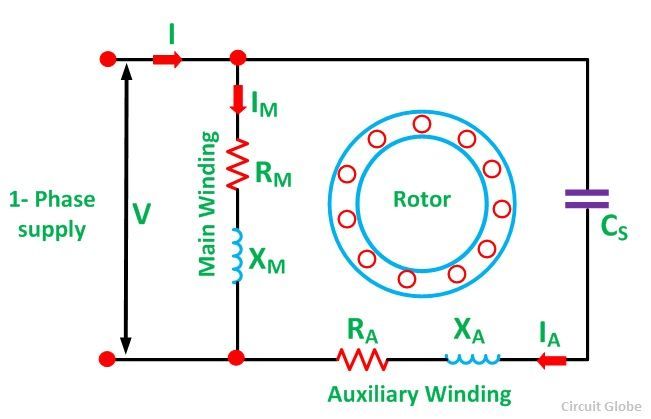
In the motor model shown below from your source, the start (aux) winding clearly shows a resistive element accounting for the winding conductor copper resistance as well as the coil. At the instant the motor is put across the line, the main winding’s copper resistance is the only restriction to current flow. The winding has zero inductive reactive present at this moment as there is a minuscule time delay in the magnetic field building up through the laminations to oppose the current flowing through the same winding. A similar delay is happening through the rotor (squirrel cage) causing induced current to flow in it. This is a transient decaying process as the rotor starts to rotate towards full speed.
Also the following differences exist between windings:
Ra > Rm
Xm > Xa
Ia leads Im by about ~80°
1779562386698.png
Inductance (L) is a function of the winding geometry- # turns, spacing, area of the coil, stator core material, etc.
The inductive reactance (XL) is a function of the physical winding (L) and the frequency of the varying current resulting from the net "effective voltage" present across the winding. Effective voltage includes the varying amount of counter emf developed by the rotor current from standstill (locked rotor) thru full speed. Not until the rotor is at "full speed" will the full XL of the stator be created and motor input current be ~FLA.
 

Attachments

  • 1779568039046.png
    1779568039046.png
    117.7 KB · Views: 0

mm08822

Well-known member
Joined
Jan 13, 2012
Messages
5,895
Location
NJ
There is a lot of electrical theory that’s “usually” easier to explain with just “it kickstarts the motor”. I’m betting that if you showed everyone the sine wave and how it shifts with the addition of a capacitor there would be lightbulbs brightening up.
It doesn't end there. There is the entire magnetic field interaction between stator and rotor as rotation occurs up through full speed.
 

mm08822

Well-known member
Joined
Jan 13, 2012
Messages
5,895
Location
NJ
But we are talking specifically about START capacitors for induction motors.

I WAS WRONG ! The centrifugal start switch cuts out the START capacitor from the start winding, but leave the run capacitor attached to the start circuit.

This simple image show typical wiring (yes, the 2 capacitor may be in one housing). The red line labeled "R" is also called the HOT line.

Screenshot 2026-05-23 114628.png

Note I used the term "looks like". Yes, greatly over simplifying. Bottom line, a fully discharged capacitor connected to a power source (AC or DC) will try to charge itself as fast as possible causing a momentary high current (and potentially low voltage) condition.
Hermetically sealed motors don't used cent switches or exposed shafts. This is chosen to eliminate compressor gas leakage. The PSC type motor doesn't need a cent switch and the cap is external to anticipate its failure and replacement.

This statement is still wrong "Bottom line, a fully discharged capacitor connected to a power source (AC or DC) will try to charge itself as fast as possible causing a momentary high current".
The capacitive reactance provided by the capacitor in the "start" winding is to create a phase shift of the current to alter the stator magnetic path relative to the rotor. XC is in series with winding resistance and the increasing XL. The cap will attempt to charge in 1/120th of a sec dependent upon the voltage present across it. And then discharge and recharge in the opposite polarity on the next 1/2 cycle.
 

mm08822

Well-known member
Joined
Jan 13, 2012
Messages
5,895
Location
NJ
Okay, what type of motor is typically used in a residential air conditioner ?

I found this statement with Google

Capacitor-Start, Capacitor-Run Air Conditioner Motor​

This type of induction motor design is common in AC compressors and is similar to the capacitor-start design except that there is a second capacitor known as the RUN capacitor, which is connected in parallel with the START capacitor and the switch.

Newer, variable speed AC compressors, use BLDC.

Some (especially in RVs) air conditioners actually convert DC (12v) to 3 phase AC (not the same voltage you find in industrial applications). 3 phase motors are much more efficient than single phase.
This provides increased starting torque at the expense of adding more hardware cost. IIRC, it can provide 200% of full load torque at start-up.
PSC motors are only about 50%.
 

mm08822

Well-known member
Joined
Jan 13, 2012
Messages
5,895
Location
NJ
For single speed systems, permanent capacitor motors. The run capacitor is always in circuit with the second stator rotor winding, and there is no centrifugal switch.

For variable speed systems, they usually have some sort of inverter with either a 3 phase or brushless DC motor, and no single consumable motor capacitor (just the capacitors in the inverter driver).

Multi-speed blowers used to have various tapped windings, but today, they're more often electronically commutated motors (brushless DC). The main difference for our purposes between brushless DC and VFD is that a VFD doesn't rely on permanent magnetics, and instead induces the magnetic field onto the 3 phase rotor. The catch is that the permanent magnet severely limits the motor's torque capability, so a brushless DC motor will be used in higher speed applications.

As for efficiency of 3 phase vs single phase motors, that's a misnomer. 3 phase doesn't make a motor inherently more efficient, though it does improve the motor's locked rotor characteristics, and eliminates the needs for capacitor start.
 

Ohmthis

Well-known member
Joined
Jan 20, 2013
Messages
3,009
Location
Outside of Louisville KY
It doesn't end there. There is the entire magnetic field interaction between stator and rotor as rotation occurs up through full speed.
I’m aware of the theory. My point is that it’s so much easier to put things in easily understood terms. Electrical theory when you start talking about resistance, capacitance, inductance, impedance, and so on and how they interact can be……..over the top. I’m loving that people here are taking the time to go in depth. I’m nerding out to be honest.
 

mm08822

Well-known member
Joined
Jan 13, 2012
Messages
5,895
Location
NJ
I’m aware of the theory. My point is that it’s so much easier to put things in easily understood terms. Electrical theory when you start talking about resistance, capacitance, inductance, impedance, and so on and how they interact can be……..over the top. I’m loving that people here are taking the time to go in depth. I’m nerding out to be honest.
Sometimes difficult to find a good analogy - easily relatable or not. A lot of the details once learned get lost in the cobwebs due to lack of need.
 

theoldwizard1

Well-known member
Joined
Feb 22, 2011
Messages
43,132
Location
SE MI
To answer the question "Hard Start vs Soft Start" ...

A soft start limits the current (momentarily) going into the motor as the motor starts up.
 

joel63

Well-known member
Joined
Oct 9, 2012
Messages
1,909
Location
Central FL
The better "521" hard start kits have a potential relay, and back EMF generates a voltage that pulls the hard start capacitor out of the circuit when the compressor spins fast enough.
Yes! The potential relay, sometimes referred to as a voltage relay, disconnects the start capacitor from the start winding. (5 2 1 - Common / Start / Run) On start up, The coil in the relay senses the BMF in the start winding and opens the contacts, at around (75 to 80% of full speed) disconnecting the start capacitor (from the circuit. The motor then continues to runs as a PSC motor.
 
To avoid these ads, REGISTER NOW!
Top Bottom