

You are using an out of date browser. It may not display this or other websites correctly.
You should upgrade or use an alternative browser.
You should upgrade or use an alternative browser.
Hello all
- Thread starter Timm129
- Start date
SC-Eric
Well-known member
Sure! You would be surprised what can be repaired! Post up some pics...


premierguy
Well-known member
- Joined
- May 24, 2008
- Messages
- 92
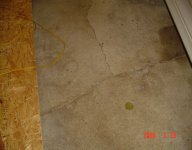
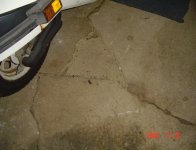
My flooring question is .. Is there anything that can be done with an old and fairly heavily cracked slab??? besides tear out and replace?? any type of coverings???? etc.??
Thanks
Your substrate is reminiscent of cold weather environment concrete degradation over an X # of years. Perhaps there may be outside irrigation issues around the perimeter of the garage substrate that need some attention.
1) At what distance are the actual expansion joints? From the pics….Hmmm
2) What material has been used in the larger sized cracks? Hmmm
I deal with these issues and find that the simplest solutions often require more work well worth the time spent…. My overall answer is “YES”…. You can do it!
thegarageguy
Well-known member
If you are talking DIY, then NO. or at least nothing that will look good or last.
If you are looking for something professionally done, then YES.
What I would do is remove all of your patch work, repatch, then trowel on a resinous cement (not before properly prepping ofcourse). Then you can have your choice of any flake or quarts floor so as to help hide some of the patch work. Forget the idea of a solid color system (too difficult to hide patch work).
If the whole slab is detiriorated and cracked then I would suggest to resurface the whole slab with a resinous cement and a decorative epoxy coat over it.
I have done many much worse and you'd never know it was in its prior condition.
A thin film epoxy system may not be the solution for you. Find a professional installer in your area that has done resurfacing and have them anylize it. Definately a more expensive fix but the proper one for sure.
If you are looking for something professionally done, then YES.
What I would do is remove all of your patch work, repatch, then trowel on a resinous cement (not before properly prepping ofcourse). Then you can have your choice of any flake or quarts floor so as to help hide some of the patch work. Forget the idea of a solid color system (too difficult to hide patch work).
If the whole slab is detiriorated and cracked then I would suggest to resurface the whole slab with a resinous cement and a decorative epoxy coat over it.
I have done many much worse and you'd never know it was in its prior condition.
A thin film epoxy system may not be the solution for you. Find a professional installer in your area that has done resurfacing and have them anylize it. Definately a more expensive fix but the proper one for sure.
Last edited:
SC-Eric
Well-known member
Thanks for the pics... Are those cracks everywhere? Also, could we get a pic of the whole garage with alot of light in hopes of seeing how (and where) those cracks are going?
I agree with some of what garageguy is saying. I would use an flexibilized epoxy mortar and not a polymer modified concrete. The epoxy grout would be MUCH stronger. Another option would be to use a flexible membrane (like our IntegraFlex 1980) to bridge the whole mess.
All of our answers are subject to change depending on whether the cracking is localized or... just... all over the place.
I agree with some of what garageguy is saying. I would use an flexibilized epoxy mortar and not a polymer modified concrete. The epoxy grout would be MUCH stronger. Another option would be to use a flexible membrane (like our IntegraFlex 1980) to bridge the whole mess.
All of our answers are subject to change depending on whether the cracking is localized or... just... all over the place.
Thanks for all the ideas...
Garage guy .. or anyone How can I find a "reputable" pro in my area??? my zip is 61821
I like the idea of resurfacing the whole slab and then applying a nice decroative coating ....
Ill try to get more pics later Im in the progress of finishing and insulating the garage so things are a little messy now. The first slab which is a normal 2 car wide is the bad one. The other one behind it is brand new. I took my normal 2 car garage and added another 24 feet behind it. and of course it is still too small ........
Garage guy .. or anyone How can I find a "reputable" pro in my area??? my zip is 61821
I like the idea of resurfacing the whole slab and then applying a nice decroative coating ....
Ill try to get more pics later Im in the progress of finishing and insulating the garage so things are a little messy now. The first slab which is a normal 2 car wide is the bad one. The other one behind it is brand new. I took my normal 2 car garage and added another 24 feet behind it. and of course it is still too small ........
Last edited:
Kevin54
MEMBER EMERITUS
If one section is hooved from the other at the cracks, then I would say it better to tear out. If the sections are even, then I would take a diamond wheel on a cutoff tool, score the crack a little, then fill. Trying to fill a hairline crack would not give you enough material for any bite I would think.
thegarageguy
Well-known member
Wolverine is right about the flex resin, I use a flex resin extensively. Again it all depends on the condition of the slab which is difficult to determine with pics over a cpu with low resolution. To me, the pics look like your slab has settled greatly and sunk in some areas and pushed up in others.
The big difference between an epoxy system and a resinous cement is that with epoxy you can basically only spread about 3/16" per layer and the resinous cement spreads out 1/4"-1/2". The potential to hide patch work and flaws are much greater.
Again, a pro needs to actually see it and determine the best solution. Search online for industrial manufacturers anywhere in the states and ask them for a qualified pro that can handle your type of situation.
Good luck!
The big difference between an epoxy system and a resinous cement is that with epoxy you can basically only spread about 3/16" per layer and the resinous cement spreads out 1/4"-1/2". The potential to hide patch work and flaws are much greater.
Again, a pro needs to actually see it and determine the best solution. Search online for industrial manufacturers anywhere in the states and ask them for a qualified pro that can handle your type of situation.
Good luck!
premierguy
Well-known member
- Joined
- May 24, 2008
- Messages
- 92
If the old portion of cement has no cut in expansion joints, it would be a good idea to begin cutting in new ones (cement saw @ 1/2 the distance of floor depth, thoroughly vac, clean sidewalls with denatured alcohol, then fill in with resinous grout material with properties of elongation @ 200-300%). This is applicable for the cracks that can be filled from top to bottom accordingly. Smaller cracks can be addressed with smoother flowing resinous modified materials.
Specialized fillers should never be applied unless the cause for failure is addressed properly.
Every crack in older floors has had dirt and grime seep up and down the inner sidewalls already…hence; it is a good idea to make sure that the contractor cup grinds every crack as mentioned earlier, with (high rpm equipment) then…. Blow out remaining particles and brush in acidic liquids at percents that will easily remove excess grime, nor cause further damage to your concrete by balancing the pH level afterwards. Thoroughly dry out each crack after this process… Fans, heat and low humidity levels are a blessing for proper drying at this point.
“Properly” for the old concrete will involve oil removal (Mechanical etching/Wet-Vac P/U of oily sediments – PH balancing - then let thoroughly dry) before shot blasting that area to a 60-80-grit feel and blow out the remaining dust that wasn’t picked up by the simultaneous Blast and Vac process…
This of course applies to garage flooring poured and cured w/o any expansion joints cut or troweled in the first place.
I agree with the last statement on the possibility of heavy movement from settlement...
So, make sure those areas are ground down effectively for "leveling" to save on overlayment materials...
It can be done to perfection!!!
Specialized fillers should never be applied unless the cause for failure is addressed properly.
Every crack in older floors has had dirt and grime seep up and down the inner sidewalls already…hence; it is a good idea to make sure that the contractor cup grinds every crack as mentioned earlier, with (high rpm equipment) then…. Blow out remaining particles and brush in acidic liquids at percents that will easily remove excess grime, nor cause further damage to your concrete by balancing the pH level afterwards. Thoroughly dry out each crack after this process… Fans, heat and low humidity levels are a blessing for proper drying at this point.
“Properly” for the old concrete will involve oil removal (Mechanical etching/Wet-Vac P/U of oily sediments – PH balancing - then let thoroughly dry) before shot blasting that area to a 60-80-grit feel and blow out the remaining dust that wasn’t picked up by the simultaneous Blast and Vac process…
This of course applies to garage flooring poured and cured w/o any expansion joints cut or troweled in the first place.
I agree with the last statement on the possibility of heavy movement from settlement...
So, make sure those areas are ground down effectively for "leveling" to save on overlayment materials...
It can be done to perfection!!!
Question
hey, man. is there may i ask you a question about your topic?here is my email : [email protected] ________________________________________________________________________Green Laser,Red Laser,Blue Laser,Qi Gong,Kung Fu,
hey, man. is there may i ask you a question about your topic?here is my email : [email protected] ________________________________________________________________________Green Laser,Red Laser,Blue Laser,Qi Gong,Kung Fu,