To avoid these ads, REGISTER NOW!

Help me understand why this Shop Vac won't run

rslaback

Well-known member
Joined
Jul 24, 2010
Messages
4,095
Location
Westcentral Wisconsin
I have a Shop Vac project I am working on that had been deemed scrap. It may or may not have been disassembled and diagnosed in order to make that determination.

I took a look at it today and the motor doesn't spin. I verified that the cord and DPST switch are good. The motor appears to be an Ametek based on the brush holder design. Where it gets weird is that I cannot find anything physically wrong with the motor. A visible check of the frame windings looks good. The rotor looks ok as well. I did check the rotor and none of the pads short to ground, the pads have consistent values from pad to pad and consistent values on opposite pad pairs. If I meter at the brush holders I get no reading between the holders themselves but each of them to ground gives 120vac. The system does not blow a breaker. I did see it flinch once.

What am I missing here? I was fully expecting to see a bad switch or a bad cord or consumed brushes or a burned winding and it doesn't appear to be any of those things.
 
To avoid these ads, REGISTER NOW!

Chuckster in NJ

Well-known member
Joined
Jan 26, 2010
Messages
2,362
Location
Hunterdon County NJ
Bad cord, dirty commutator, no spring tension on brushes, high temp fuse, bad switch…….. "IF" not one of those things you may have an open (bad) winding.

Get an ohm meter and ring ever out starting with the cord.

TIP! Make sure you have voltage at the outlet. ;)
 

Chuckster in NJ

Well-known member
Joined
Jan 26, 2010
Messages
2,362
Location
Hunterdon County NJ
This should be fine tuned a bit. The ohm meter won't work if you have the shopvac plugged in.
Unplug it at the outlet first. then the ohm test, and finally make sure you have voltage at the outlet
"IF" this needs to be explained to that detail maybe someone shouldn’t be working anything electrical related…… Maybe this will help “fine tune” my post #6. ;)
IMG_1589.jpeg
IMG_3019.jpeg
 
OP
R

rslaback

Well-known member
Joined
Jul 24, 2010
Messages
4,095
Location
Westcentral Wisconsin
How can you have 120v to ground on opposing brushes?
each brush to ground gives me 120. I included that to explain why I am not getting a voltage across the brushes but I know that there is power to them. So in other words the power is going through the rotor. If it were not, the brush on the hot side would show power but the brush on the neutral side would not.
 

dave*99

Well-known member
Joined
May 5, 2009
Messages
4,325
Location
Coastal NJ
each brush to ground gives me 120. I included that to explain why I am not getting a voltage across the brushes but I know that there is power to them. So in other words the power is going through the rotor. If it were not, the brush on the hot side would show power but the brush on the neutral side would not.
That would indicate an open in the neutral connection from the brush to the plug.
 
To avoid these ads, REGISTER NOW!

TRWham

Well-known member
Joined
Aug 11, 2017
Messages
2,004
Location
East Cobb County, Georgia
I would be looking at impedance through the system rather than voltage. All of the coils in this type of motor are in series. As you read resistance from the line in through the various points in the motor moving toward the neutral connection, eventually you should find one measurement that goes to infinity (or at least very, very high), and that's your problem, right there.
 

mm08822

Well-known member
Joined
Jan 13, 2012
Messages
6,229
Location
NJ
With the vac unplugged and the dpst closed (ON), measure the resistance across the plug hot and neutral blades. What do you get?
 
  • Like
Reactions: RPH
OP
R

rslaback

Well-known member
Joined
Jul 24, 2010
Messages
4,095
Location
Westcentral Wisconsin
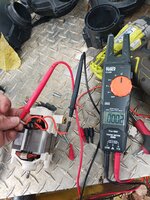
Did some more work on this today. Used my Klein meter that does zero out fully.

20250910_133054.jpg

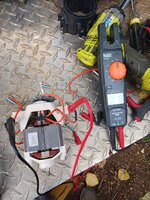
This motor doesn't have any permanent magnets. The power comes in and goes through a housing coil and then to the brush holder.


20250910_132730.jpg


Resistance through each of the housing coils is .2 ohms.


17575294535418239772546369297083.jpg


Resistance from brush to brush is consistent at 1.6 ohms as armature is spun.

20250910_132955.jpg

The switch tests good and has been removed, powering each coil lead directly with no change.

Without knowing the housing coil specs, .2 ohms seems low. How likely is it that I have a shellac failure on both housing coils causing a short and low resistance?
 

dave*99

Well-known member
Joined
May 5, 2009
Messages
4,325
Location
Coastal NJ
Did you confirm the power switch is working properly? Is there a thermal fuse hidden somewhere?
Looks like you checked that....

1757533236237.png

This link should work if you let it take you to Youtube.

 
Last edited:
OP
R

rslaback

Well-known member
Joined
Jul 24, 2010
Messages
4,095
Location
Westcentral Wisconsin
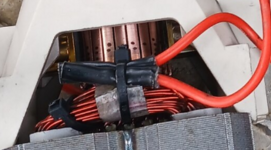
Did you confirm the power switch is working properly? Is there a thermal fuse hidden somewhere - in the tape?
Check for continuity across this device.

1757533236237.png

This link should work if you let it take you to Youtube.

I wired it directly to remove the switch from the possibilities. If there was a blown thermal fuse, wouldn't i get an overlimit instead of .2 ohms?
 

dave*99

Well-known member
Joined
May 5, 2009
Messages
4,325
Location
Coastal NJ
I wired it directly to remove the switch from the possibilities. If there was a blown thermal fuse, wouldn't i get an overlimit instead of .2 ohms?
Yes I missed that in your photo. You would read overlimit across an open fuse.
 

dave*99

Well-known member
Joined
May 5, 2009
Messages
4,325
Location
Coastal NJ
On second glance - that tape looks like it's only a splice. Is there an open fuse elsewhere?


It's worth putting a piece of plywood on your metal bench when working on electrical stuff....
 

iron block

Well-known member
Joined
Jun 22, 2015
Messages
267
Location
Bay Area, CA
Just to confirm -- when you test the motor, is it set up with the leads with the black terminals each connected to one of the brushes, and is AC power applied between the two leads with the bare metal terminals?

And what resistance do you read between those two leads with the bare metal terminals in this test configuration?
 

mm08822

Well-known member
Joined
Jan 13, 2012
Messages
6,229
Location
NJ
Did you apply power directly to the motor leads? (Not using the original cord)

Did you do what post 15 suggested? Or maybe now, short the hot and neutral together after the switch and measure resistance at the plug blades?
 
OP
R

rslaback

Well-known member
Joined
Jul 24, 2010
Messages
4,095
Location
Westcentral Wisconsin
Score one for the good guys. It's running again. The motor from lead to lead measured in at 2.6 ohms. But at the plug end it was 8 megaohms. Cut off the plug and measured the resistance on the conductors and we are back to normal. Wired in a new plug.

I've always just verified a cord was good by measuring voltage at the ends. This cord had enough internal resistance in the plug that even though it was providing 122vac it didn't have enough amperage to magnetize the coils.
 
Last edited:

alfadan

Well-known member
Joined
Mar 9, 2007
Messages
2,141
Location
Augusta, ks
There is a thermal fuse wedged into two fork like things near the windings. It looks like a piece of solder. I replaced one with...a piece of solder.
 

dave*99

Well-known member
Joined
May 5, 2009
Messages
4,325
Location
Coastal NJ
Score one for the good guys. It's running again. The motor from lead to lead measured in at 2.6 ohms. But at the plug end it was 8 megaohms. Cut off the plug and measured the resistance on the conductors and we are back to normal. Wired in a new plug.

I've always just verified a cord was good by measuring voltage at the ends. This cord had enough internal resistance in the plug that even though it was providing 122vac it didn't have enough amperage to magnetize the coils.
Great. Keep in mind your high input impedance voltmeter will often be fooled measuring voltage on an unloaded cable. Look back to post 13. You found the open in the neutral right in the plug.
 
To avoid these ads, REGISTER NOW!
Top Bottom