Hi All,
I have been reading many of the posts here and they have a been a terrific help in trying to figure out which way to go. I have a plan in which I'd like to share to see what I may be missing but the first issue I have is as follows.
I have an older slab (~20 years old) with a newer slab (1 yr old) that was poured next to it. There is nothing physically attaching the two slabs. Also, a wall was moved (extended out two feet, very long story) which in turn brought an approach slab from the outside to the inside and is butted up to the 20 year old slab with a felt joint in between.
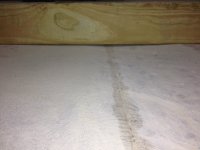
Now to describe the issue, the 1 yr. old slab rose after it was poured around 1/4", I rented a hand grinder and have taken this down and it now is roughly the same height as the 20 yr. slab, but, in doing so I've exposed the aggregate and the level going from ~ 6" from the new slab to 6" on the old slab has a pronounced dip., this is the same issue for the other adjoining area. The pictures don't show as much as I would have liked them to but essentially if you hold a straight edge across where the slabs meet 6" back on either side there is from a 1/8 to 1/2" depression over the 20 plus feet of floor.
I had read on the forum to fill the joints in the cement with the Sikaflex product but since this is both a joint line and a depression should I try to put in a modified polymer filler over the whole area to flatten it? I plan on grinding the whole floor but it sounds like that is the last mechanical prep step.
I had already purchased a polymer modified portland cement (Quikrete), the epoxy products that I saw would not give me enough material to fill these areas without breaking the budget.
Should I use the Quikrete product to smooth out the areas? Should I fill the gaps first with the Sikaflex than go over it with the Quikrete? Or none of the above and do something different?
For the floor coating I'm still deciding, I'd like a finished red floor with a medium broadcast of black and white chips but one thought is the 4195 (white in color) from Versatile, they state it has a moisture resistance of 8 lbs of MVE vs. 3 MVE for other epoxies. I am not aware of any moisture issues but thought it can't hurt....a complete broadcast of paint chips (since the base is white) followed by their 4800 clear epoxy.
Too much stuff to get a handle on but one thing at a time!
Thanks in advance for any thoughts!
I have been reading many of the posts here and they have a been a terrific help in trying to figure out which way to go. I have a plan in which I'd like to share to see what I may be missing but the first issue I have is as follows.
I have an older slab (~20 years old) with a newer slab (1 yr old) that was poured next to it. There is nothing physically attaching the two slabs. Also, a wall was moved (extended out two feet, very long story) which in turn brought an approach slab from the outside to the inside and is butted up to the 20 year old slab with a felt joint in between.
Now to describe the issue, the 1 yr. old slab rose after it was poured around 1/4", I rented a hand grinder and have taken this down and it now is roughly the same height as the 20 yr. slab, but, in doing so I've exposed the aggregate and the level going from ~ 6" from the new slab to 6" on the old slab has a pronounced dip., this is the same issue for the other adjoining area. The pictures don't show as much as I would have liked them to but essentially if you hold a straight edge across where the slabs meet 6" back on either side there is from a 1/8 to 1/2" depression over the 20 plus feet of floor.
I had read on the forum to fill the joints in the cement with the Sikaflex product but since this is both a joint line and a depression should I try to put in a modified polymer filler over the whole area to flatten it? I plan on grinding the whole floor but it sounds like that is the last mechanical prep step.
I had already purchased a polymer modified portland cement (Quikrete), the epoxy products that I saw would not give me enough material to fill these areas without breaking the budget.
Should I use the Quikrete product to smooth out the areas? Should I fill the gaps first with the Sikaflex than go over it with the Quikrete? Or none of the above and do something different?
For the floor coating I'm still deciding, I'd like a finished red floor with a medium broadcast of black and white chips but one thought is the 4195 (white in color) from Versatile, they state it has a moisture resistance of 8 lbs of MVE vs. 3 MVE for other epoxies. I am not aware of any moisture issues but thought it can't hurt....a complete broadcast of paint chips (since the base is white) followed by their 4800 clear epoxy.
Too much stuff to get a handle on but one thing at a time!
Thanks in advance for any thoughts!