I have come across an old Holtzapffel & Deyerlein metal scraping plane, that has borer in the woodwork. I can find very little about this tool, would I be making a mistake having the woodwork replaced, or is it best to keep it original and accept the borer.

You are using an out of date browser. It may not display this or other websites correctly.
You should upgrade or use an alternative browser.
You should upgrade or use an alternative browser.
Holtzapffel & Deyerlein metal scraping plane
- Thread starter 73lj
- Start date


3baygarage
Well-known member
That question may be a first for GJ.
Do you intend to sell this? If so, I would let the purchaser, maybe a restorer deal with it.
I hope the feller that did the damage is long gone, otherwise I'd be bagging that tightly and fumigating it.
Do you intend to sell this? If so, I would let the purchaser, maybe a restorer deal with it.
I hope the feller that did the damage is long gone, otherwise I'd be bagging that tightly and fumigating it.
RTM
Well-known member
Completely agree with thisDo you intend to sell this? If so, I would let the purchaser, maybe a restorer deal with it.
I hope the feller that did the damage is long gone, otherwise I'd be bagging that tightly and fumigating it.
Definitely bag it tightly, and look for signs of fresh pellets. If present, there are stories of boric acid killing the borers.
Roberts210
Well-known member
That is still a very desirable tool.
It is my great grandfathers tool so I’m not really looking to sell, and would like to restore it if that doesn’t kill the value. If it’s best to keep it original I have already treated the borer and can keep it as it is. It is just a shame it has the damage it does. Does anyone know what wood would have originally been used if I was to take on the restoration?That question may be a first for GJ.
Do you intend to sell this? If so, I would let the purchaser, maybe a restorer deal with it.
I hope the feller that did the damage is long gone, otherwise I'd be bagging that tightly and fumigating it.
Firebrick43
Well-known member
They wouldn't refer to that plane as a "metal scraping plane" It would be an infill scraper. That would be pre 1826 or 1827. Probably beechwood is my guess.
I wouldn't dare putting value on a London infill plane, nor would I suggest doing anything with it until you can find someone that really understands what it is.
Try the old tools list?
I wouldn't dare putting value on a London infill plane, nor would I suggest doing anything with it until you can find someone that really understands what it is.
Try the old tools list?
Roberts210
Well-known member
Probably Beech if its from Germany.
RTM
Well-known member
I don’t know that that is a woodworking plane. I think it was made for scraping metal. In the WW world, if it looks like a WW tool, but seems way over built, it might be a printers tool. Seen miter boxes and planes that are just really dense, looked them up later, and they were printers tools.They wouldn't refer to that plane as a "metal scraping plane" It would be an infill scraper. That would be pre 1826 or 1827. Probably beechwood is my guess.
I wouldn't dare putting value on a London infill plane, nor would I suggest doing anything with it until you can find someone that really understands what it is.
Try the old tools list?
What did Grampa do for a living?
I would agree with beech. Is the handle inlet, or is it integral to the entire infill? If I let, might be able to put a vintage handle in, and reshape to look right.
Firebrick43
Well-known member
That’s not for scraping metal. It is for woodworking. Cabinet scrapers and scraping planes are useful for finishing wild and difficult grain without tearing out. Rose wood and ebony were popular in Victorian era woodworking and cabinet scraper were very hard on the hands to use more than 15 mins or so. They were more used for difficult but small areas. Larger pieces that needed significant work used handplane style scrapers.I don’t know that that is a woodworking plane. I think it was made for scraping metal. In the WW world, if it looks like a WW tool, but seems way over built, it might be a printers tool. Seen miter boxes and planes that are just really dense, looked them up later, and they were printers tools.
What did Grampa do for a living?
I would agree with beech. Is the handle inlet, or is it integral to the entire infill? If I let, might be able to put a vintage handle in, and reshape to look right.
Here is my modern LV scraping plane and a cabinet scraper.

A metal scraper is more like a file. This is a modern carbide one, but still the same file like shape as the old carbon steel scrapers were.

Some times used nearly straight up to do the final scraping of oil pockets with a special way of hitting it but typically used at a much lower angle. A hand plane like tool would be impossible to use as you could not see what you were doing to scrape machines in nor would fit in the envelope needed for machine ways. To plane printers linotype plates would take less effort than many standard hard woods would
Infills gained popularity in Edinburgh and quickly spread to London. There were very popular during the Victorian era. Really didn’t spread to anywhere else until the modern one made by craftsman in the last 20 years. Most infills in later years used heavy ebony as the infill instead of beech wood common in your average wood body hand planes in Britain and America. Many of the infills were very heavy, twice the weight of the standard wood body planes of the time and even heavier than the later mass produced bronze and cast iron hand planes. It was thought to carry momentum and help with dense tropical woods.
Mitre planes were similarly heavy for trimming end grain on the chute boards.
Last edited:
Firebrick43
Well-known member
It’s not German, it was made in London.Probably Beech if its from Germany.
Thank you all for the responses. The reason I thought it was a metal scraping plane is that it appears identical as far as I can tell to the plane in this picture:
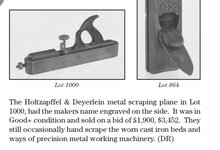
I have just come across this website that has a small amount of information on this tool, although it appears the tool they were discussing was from another maker - http://www.petermcbride.com/metal_plane/. And to answer one of my questions they support Beechwood.
Where I am now getting confused as my great grandfather was a carpenter so as far as I know he would not have been working on cast iron machine beds. It may be possible that he received this as barter for some work he had done. This was one of many planes I received in a box, the others all definitely woodworking planes. So if this is a metal scraping plane, possibly he was using this for infill work.
Reading the website above, and the pictures they have of the stamped Holtzapffel & Deyerlein plane, this may be a unique tool so I think I will look at just cleaning and maintaining tool rather than replacing the handle.
I have just come across this website that has a small amount of information on this tool, although it appears the tool they were discussing was from another maker - http://www.petermcbride.com/metal_plane/. And to answer one of my questions they support Beechwood.
Where I am now getting confused as my great grandfather was a carpenter so as far as I know he would not have been working on cast iron machine beds. It may be possible that he received this as barter for some work he had done. This was one of many planes I received in a box, the others all definitely woodworking planes. So if this is a metal scraping plane, possibly he was using this for infill work.
Reading the website above, and the pictures they have of the stamped Holtzapffel & Deyerlein plane, this may be a unique tool so I think I will look at just cleaning and maintaining tool rather than replacing the handle.
Roberts210
Well-known member
If Grandpa was a carpenter, he used it on wood.
BillK
Well-known member
What does the blade look like ?I have come across an old Holtzapffel & Deyerlein metal scraping plane, that has borer in the woodwork. I can find very little about this tool, would I be making a mistake having the woodwork replaced, or is it best to keep it original and accept the borer.
tombell572
Well-known member
Metal scraping as I know it is performed with hand scrapers such as noted by Firebrick in the above post #9 or power scrapers such as the Biax seen here: https://www.dapra.com/biax/power-scrapers. The above illustrations shown upthread appear to be from an auction catalog which are ofter inaccurate. My guess is a woodworking tool.
Tom B.
Tom B.
Roberts210
Well-known member
Ditto on the inaccuracies of auction catalogs, and also ebay auctions.
This is a very interesting plane! I don't think this is a woodworking plane. Although it would be nice to see a picture of the sole and blade, it does not appear similar to any scraping or toothing plane I've ever seen. It would also be nice to know the weight of the plane, and the width and configuration of the iron.Reading the website above, and the pictures they have of the stamped Holtzapffel & Deyerlein plane, this may be a unique tool so I think I will look at just cleaning and maintaining tool rather than replacing the handle.
Peter McBride is tremendously knowledgeable and clearly he has done significant research on his plane that is quite similar to yours. The section in Holtzapffel's book that McBride links to shows a picture of a plane that appears identical to yours, along with the following text:
The smith's-plane for brass, iron, and steel, fig. 330, has likewise a perpendicular cutter, ground to 70 or 80 degrees; it is adjusted by a vertical screw, and the wedge is replaced by an end screw and block, as shown in the figure, which is one-eighth size. In the planes with vertical irons, the necessity for the narrow mouth ceases; and in the smith's plane some of the irons, or more properly cutters are also grooved on the faces, by which their edges are virtually divided into several narrow pieces; this enables the instrument to be more easily employed in roughing-out works, by abstracting so much of the width of the iron, and by giving it a greater degree of penetration, but the finishing is done with smooth-edged cutters, and those not exceeding from five-eighths of an inch to one inch wide.
Note the use: for "brass, iron, and steel". McBride notes that his plane weighs over 6 pounds. This makes sense for a plane used to cut metal, and is far more than the weight of typical woodworking planes for scraping and toothing. Note also the angle of the cutting edge; 70 or 80 degrees for a 90-degree bedding angle makes sense for metal, but would probably not provide enogh clearance angle for wood. Note also that the use of a grooved iron for "roughing out" is mentioned: this makes sense for metal, but not for wood.
Jim Bode has a similar plane listed on his website (https://www.jimbodetools.com/products/rare-holtzapffel-toothing-plane-92469u) which he describes as a toothing plane. He lists "Russell, ANTIQUE WOODWORKING TOOLS, page 371" as a reference. Unfortunately I don't have this book and it is not easily available.
Although Bode describes this as a toothing plane, I am skeptical. I am not aware of any toothing planes with an iron this narrow (7/8"). if you have ever used a toothing plane it is hard to imagine why someone would build one that narrow; they more typically have 2" irons. Additionally, if narrow toothing planes were useful then I'd argue that someone would have produced them in the form of a standard wooden molding plane.
I believe what you have there is a very rare and unusual plane, and an important historical piece. As such I would recommend no restoration whatsoever, at least for the moment.
Firebrick43
Well-known member
5 and 1/2 lbs to 6 lbs is a pretty common weight for infill planes. Some of the panel infills were over 9 lbs.This is a very interesting plane! I don't think this is a woodworking plane. Although it would be nice to see a picture of the sole and blade, it does not appear similar to any scraping or toothing plane I've ever seen. It would also be nice to know the weight of the plane, and the width and configuration of the iron.
Peter McBride is tremendously knowledgeable and clearly he has done significant research on his plane that is quite similar to yours. The section in Holtzapffel's book that McBride links to shows a picture of a plane that appears identical to yours, along with the following text:
The smith's-plane for brass, iron, and steel, fig. 330, has likewise a perpendicular cutter, ground to 70 or 80 degrees; it is adjusted by a vertical screw, and the wedge is replaced by an end screw and block, as shown in the figure, which is one-eighth size. In the planes with vertical irons, the necessity for the narrow mouth ceases; and in the smith's plane some of the irons, or more properly cutters are also grooved on the faces, by which their edges are virtually divided into several narrow pieces; this enables the instrument to be more easily employed in roughing-out works, by abstracting so much of the width of the iron, and by giving it a greater degree of penetration, but the finishing is done with smooth-edged cutters, and those not exceeding from five-eighths of an inch to one inch wide.
Note the use: for "brass, iron, and steel". McBride notes that his plane weighs over 6 pounds. This makes sense for a plane used to cut metal, and is far more than the weight of typical woodworking planes for scraping and toothing. Note also the angle of the cutting edge; 70 or 80 degrees for a 90-degree bedding angle makes sense for metal, but would probably not provide enogh clearance angle for wood. Note also that the use of a grooved iron for "roughing out" is mentioned: this makes sense for metal, but not for wood.
Jim Bode has a similar plane listed on his website (https://www.jimbodetools.com/products/rare-holtzapffel-toothing-plane-92469u) which he describes as a toothing plane. He lists "Russell, ANTIQUE WOODWORKING TOOLS, page 371" as a reference. Unfortunately I don't have this book and it is not easily available.
Although Bode describes this as a toothing plane, I am skeptical. I am not aware of any toothing planes with an iron this narrow (7/8"). if you have ever used a toothing plane it is hard to imagine why someone would build one that narrow; they more typically have 2" irons. Additionally, if narrow toothing planes were useful then I'd argue that someone would have produced them in the form of a standard wooden molding plane.
I believe what you have there is a very rare and unusual plane, and an important historical piece. As such I would recommend no restoration whatsoever, at least for the moment.
The fact that they stated it was "for brass, iron, and steel" tells me that they don't have a clue about what they are talking about. You could scrape brass and cast iron even if you couln't see what your doing with a scraping type blade but no way you could work steel with a plane. Especially at the time where most steels were very high carbon sheets forge welded to wrought iron backings. The blade wouldn't survive seconds.
Even modern mild steels couldn't be reliably "planed" with such a device. To much force, not HSS to survive for more than a few inches, and again, you cant see what your doing.
5 and 1/2 lbs to 6 lbs is a pretty common weight for infill planes. Some of the panel infills were over 9 lbs.
The fact that they stated it was "for brass, iron, and steel" tells me that they don't have a clue about what they are talking about. You could scrape brass and cast iron even if you couln't see what your doing with a scraping type blade but no way you could work steel with a plane. Especially at the time where most steels were very high carbon sheets forge welded to wrought iron backings. The blade wouldn't survive seconds.
Even modern mild steels couldn't be reliably "planed" with such a device. To much force, not HSS to survive for more than a few inches, and again, you cant see what your doing.
Show me any other plane with a 7/8" blade that weighs over 6 pounds. Even a big infill shoulder plane doesn't weigh that much.
I'm surprised that you think that the Holtzapffels "don't have a clue about what they are talking about". I'm sure with the volume of material they wrote that some inaccuracies crept in, but to say that they don't have a clue is pretty extreme. The fact that Peter McBride owns a plane that matches Holtzapffel's description nearly exactly would seem to lend some validity to the material in the book.
Metal planing has a long history. It shouldn't be a surprise that the technology started out with hand tools. Have you ever used a file?
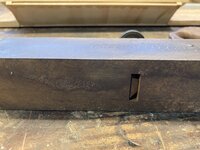
Photos of the sole and iron below. The plane weighs a bit over 7lb. The cutting edge of the iron is 5/8” wide. The iron is vertical in the body of the plane and does appear to have an angle of approx 70 degrees as suggested. I agree, I will leave it as it is and not touch the wood. Whatever it is and how ever old it is, all the adjusting screws and the screw which clamps the iron move freely, and it all feels well madeThis is a very interesting plane! I don't think this is a woodworking plane. Although it would be nice to see a picture of the sole and blade, it does not appear similar to any scraping or toothing plane I've ever seen. It would also be nice to know the weight of the plane, and the width and configuration of the iron


Chance
Well-known member
Thanks for the photos. Appreciate just getting to see it.Photos of the sole and iron below. The plane weighs a bit over 7lb. The cutting edge of the iron is 5/8” wide. The iron is vertical in the body of the plane and does appear to have an angle of approx 70 degrees as suggested. I agree, I will leave it as it is and not touch the wood. Whatever it is and how ever old it is, all the adjusting screws and the screw which clamps the iron move freely, and it all feels well made
RTM
Well-known member
I have several infills, and several scrapers, and I know of Peter McBride, and trust his work a long ways. He has more high quality infills than anyone I know (and in Aus no less).
But instead of me talking out of other orfices, lets go back and look for period literature. Let’s try this book, published in 1872, talking about said people making lathes.

Or another from 1822, where there are described as a celebrated lathe mfgr.

So what do lathes have that might need the metal scraped on? Maybe the ways?
And just to confirm we weren’t talking about an all wood pole lathe, let’s see what they looked like
So yeah, maybe they used it as an infill plane to scrape those fine cabinets seen with the lathes, or maybe they scraped the ways.
And yes, googling images of
scraping plane lathe ways
Will give you half pix of scraper planes, as noted above, and half pix of a guy scraping lathe ways with a stick shaped object as shown above. So nothing definitive in supporting the plane for metal scraping. Some of the google books literature from the pre 1930 era talk of plane and scrape as two separate steps, but it’s not clear whether plane is to use a tool, or to put the surface “into plane”, as there are no pix.
Since all the scraper planes I have seen for wood scraping are wide, and the printers etc I’ve seen have been narrow, I’m sticking with my theory. The rest can draw what ever conclusions work for you.
It’s a very niche tool, I’ve only seen 2 in real life, this makes #3.
But instead of me talking out of other orfices, lets go back and look for period literature. Let’s try this book, published in 1872, talking about said people making lathes.
Notes on the Epicycloidal Cutting Frame of Messrs. Holtzapffel & Co
books.google.com
Or another from 1822, where there are described as a celebrated lathe mfgr.
The Technical repository, by T. Gill
books.google.com
So what do lathes have that might need the metal scraped on? Maybe the ways?
And just to confirm we weren’t talking about an all wood pole lathe, let’s see what they looked like
So yeah, maybe they used it as an infill plane to scrape those fine cabinets seen with the lathes, or maybe they scraped the ways.
And yes, googling images of
scraping plane lathe ways
Will give you half pix of scraper planes, as noted above, and half pix of a guy scraping lathe ways with a stick shaped object as shown above. So nothing definitive in supporting the plane for metal scraping. Some of the google books literature from the pre 1930 era talk of plane and scrape as two separate steps, but it’s not clear whether plane is to use a tool, or to put the surface “into plane”, as there are no pix.
Since all the scraper planes I have seen for wood scraping are wide, and the printers etc I’ve seen have been narrow, I’m sticking with my theory. The rest can draw what ever conclusions work for you.
It’s a very niche tool, I’ve only seen 2 in real life, this makes #3.
Firebrick43
Well-known member
Show me another maker making planes to scrape metal?Show me any other plane with a 7/8" blade that weighs over 6 pounds. Even a big infill shoulder plane doesn't weigh that much.
I'm surprised that you think that the Holtzapffels "don't have a clue about what they are talking about". I'm sure with the volume of material they wrote that some inaccuracies crept in, but to say that they don't have a clue is pretty extreme. The fact that Peter McBride owns a plane that matches Holtzapffel's description nearly exactly would seem to lend some validity to the material in the book.
Metal planing has a long history. It shouldn't be a surprise that the technology started out with hand tools. Have you ever used a file?
And knowledge about steels used in the 1820’s and 30’s would still make say that the author was not knowledgeable in its use, or the editor or typesetter screwed up. And I would say that when those planes were were developed by John Jacob, Charles father, and not Charles himself. There may have been something lost in passing down information there. He would have been 15-20 years old at the time those planes were manufactured.
Cast iron was roughed out by cutting grooves with caping chisels chisels by second year apprentice. First year apprentice would come in then and used these regulating grooves and cold chisels to remove the bulk. Then it was finished out by the third year apprentice or journeyman with finer chisels and then scrapers.
After reading this I used it once on a large burkhardt Weber milling machine(size of a small 2 story house) on the new tool changer part that had a 2x3x1/2” pocket not milled in by the manufacture for some reason. It saved at least a day of disassembly and a day of reassembly, and I completed it in about 3 hours going slow.
Again no machine I have scraped or even the very old machine tools I have seen in museums would a hand plane shape tool fit or see what you were doing.
Have I used a file? What a low insult. I have used and own most types, and some that many have never seen like pull files for my die filer, die files, riflers, even some hand cut French rasps and files
Especially galling since I posted a picture of a single tooth file(aka a scraper) in post 9 that I have used professionally for years and even own a powered version, a Biax.
Have YOU done any scraping of machine tools?
Have I used a file? What a low insult.
Sorry, it wasn't intended as an insult, merely to point out that we all know that you can cut steel with steel.
With that, I'm out of this discussion.
Firebrick43
Well-known member
Some of the google books literature from the pre 1930 era talk of plane and scrape as two separate steps, but it’s not clear whether plane is to use a tool, or to put the surface “into plane”, as there are no pix.
They are more than likely talking about the metal plane or metal planer that became popular in the 1810’s. Was basically a shaper in reverse. Virtually disappeared in just a few years by the ww2 due to the availability of HSS steel cutters and low rates of metal removal.
Planers were how most other machine tools were made. They were a very good machine to make dovetail ways on, lots of bed support. This also made them quite large for their work envelope which also lead to their demise as many shops space is a premium.
Last edited: