To avoid these ads, REGISTER NOW!

Large drywall patch question

zoomzoomjeff

Well-known member
Joined
Sep 21, 2009
Messages
1,471
Location
Des Moines, IA area
I'm readying the new baby room and have to do some drywall work. I'm new to drywall, never done it, although a great guy at Menards gave me enough helpful advice to inspire confidence.

The drywall in our old home comes in 3 layers--2 sheets of cement board, and 1 standard drywall. Not uncommon for these old houses to get layered over, so I hear. I replaced the windows in the house down to the rough framing. Now it's time to finish everything.

Directly below the window is a torn out section of drywall where the sawzall blade caught the edge of the cement board and pulled/cracked the drywall. I figured during the patch, I would span the next few studs over for strength. Plus the previous guy did a ****** job, so I'm ripping that out anyway. So today, I found the stud to the left where I'm going to attach. I'll do the same thing for the right side. Then, square up the cut lines, cut a new identical piece, screw it into the studs and tape & mud.

QUESTION--How far down do I attach the new drywall?
A few inches above the baseboard so I can use the existing drywall to tape onto?
Flush with the top of the baseboard so there's no seams to really match?
Pull the baseboard, replace drywall, reattach baseboard trim?

I planned on pulling the baseboard but when I started to, it looked like I may be opening up a whole new can of worms with where the carpet attaches, and being able to get the baseboard low enough again to match the rest of the room.

--temporarily stuck
 

Attachments

  • IMG_4878.jpg
    IMG_4878.jpg
    138.1 KB · Views: 172
To avoid these ads, REGISTER NOW!

srmofo

Well-known member
Joined
Oct 15, 2009
Messages
6,161
Location
SW ohio
Personally I would pull the base board.

The tack strips should hold the carpet. Then just push it down and shoot a few nails back into it. If its not perfect no one will notice after a touch of paint
 

55chevr

Member
Joined
Jun 12, 2011
Messages
20
Location
Long Island
You could plaster the area and cover with nylon spackling wall cover. I have used this repair on big patches. Can be purchased in 3' widths.
 

Jhoff310

Well-known member
Joined
Jan 2, 2012
Messages
876
Location
Perrysburg Ohio
Personally I would pull the base board.

The tack strips should hold the carpet. Then just push it down and shoot a few nails back into it. If its not perfect no one will notice after a touch of paint

I second this. ..Cut your patch area as square as possible. Yank the baseboard, slap up the new...mud it, sand it paint it done.

Jeff
 
OP
Z

zoomzoomjeff

Well-known member
Joined
Sep 21, 2009
Messages
1,471
Location
Des Moines, IA area
Sweet! Thanks for the direction guys. I appreciate the help from people that have done it before me.

And bunchgrass, thanks for the link--very informational, I already (over)studied their site last night.

Wife is getting nesting anxiety and wants this done YESTERDAY! (yes, I admittedly procrastinate) We have 4 weeks left and have to do drywall, paint, window trim, crib, furniture, etc, etc. This was the hardest part for me and was more of a mental obstacle than anything. Thanks again guys!!
 

mtesh73

Well-known member
Joined
May 19, 2013
Messages
185
Location
Colts Neck, NJ
dont forget, when you get done sanding and its "perfectly" smooth dont just slap some paint on it. the rest of the wall has 2 or 3 coats of paint and texture to match. if you just paint it the patch will stick out like a sore thumb. pick up a good quality primer, ben moore fresh start for example. roll that on with a thick roller and feather it onto the existing finish. once dried it should be pretty close to the texture on the rest of the wall. now top coat, 2x.

patched alot of drywall holes and with this method the patchwork is indistinguishable.
 
To avoid these ads, REGISTER NOW!

TommyK

Well-known member
Joined
Mar 29, 2011
Messages
546
Location
CT
I'm readying the new baby room and have to do some drywall work. I'm new to drywall, never done it, although a great guy at Menards gave me enough helpful advice to inspire confidence.

The drywall in our old home comes in 3 layers--2 sheets of cement board, and 1 standard drywall. Not uncommon for these old houses to get layered over, so I hear. I replaced the windows in the house down to the rough framing. Now it's time to finish everything.

Directly below the window is a torn out section of drywall where the sawzall blade caught the edge of the cement board and pulled/cracked the drywall. I figured during the patch, I would span the next few studs over for strength. Plus the previous guy did a ****** job, so I'm ripping that out anyway. So today, I found the stud to the left where I'm going to attach. I'll do the same thing for the right side. Then, square up the cut lines, cut a new identical piece, screw it into the studs and tape & mud.

QUESTION--How far down do I attach the new drywall?
A few inches above the baseboard so I can use the existing drywall to tape onto?
Flush with the top of the baseboard so there's no seams to really match?
Pull the baseboard, replace drywall, reattach baseboard trim?

I planned on pulling the baseboard but when I started to, it looked like I may be opening up a whole new can of worms with where the carpet attaches, and being able to get the baseboard low enough again to match the rest of the room.

--temporarily stuck

The outlet there is going to make the **** joint difficult to tape. You will need to feather the compound out well past the outlet. I would remove the outlet and safe the wires in the box so you can trowel right over the top of it.
 

schor

Well-known member
Joined
Apr 16, 2013
Messages
531
Location
Ajax, Ontario
You have the line on the left where the drywall ends and it looks like also on the right. Don't take any more off the left or right if your at the end of the 2 sheets.

Take up the baseboard, remove all the drywall down to the floor. To the left of the window cut a nice horizontal line in the existing drywall. Get yourself some nice square areas to patch.

The new patched drywall should go down to the floor within 1/2". You don't want it touching the floor.

I would not use tape between any existing drywall and new, you can use tape on the vertical edge of the 2 new pieces.

When mudding your going to have some filling to do between the old and new, your not using tape. So I would go with a 60 or 90 minute cure compound for filling those cracks. The compound dries very hard and is not easily sandable so be careful that your only filling the cracks to be under flush with the drywall. Once that cures you can start mudding. If you use normal mud on deep or large openings its going to take forever for the mud to set and it will shrink and you'll need to wait days for it to dry, but then you won't wait and get frustrated and try to fill too soon, eventually making a huge mess.
 

schor

Well-known member
Joined
Apr 16, 2013
Messages
531
Location
Ajax, Ontario
The freshstart is great stuff. You may find that after you paint things don't look as good as you thought, hit it again with mud to feather things out. Then prime it again and check it again. If it's your first time this can take a few tries. When feathering between the new and old your probably looking minimum 18" feather to each side of the joint to make things look good.


dont forget, when you get done sanding and its "perfectly" smooth dont just slap some paint on it. the rest of the wall has 2 or 3 coats of paint and texture to match. if you just paint it the patch will stick out like a sore thumb. pick up a good quality primer, ben moore fresh start for example. roll that on with a thick roller and feather it onto the existing finish. once dried it should be pretty close to the texture on the rest of the wall. now top coat, 2x.

patched alot of drywall holes and with this method the patchwork is indistinguishable.
 
OP
Z

zoomzoomjeff

Well-known member
Joined
Sep 21, 2009
Messages
1,471
Location
Des Moines, IA area
The outlet there is going to make the **** joint difficult to tape. You will need to feather the compound out well past the outlet. I would remove the outlet and safe the wires in the box so you can trowel right over the top of it.
Yeah, the picture doesn't show it, but the drywall around the outlet is crumbly. Figured I would go to the right of the outlet another 16" to grab the next stud.

You have the line on the left where the drywall ends and it looks like also on the right. Don't take any more off the left or right if your at the end of the 2 sheets.

Take up the baseboard, remove all the drywall down to the floor. To the left of the window cut a nice horizontal line in the existing drywall. Get yourself some nice square areas to patch.

The new patched drywall should go down to the floor within 1/2". You don't want it touching the floor.

I would not use tape between any existing drywall and new, you can use tape on the vertical edge of the 2 new pieces.

When mudding your going to have some filling to do between the old and new, your not using tape. So I would go with a 60 or 90 minute cure compound for filling those cracks. The compound dries very hard and is not easily sandable so be careful that your only filling the cracks to be under flush with the drywall. Once that cures you can start mudding. If you use normal mud on deep or large openings its going to take forever for the mud to set and it will shrink and you'll need to wait days for it to dry, but then you won't wait and get frustrated and try to fill too soon, eventually making a huge mess.
I've got a full sheet of drywall, was only 6 bux, so length of that patch shouldn't be a problem, material wise. Interesting note on the drywall NOT touching the bottom of the floor. I'll follow that, although the previous guys have it touching. Can you elaborate on why not to tape? I got normal drywall compound not the hot stuff, based on Menards guy, who said since i was new, I could sand it easier, and keep fixing mistakes, the tradeoff being dry time, IIRC. I guess I was thinking 24 hrs between recoats, not days. :eyecrazy: ****.


Oh yeah, for primer, I was going to use Kilz, which is a good all around primer.
 
OP
Z

zoomzoomjeff

Well-known member
Joined
Sep 21, 2009
Messages
1,471
Location
Des Moines, IA area
I figured I would post an update in gratitude to those who replied. You guys really helped me out. Honestly, fear led to procrastination. Once I got started, it wasn't as hard as I made it out to be.

I used a laser level that I had to mark out the horizontal and vertical lines, in order to give me a fairly square empty spot. That also helped me measure the new piece. I started to remove the baseboard but it cracked. The carpet and pad, and some other subflooring pretty much made it impossible to remove the baseboard. So I removed the old drywall and pulled up the old scraps between the baseboard and wall, and vacuumed up the dust. I saw what some of you said about not letting the drywall sit on the floor. The old stuff did this and the bottom of it was moldy, probably due to the old window that leaked.

I used construction adhesive to place the new panel on the wall and set it in place. Then I realized the wall has a bow in it that I wasn't aware of until placing the patch with all of it's adhesive glory into place. When I went to drive the screws, the new drywall stayed rigid, and the screws pulled through in places where the panels were not pressed against each other. So I pumped some adhesive in the largest gaps to give it some sort of "backing". This mostly occurred on the corners of the patch. Probably not what the pros do, but....it worked.

Then that left me with literally 3/8" proud drywall on the corners where the wall bowed. This was not conventional drywall finishing, but I busted out the belt sander with 60 grit and smoothed it all down. Lots of time and dust later...wall is smooth.
 

Attachments

  • IMG_4879.jpg
    IMG_4879.jpg
    145.2 KB · Views: 23
  • IMG_4881.jpg
    IMG_4881.jpg
    141.6 KB · Views: 16
OP
Z

zoomzoomjeff

Well-known member
Joined
Sep 21, 2009
Messages
1,471
Location
Des Moines, IA area
Paper taped the joints, used compound and troweled everything level. Feathered everything way out as recommended here. I was **** about this. Waited to dry, scuff sanded, skimmed it again with compound. Did this x3.

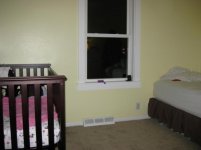
Then masked, primed, painted the entire room including an acccent wall. Built the window jambs, facing, trim, etc from a Arts & Crafts/Craftsman hybrid design I made. Painted the baseboards. Primed, painted, and installed window trim with a new Hitachi finish nailer.

Took a day to: remove all of the tools, temporary sawhorse painting table, took a Q-tip with paint and touched up where the accent walls meet the regular walls, pulled the painter's tape and pulled up plastic from the carpet. (I had the entire carpet covered during the entire operation, thankfully) Reinstalled the HVAC registers I had sealed off, re-wired outlets back into boxes, tried to figure out some backward *** wiring on one outlet. Vacuumed the room, assembled the crib, and waited for the wife to come home to see the finished product.

2 weeks later, baby #2 arrived. Now I'm sleep deprived again. :) Anyways, wanted to follow up with how the progress went, and wanted to thank everyone here for all of the help. I've been a member for a while, but this was the first thread I started. Thanks! --Jeff
 

Attachments

  • IMG_1321 (800x600).jpg
    IMG_1321 (800x600).jpg
    33.7 KB · Views: 5
  • IMG_1322 (600x800).jpg
    IMG_1322 (600x800).jpg
    144.2 KB · Views: 5
Last edited:
To avoid these ads, REGISTER NOW!
Top Bottom