To avoid these ads, REGISTER NOW!

Let’s talk pressure washers in 2025

All

Well-known member
Joined
Mar 28, 2013
Messages
606
@fatfillup

mike93lx kindly tagged you on my behalf, not the OP's.

I piggy backed my issue on the OP's thread, because this thread was full of good information about pressure washer's in general, and based on the thread title, it seemed fitting that my issue would fit right in.

You mentioned reading only a few posts... but post #77 is where this this thread picked up again with a new problem pertaining to a true commercial pressure washer, not a consumer model.

In Post #77, I reported that there appeared to be no water flowing through the General Pump T 47 Series TS1021 pump, and that the inlet filter and piping to the pump were clear and flowing. I mentioned that I would be removing the valve caps to the pump to inspect them. Since that post, I had a chance to do just that.

I started with the first valve on the bottom low pressure half of the pump, nearest to the inlet. Indeed, there was water in the pump, but there was also a stalactite of red rust corrosion visible in the low pressure rail once I pulled the valve assembly. The water side of the pump head is all brass, so I suspect the ferritic corrosion is due to either the high pressure output hose having a steel fitting, or the low pressure inlet elbow having a steel elbow welded to a bracket. I just now eliminated that steel elbow, replacing it with brass.

The remaining two low pressure valve assemblies were found to be stuck closed when extracted, and their removal revealed significantly more corrosion filling the low pressure rail in the pump head body. At that point, it was clear that the entire pump head needed to be removed.

The high pressure valves were all operable and stiction free, but did have traces of red iron corrosion around the poppet plates and seats. With the valve body off of the pump body, I inspected the ceramic plungers, and found a hairline crack on one of them, on the crankcase side of the plunger. Oily residue was also present on all three of the ceramic plungers, at the crankcase end.

Trying to decide now whether or not to rebuild this TS1021 head, or see if I can find a TSS2021 head, to in order to get the nickel plating and the fine threads for the valve caps.
 
To avoid these ads, REGISTER NOW!

fatfillup

Well-known member
Joined
Jan 17, 2009
Messages
10,314
Location
Finksburg, Md
Ok, very common for valves to stick shut if the pump has sat for a while. Have seen it on new pumps that have set on the shelf before being used. Normally, you can pull them out, unstick them, and the pump will work fine. Not common to have the build up you do but the pump has sat for years. I would try cleaning the rust out without removing the seals, just the valves, and flush it well. Reassemble the pump. Then force water to the pump by hooking the garden hose directly to the pump. Look for leaks under the head. This will tell you about the condition of the seals and if the pump head is warped from freezing. Also, while the head is off, look at the crankcase side of the pump where the head bolts to. The area where the brass packing retainers mate up to the head should be flat and not corroded and eaten away. If it isn't flat, you will need a new pump.
As to replacing the head with a nickel plated head and the fine valve cap threads, I can see no benefit.
While force feeding the pump with water, no gun on the pressure hose, turn the machine on and see if you can get water to pass through the heater coil. It may be clogged up with rust. This may or may not be able to be cleared. If you get water passing through the coil, put the gun on without a nozzle and cycle the gun with the machine running. Make sure you have the unloader installed. This will test the unloader function and also the coil for holes. Note, you may jam your gun up with rust from the coil. Next, put a nozzle in and see if it makes pressure.
If the coil is intact, then decide on rebuilding or replacing the pump. You will definitely need a seal extractor tool, 20 mm for that pump.
And the cracked plunger will need replaced also. Also, look at the oil in the crankcase, if may very well be milky.
 

Hohn

Well-known member
Joined
Aug 25, 2016
Messages
2,644
Location
Diesel Central, Indiana
Are we still up for talking about pressure washers in 2025? Before it turns 2026?

@Hohn

@Tinkerer2

If so, then can we please talk about why my belt driven General Pump T 47 Series TS1021 4.8 GPM @ 3K PSI with a Suttner ST-261 Unloader does not appear to be moving any water period?

It is pre-fed by a float tank... I changed the water filter (new filter head, bigger screen, clear bowl, can see supply water flowing), I disassembled and cleaned the float valve, and I reverse flushed the supply line between the pump and the float tank... and was able to reverse fill the float tank via that supply line... so I KNOW that water is available to the pump, which is rated at 9 feet of suction head, and there is only 1 foot of rise between the bottom of the float tank and the entry to the pump.

Yet no water emerges at the port where the pressure hose would otherwise attach.

I removed the belt cover, and the belt is in tact, turns the pump sheave without slippage when driven by the 16 HP B&S Vanguard, which has only been run at idle for less than a minute at a time, since no water is emerging.

I'm not talking about pressurized water... I'm talking about ANY water flow period.

What I used to be able to do is run low pressure water through the pressure washer plumbing and boiler coil to clear out any little bits of mineral accumulation prior to connecting the pressure hose. It has been about 10 years since I last used this machine.

I disconnected the output line from the pump, that goes to a cross fitting that holds the unloader, and there was water in it... but I don't know if it was old water or new water.

I'm about to remove all 6 valve caps on this triplex pump to see if there is anything obviously evident. I am reticent to remove the head without a full set of new seals, and the special tools to remove and reseat them on hand.

I have a feeling that the issue is with the unloader, but I'm not sure how to isolate what the problem is. I don't want to disassemble things due to my ignorance of the simple things that could be the cause.

So let's talk. Tawk some sense to me. Tell me how to methodically tackle this problem, now that you know that I have already tackled the water supply.

Thanks!
The unloader should have only two positions: closed or open. Once open it will vary how far it's open depends on the bypass setting (how tightly you have preloaded the spring) vs the pump outlet flow (the pump has only one output curve, the unloader just sets a pressure value where that curve goes flat in terms of pump RPM). The unloader is effectively just an overpressure relief that opens when the output of the pump gets too low (pressure too high). The excess water flow through the unloader can either recirculate within the unloader, or that recirculation can be on a larger flow loop that includes any external tanks. The latter is preferable because it slows heat build up while in bypass.

It sounds to me like your inlet or outlet check valves in the pump are stuck from years of disuse. You have water getting to the pump's inlet fitting, but you have no proof that water can go beyond that point.

This is exacerbated by your flowing water from a small tank via gravity instead of sending it the full positive pressure of, say, a garden hose. A garden hose has enough pressure it might be able to force open a sticky check valve, but with only gravity, you have limited margin.

The most likely culprit is mineral deposit accumulation. It might be work sending some vinegar into your pump inlet if you're loathe to open the pump.

The pump can turn freely so the plungers are moving. But if the check valves are stuck, you're not actually moving any net fluid displacement.
EDIT: oops, late to the party. Gotta read the rest of the thread next time one revives.
 

All

Well-known member
Joined
Mar 28, 2013
Messages
606
@fatfillup (If short on time, please skip ahead to "New Questions", further below)

Background:

I checked my PM records, and it was you who helped me a dozen years ago, when I first bought the PW and found a hole in the coil. At that time I bought a whole new coil ($1,000) and needed to also buy an entirely new electrode plate assembly and a different diesel injector to work with that assembly (more hundred$, but I forget how many more hundreds, and forget why the electrode plate had to be replaced instead of just the electrodes, other than it was redesigned and the old design was no longer supported).

Long story short... after spending thousands for the machine (complete with "Invoices" of all the service work that had supposedly been done, which turned out to be estimates of all the work that needed to be done, and these estimates were fraudulently doctored to appear as Invoices, complete with fake check numbers for the amounts paid, as later determined from company who supposedly had done the work, but didn't), and then spending thousands more in parts alone to fix this machine as I discovered problems in attempted use, and on top of this ...spending 6 months of my life, labor, and learning curve fixing each issue as it appeared... I simply burned out on the machine and mothballed it. A decade later, I now have a project where I really need it.

Why Water Was In the Pump:

When I parked it, I drained the coil, and left the drain open so that condensation could also drain, even though I kept the machine well covered. What I didn't realize at the time was that the all plastic float tank also needed to be vacuumed out or bailed, as there is no provision to drain the plastic tank. I didn't think that water would hurt the well covered plastic tank, however, the float height of the tank is higher than the pump. Yet since the drain port of the coil is lower than the pump, I thought draining the coil would drain the pump.

Possible Reasons Why Iron Corrosion Was in Pump:

A. Mi-T-M welded a black iron elbow in the piping of the garden hose inlet port. When I inspected the inside of the elbow, it was full of bright orange iron flakes.

B. Mi-T-M connected steel fittings to the brass pump head for the high pressure outlet rail.

C. General Pump uses steel bolts (metric Property Class 10.9) to attach the brass water end to the aluminum crankcase end.

D. Mi-T-M utilized the common "green cap" water inlet screen, which I replaced with a brand new identical housing assembly 12 years ago, and thus it only had a couple of hours use. However, the filter housing is made out of cast aluminum, which is anodized or painted on the outside, but raw aluminum on the inside, where exposed to water. The #50 mesh steel screen inside is stainless steel, which is cathodic to aluminum.

In the presence of an electrolyte (water), the aluminum water filter housing becomes a sacrificial anode... and creates copious amounts of aluminum oxide... a white powdery substance that looks just like calcification of mineral deposits from hard water, but is actually aluminum corrosion from the galvanic interaction with the stainless steel. Aluminum corrosion is something I am familiar with, and can recognize by sight.

When I showed the filter housing to the local pressure washing service center, they said "oh, that is detergent deposits... you're using too much soap." I have never used ANY soap with this pressure washer, and besides, the filter is on the inlet side of the float tank, upstream from the pump. This is one reason I do the work myself. The local service shops do not inspire confidence.

Going Forward:

Now that I have removed the water side of the pump body, I realize that the pump head cannot "drain" unless a valve cap is pulled, or unless the plastic float tank BELOW the pump is COMPLETELY empty. I'm going to remove the float tank and drill a drain port and install a valve at that new drain port in order to drain the float tank, and thus the pump, without having to pull the lower valve caps every time I put the machine away.

New Questions:

1. I have freed up all the valve assemblies (General Pump Part #36703201, Diagram #11). I have not cracked the valve assemblies apart yet to separate the spring, cage, poppet plate, and seat into there separate pieces. Is there any benefit from doing so? Since I'm already in this deep, should I go ahead and get Kit #1 and replace all of the valves anyway, even though they feel like they open/close functionally?

2. What is the difference between Kit #4 and Kit #5. Each kit contains the same parts... the 6 valve caps and 6 Orings that fit under the hex head of the valve cap. My brass valve caps are fine, I only need new O rings for the head of the valve caps (Diagram #9, General Pump Part # 701002, Size .797x.103). Is there a typo, where Kit #4 only has the caps without the O rings? Or is the difference between Kit 4 vs. Kit 5 the difference between nickel plated caps vs non plated caps, or fine threads vs coarse threads?

3. How bad is a hairline crack in the ceramic plunger, that is otherwise smooth to the touch, with no chips or ridges? Still replace?

4. The pump oil is clear and honey amber. I had changed the oil with genuine General Pump oil before I parked it. However, removing the pump head revealed black oily residue underneath the pump that was not previously visible without the head removed. Some of the black oily residue is on the ceramic plungers. Are these strong enough indicators to replace the oil seals for each plunger?

5. Per your suggestion in your post above, I checked the interfacing edges of the pump crankcase and there is no corrosion, and nothing is eaten away. It all looks good and as designed. The corrosion in the water side brass head is limited to the low pressure inlet rail. Is there supposed to be any type of die cut gasket that goes between the brass water side body and the aluminum crankcase side body?

Thanks!
 

Hohn

Well-known member
Joined
Aug 25, 2016
Messages
2,644
Location
Diesel Central, Indiana
Hohn, your explanation is accurate which is something I rarely see outside of the industry.
Thanks. High pressure diesel injection pumps aren't too different from PW pumps in basic operation.

Way too many people treat the unloader like a pressure regulator. In diesel injection systems, overpressure relief and pressure regulation are always two separate devices at different locations. They are separate functions that are easily confused for each other.
 

fatfillup

Well-known member
Joined
Jan 17, 2009
Messages
10,314
Location
Finksburg, Md
New answers :ROFLMAO:
1.Don't separate the valves into pieces, no benefit. To check the valves a bit closer, I set the valves in the vise with the plastic *** down. Put water on top of the poppets up to the top of the valve seat and walk away, The water should remain in the valve. If it leaks through you either have a small piece of **** holding the valve open or it is bad. Kit 1 is the proper valve kit for that pump.

2. The difference between Kit 4 and 5 is nickel plating. The orings are available separately but truly, if they aren't leaking, I don't replace them.

3. The crack is bad, you will **** air through it and eventually eat up the packings. I wouldn't replace until you see if the machine is going to work but that is me. They are not cheap. But if you have an old spare pump, as long as the plunger isn't cracked, they really don't wear much, put a used one in.

4. I wouldn't worry about the black oily residue as you really don't know if it came from the pump. I only replace oil seals if I see oil on the base plate under the pump. And again wait till you see if its going to work before you put seals in. Oils seals will not cause a pump to not work and they almost never leak bad enough to dump all the oil and cause a failure.

5. No gasket between head and pump.
 

fatfillup

Well-known member
Joined
Jan 17, 2009
Messages
10,314
Location
Finksburg, Md
At least on my PW, the unloader is specifically labeled for changing pressure
Primary function of the unloader is to set the spike pressure. That is the pressure used to send the unloader into bypass. You can certainly wind the unloader out to change working pressure, and you can also over adjust the spike pressure and put unnecessary strain on the entire system.
Machine is designed to run at 3000 psi, spike is set about 3400. You can wind the unloader in set the spike at 4500 psi and your working pressure won't change. You will get a huge burst of pressure when you pull the trigger then it will die back down to 3000 psi.
I tell my customers to never adjust the unloader. If you want less pressure, slow the engine down, or put a nozzle in with a larger hole or step back 12 inches.
 
  • Like
Reactions: All
To avoid these ads, REGISTER NOW!

Hohn

Well-known member
Joined
Aug 25, 2016
Messages
2,644
Location
Diesel Central, Indiana
At least on my PW, the unloader is specifically labeled for changing pressure

Right, because it's too hard for marketing departments to educate the consumers on why the unloader isn't a regulator. Understanding why involves explaining how engine power curves and pump curves match, and the effect of orifice sizing. This is beyond what marketing can generally do. So they punt and take the easy option. And if you burn up the pump or unloader on a cheap consumer grade PW, they simply do not care. They're happy to sell you another cheap PW with guidance that will help shorten its life.

The correct way to adjust pressure, of course, is by changing the orifice size used. This is why:

Let's say you buy a typical 3.5gpm gas pressure washer. Like this one:

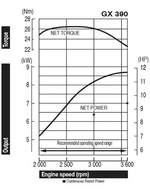
At rated power, the GX390 can produce 17 lb-ft at 3600rpm (just under 12hp). The 66DX35 needs only 14.8lb-ft at 4000psi, so the engine has more power than the pump is capable of loading at 4000psi. This is an "engine limited" arrangement, as the pump cannot create more load than the engine's rating. This means the orifice sizing has essentially no effect on engine speed (and thus pump RPM) because pump load is never higher than engine output.

With the standard 3.5 orifice, it will run about the rated 4000psi and it fill flow about 3.5gpm. If you use the unloader to drop the pressure to a more practical 2500psi, the 3.5 orifice is now only going to flow about 2.77gpm (per the orifice chart).

However, if you lowered pressure by going to a larger 4.5 orifice size, you would preserve all the 3.5gpm flow at the lower pressure.

The real world difference, however, is actually larger. This is because the 3.5gpm rated flow is rated at the rated pressure of 4000psi. The actual displacement of the CAT66dx35 is 14mm bore and 10mm stroke. That calculates to a whopping 4.4gpm at 0 psi outlet pressure (free flow, 100% efficiency) for the 3600rpm operating speed of the Honda GX390.

Pressure washer pumps are positive displacement, so the efficiency doesn't drop off hugely with increases in pressure. But it absolutely does lose efficiency at higher pressure.

The net effect of all this is that using the unloader to drop pressure will decrease flow well below the rated 3.5gpm-- about a 20% flow loss. Using the orifice to lower pressure actually *increases flow* above the nominal 3.5gpm.

So not only is using the unloader as a regulator costing you unloader life and function while reducing the life of the pump, it's costing you perhaps 25% of the output flow.
 
Last edited:

Hohn

Well-known member
Joined
Aug 25, 2016
Messages
2,644
Location
Diesel Central, Indiana
If you're more adventurous, like I am, you can venture into a pressure washer setup that is engine-limited rather than pump-limited.

My PW is originally a Simpson-made DeWalt 3.5gpm, 3800psi with a cheap AR pump. The pump failed. I replaced it with a CAT66dx, but a 4.0gpm pump.

How can I run a 4.0gpm pump with only a GX390? It's simple-- I don't run 4000psi.

The larger 66dx40 needs 17lb ft of torque to make 4000psi, where the smaller 66dx35 only needs 14.8 lb-ft. The GX390 is pretty much tapped out at 17 lb-ft, which is 23Nm.

1760449283360.png

The pump's rated flow is actually at 3400rpm, so at the full 3600rpm engine speed, it's flowing slightly more than rated flow. And the Honda engine is making a bit more torque because torque is rising as RPM falls.

So as long as you aren't pushing pressures far over 3000psi, the torque load on the engine is within it's full-speed limits. Which means I gained a ton of real-world cleaning utility with higher flow but giving up a tiny bit of peak pressure I didn't need.

The net effect is that my little GX390 is providing more than 4gpm real world flow at pressure from 2500-3000psi. This is a level of performance that is physically exhausting to use.

So while on paper my PW is now engine-limited instead of pump-limited, the pump upgrade has made it operator-limited more than anything. Even at only 2500psi, it's physically demanding to use and is well beyond what most people could manage for any long-term usage.

This pump has 14% more displacement than the 3.5gpm unit, so it has a swept volume of over 5gpm at 3600rpm. It's actually nearly a 4.4gpm flow at only 2500psi. That's a major upgrade from a 3.5gpm pressure washer, never mind a 3.5gpm unit that is neutered by improperly using the unloader as a pressure regulator.

I generally use a 4.5 orifice nozzle as my "high pressure" nozzle, with the 5 and 5.5 orifice nozzles getting the "normal pressure" duty. They're perfect for higher flow, lower pressure use like car rinsing/washing where you don't want to strip paint off metal. This setup with the 5.5 orifice crushes any coin-plug hand pressure wash setup you've ever used. The flow is a deluge large enough to make you look over your shoulder for Noah sending out a bird to investigate.
 

mike93lx

ALLIANCE MEMBER
Joined
Dec 9, 2013
Messages
37,553
Location
Richmond, VA
Right, because it's too hard for marketing departments to educate the consumers on why the unloader isn't a regulator. Understanding why involves explaining how engine power curves and pump curves match, and the effect of orifice sizing. This is beyond what marketing can generally do. So they punt and take the easy option. And if you burn up the pump or unloader on a cheap consumer grade PW, they simply do not care. They're happy to sell you another cheap PW with guidance that will help shorten its life.

The correct way to adjust pressure, of course, is by changing the orifice size used. This is why:

Let's say you buy a typical 3.5gpm gas pressure washer. Like this one:

At rated power, the GX390 can produce 17 lb-ft at 3600rpm (just under 12hp). The 66DX35 needs only 14.8lb-ft at 4000psi, so the engine has more power than the pump is capable of loading at 4000psi. This is an "engine limited" arrangement, as the pump cannot create more load than the engine's rating. This means the orifice sizing has essentially no effect on engine speed (and thus pump RPM) because pump load is never higher than engine output.

With the standard 3.5 orifice, it will run about the rated 4000psi and it fill flow about 3.5gpm. If you use the unloader to drop the pressure to a more practical 2500psi, the 3.5 orifice is now only going to flow about 2.77gpm (per the orifice chart).

However, if you lowered pressure by going to a larger 4.5 orifice size, you would preserve all the 3.5gpm flow at the lower pressure.

The real world difference, however, is actually larger. This is because the 3.5gpm rated flow is rated at the rated pressure of 4000psi. The actual displacement of the CAT66dx35 is 14mm bore and 10mm stroke. That calculates to a whopping 4.4gpm at 0 psi outlet pressure (free flow, 100% efficiency) for the 3600rpm operating speed of the Honda GX390.

Pressure washer pumps are positive displacement, so the efficiency doesn't drop off hugely with increases in pressure. But it absolutely does lose efficiency at higher pressure.

The net effect of all this is that using the unloader to drop pressure will decrease flow well below the rated 3.5gpm-- about a 20% flow loss. Using the orifice to lower pressure actually *increases flow* above the nominal 3.5gpm.

So not only is using the unloader as a regulator costing you unloader life and function while reducing the life of the pump, it's costing you perhaps 25% of the output flow.
No argument from me, just sharing a view on why it's so misused/misunderstood.

I was doing a bunch of cleaning this weekend and used the unloader to drop pressure for some asphalt cleaning I had to do... Flow was far less, but it was a one-time, quick need.
 

Hohn

Well-known member
Joined
Aug 25, 2016
Messages
2,644
Location
Diesel Central, Indiana
ONe last tidbit-- for OPE, use a thick oil like 20w50. Black bottle VR1 synthetic is about as good as it gets for OPE. You'll feel the difference in how easy it is to start the engines and how smoothly they run.
 

All

Well-known member
Joined
Mar 28, 2013
Messages
606
OK... what did I blow up?

Besides the 6K PSI pressure gauge, which had a black cap that launched into unfindable lands, and poured water out of the hole in the gauge body left behind... something else under the machine seemed to POP the instant I started the machine with the gun connected. Twice no less, in a repeat performance of dumb, and dumber.

The machine ran beautifully, and pumped water finally, after the pump head was removed and cleaned. Watching the initial water color emerging for the first time out of the coil in a decade... all the water was crystal clear... no signs of coil corrosion whatsoever.

Next step was to connect the first 50' of hose... again, no gun, no tip, just the hose, to clean the hose out. That water was dirty, so I'm thankful that I took this extra step, otherwise that gunk would be in the gun.

Next step was to connect the gun to flush the gun, without a tip. Just as I was ready to test this, an elderly couple walked up to me, so I turned off the machine's engine out of respect for them. Their close proximity puzzled me, and their presence distracted my train of thought. After they passed, I turned on the machine again, forgetting to hold the gun trigger open while doing so.

POP!

My hand hadn't even left the ignition key before the POP happened, so I shut it down, and immediately saw my hand hadn't been squeezing the gun (ST-2000) trigger. No nozzle tip was connected. Dang it, though.

I looked around the machine for where water was leaking... found the blown gauge, and removed it (on a quick release hydraulic fitting for heavy equipment).

I moved the machine to dryer ground so that I could see new witness marks where water was dripping from. Nothing was dripping from the coil base. I got a flashlight and peered inside the vertical tower of the coil. No water on the insulation pancake at the bottom, no water in the boiler can. Since the coil was basically new (I installed it in 2013, and didn't use the machine since) and had no rust water coming out, I don't think I popped any pinholes in the coil.

Hoping the pop was just the gauge blowing, I firmly squeezed the gun trigger, and started it again. Everything was fine. Water flowed through the gun without a tip. HOWEVER, as soon as I let go of the gun trigger...

POP!

WTH happened?

One cannot always keep the gun trigger open, otherwise guns wouldn't have triggers.

What is popping?

Is this an unloader not unloading?

Is there another plumbing element typically found in pressure washer systems, like a non resettable safety device, that once popped, requires replacement?

Let's back up... to bring @fatfillup to speed.

I did end up taking apart the check valves, because despite being stainless steel, there was corrosion between the poppet plate and the seat in each valve cage assembly, that wouldn't go away after a week soaking in white vinegar (5%).

I used a 3/4" close brass ******, a short #2 pencil with a good eraser head, an electrical wire nut that matched the taper of the pencil on the leaded end of the pencil, and a light tack hammer. I set the valve upside down in the 3/4" brass close ******, where the diameter of the cage side of the seat flange protruded past the plastic cage enough to reach the rim of the ******, while the cage cleared the inside of the ****** entirely. I then positioned the pencil eraser on the back side of the poppet plate, and used the tack hammer to hit the wire nut on the tip end of the pencil. One tap was sufficient to quickly and easily separate the valve assembly.

I used a finer version of Scotchbrite type scouring pads to clean the plate and seat, and then wrapped the plate in 1,000 grit wet dry sandpaper, and rubbed the plate into the seat like a mortar and pestle, to shape one into the other. I kept track and maintained isolation of each "matched" pair of plate and seat.

I could then test the sealing of plate and seat flat on the table, without a vice. They all held water. I still tested with the spring and cage assembled, to ensure the spring was still strong enough to resist the weight of water. Despite some micro pitting, they all held water, so they all went back in service.

Obviously, it is quicker and easier (but not cheaper, except in time) to get a Kit 1 and replace, but I kept thinking about your advice not to spend any money until I can confirm that the new coil isn't corroded, and the foregoing steps were not planned, but instead evolved from one thing leading to the next.

The "honey" color of the pump oil indicated that non-OEM pump oil was used... as the General Pump Series 100 oil is dark red. So all the oil was changed to new OEM GP oil. While at it, I changed the engine oil and filter as well, along with the fuel filter, fuel primer bulb, and fuel pump. Plus a new battery.

I also obtained a used 20mm ceramic plunger, and replaced the plunger that had the crack. I bought new O rings for the valve caps, since the old rings had remnants of red Loctite (which should not have been used) on them. The inner valve body O rings were reusable.

All bolts and caps were torqued to specification, but I noticed a 22 ft lb difference in GP specifications for the valve caps, depending on which GP service instructions were consulted. (73 ft lbs vs 95 ft lbs more or less, although I don't remember the exact numbers, just the range).

The thing fires right up, and unlike before, the pump obviously develops pressure after my head and valve cleaning, and the river on the street proved it also flows.

I'm not really sure what to do next... but I need to do something before I try starting it again with a gun attached.

Help!
 
Last edited:

All

Well-known member
Joined
Mar 28, 2013
Messages
606
Primary function of the unloader is to set the spike pressure. That is the pressure used to send the unloader into bypass. You can certainly wind the unloader out to change working pressure, and you can also over adjust the spike pressure and put unnecessary strain on the entire system.
Machine is designed to run at 3000 psi, spike is set about 3400. You can wind the unloader in set the spike at 4500 psi and your working pressure won't change. You will get a huge burst of pressure when you pull the trigger then it will die back down to 3000 psi.
I tell my customers to never adjust the unloader. If you want less pressure, slow the engine down, or put a nozzle in with a larger hole or step back 12 inches.

@fatfillup

I'm still stuck at where I last left this thread.

Unfortunately, when the pressure washer would not develop any pressure or flow at all (prior to my rebuilding of the water side of the pump), I did turn the knob on the unloader, running it all the way in, and all the way out, more than once. That bell cannot be unrung, even though once I get the unloader set this time, I will never ring that bell again.

But right now, I'm having trouble setting the unloader. It isn't clear where nut #8, the last nut on the stem, should be positioned as a start point, with all other components removed from the stem.

The instructions that Suttner sent with the ST-261 Unloader to set the maximum spray pressure and bypass pressure are as follows...

With the pump operating but the spray gun off, loosen set screws and remove pressure adjustment knob. Remove both nuts and set aside. Using the 2.5 mm Allen wrench, loosen set screw and turn adjusting screw with adjustable wrench counterclockwise so that it is flush with top of adjusting screw insert. Tighten set screw. With adjustable wrench, turn the adjusting screw clockwise until the screw insert bottoms out against the nut.

And THIS is where the issue is. That nut can be anywhere along the stem. It is nut #8 in the Suttner diagram (#9 in the MiTM diagram).

There is no guidance as to where nut #8 (#9) should be positioned along the stem prior to "bottoming out the screw insert" against that nut.

I have watched every YouTube video I could find for adjusting the Suttner ST-261, and most of those videos are from one bloke in the UK, who doesn't address that #8(#9) nut (the bottommost nut on the stem that is installed before anything else).

This is a trapped pressure unloader, and boy howdy, was pressure being trapped whenever the gun trigger was closed.

Any guidance will surely be appreciated.
 

fatfillup

Well-known member
Joined
Jan 17, 2009
Messages
10,314
Location
Finksburg, Md
Don't sweat your previous unloader adjusting. Doubt you hurt anything.
I didn't see a parts breakdown so I am guessing about the nuts you are referring to on the unloader stem. They are limiting nuts designed to keep you from over adjusting the unloader to too high a spike. I almost never use them. Nor do any of the manufacturers I am aware of. You can get the unloader close enough without a pressure gauge by simply listening to the motor if its a gas engine machine. Wind the unloader down with the machine running. (Proper size nozzle is helpful for getting most performance.) Listen to the engine, As the pressure increases, the motor will start to work harder. Wind it down till the motor sounds like it is lugging down and back the unloader off a bit. Shut the trigger off and pull it again. You should have a bit of a burst of pressure and then the pressure will die down a bit and the motor will sound like its under a load but not struggling. If you have a big burst of pressure and then it dies off a lot, wind the unloader out a bit more. Just continue till it sounds and feels happy.
 
  • Like
Reactions: All
To avoid these ads, REGISTER NOW!
Top Bottom