To avoid these ads, REGISTER NOW!

Magnetic Squares

Wamsutta

Well-known member
Joined
Jan 8, 2014
Messages
10,912
Location
Amarillo, Texas
T-joints are commonly used to practice welds. I usually just simply hold the two pieces together with one hand as I tack them together, but they never end up square; especially after the tacks cool. A magnetic square would be perfect to hold them in place while the tacks cool. But which one? There's all kinds of them on the market. Strong Hand Tools is one brand that makes them.

T-Joint.png
 
To avoid these ads, REGISTER NOW!

cannuck

Well-known member
Joined
Nov 30, 2021
Messages
4,702
Location
Rural SK
do that and you will ALWAYS have a crooked joint. The beauty of mag squares to set up a weld is you can properly space the joint apart without trapping a piece of wire after tacking.
 
OP
W

Wamsutta

Well-known member
Joined
Jan 8, 2014
Messages
10,912
Location
Amarillo, Texas
A magnetic square will hold the pieces in alignment while you tack them, but if your tacks and welds aren't balanced, the product still won't come out square. The amount of force a cooling weld exerts is far more than the magnet does.
How do I balance out the tacks; put a tack on opposite sides of the runner? Back when I worked at a cabinet factory, they called the piece standing up the "Runner" and the piece laying down the "Sleeper."
 
OP
W

Wamsutta

Well-known member
Joined
Jan 8, 2014
Messages
10,912
Location
Amarillo, Texas
do that and you will ALWAYS have a crooked joint. The beauty of mag squares to set up a weld is you can properly space the joint apart without trapping a piece of wire after tacking.
Are you trying to say magnetic squares aren't strong enough for what I'm trying to do; the pieces need to be clamped?
 
Last edited:

cannuck

Well-known member
Joined
Nov 30, 2021
Messages
4,702
Location
Rural SK
Are you trying to say magnetic squares aren't strong enough for what I'm trying to do; the pieces need to be clamped?
If you do not provide the correct clearance between the 2 plates and leave them touching each other, when you tack any one place it will bend the plate off of 90 degrees with more force than the magnets will hold. That gap is often done with welding wire, and when you tack a wire spaced gap the contraction of the tack will trap the wire. When plates are positioned apart with magnets they will simply slide down the gap by slipping on face of magnetic angle positioner, maintaining exactly 90 degrees. You NEVER **** 2 pieces together with no gap unless you are prepared to deal with the resulting distortion and tolerate the stress you are building into the joint. Also, as plate thickness goes up, the gap is needed to allow full penetration of weld bead(s).
 
OP
W

Wamsutta

Well-known member
Joined
Jan 8, 2014
Messages
10,912
Location
Amarillo, Texas
If you do not provide the correct clearance between the 2 plates and leave them touching each other, when you tack any one place it will bend the plate off of 90 degrees with more force than the magnets will hold. That gap is often done with welding wire, and when you tack a wire spaced gap the contraction of the tack will trap the wire. When plates are positioned apart with magnets they will simply slide down the gap by slipping on face of magnetic angle positioner, maintaining exactly 90 degrees. You NEVER **** 2 pieces together with no gap unless you are prepared to deal with the resulting distortion and tolerate the stress you are building into the joint. Also, as plate thickness goes up, the gap is needed to allow full penetration of weld bead(s).
So should I put a piece of MIG wire underneath the runner on each end before I apply the magnets?
 
OP
W

Wamsutta

Well-known member
Joined
Jan 8, 2014
Messages
10,912
Location
Amarillo, Texas
I think I got it figured out what you guys are telling me.

If I leave a gap in the joint, that will allow room for the metal to expand, preventing the runner from tilting one way or the other.
 

whateg01

Well-known member
Joined
Mar 13, 2006
Messages
11,814
Location
doo dah, kansas, usa
I think I got it figured out what you guys are telling me.

If I leave a gap in the joint, that will allow room for the metal to expand, preventing the runner from tilting one way or the other.
It doesn't expand. It contracts when it cools. If you want to see it in action, run a good bead across one side of a piece of square tubing. Let it cool, then set it on something flat
 

cannuck

Well-known member
Joined
Nov 30, 2021
Messages
4,702
Location
Rural SK
So should I put a piece of MIG wire underneath the runner on each end before I apply the magnets?
what you put there depends on the thickness of the materials you are welding and if you need a full penetration root - and of course if your welder has the power to penetrate half way through the plate with gap. For no other weld prep, I like to be almost 1/2 material thickness - so if you are doing 1/4 plate as was suggested above you might want 3/32 or even 1/8. Once you get over 1/4" unless you are hitting it with BIG power time to start doing some bevelling to prep the weld to reach full root depth.

I should add if you have only a limited amount of power, you can still weld any material thickness. You just have to learn how to prep the joint and design the weld. On some critical jobs, multi-pass welds can induce less stress and distortion (and keep in mind EVERY weld does both of those things). Hang out on a welding website and practice, practice, practice.
 

whateg01

Well-known member
Joined
Mar 13, 2006
Messages
11,814
Location
doo dah, kansas, usa
what you put there depends on the thickness of the materials you are welding and if you need a full penetration root - and of course if your welder has the power to penetrate half way through the plate with gap. For no other weld prep, I like to be almost 1/2 material thickness - so if you are doing 1/4 plate as was suggested above you might want 3/32 or even 1/8. Once you get over 1/4" unless you are hitting it with BIG power time to start doing some bevelling to prep the weld to reach full root depth.

I should add if you have only a limited amount of power, you can still weld any material thickness. You just have to learn how to prep the joint and design the weld. On some critical jobs, multi-pass welds can induce less stress and distortion (and keep in mind EVERY weld does both of those things). Hang out on a welding website and practice, practice, practice.
I'm not trusting any welds in 3/4" steel don't with a 125A mig no matter how many passes unless they preheated it to red hot and held it there while running beads
 
OP
W

Wamsutta

Well-known member
Joined
Jan 8, 2014
Messages
10,912
Location
Amarillo, Texas
It doesn't expand. It contracts when it cools. If you want to see it in action, run a good bead across one side of a piece of square tubing. Let it cool, then set it on something flat
Run a flat weld on one side of the top, or run a horizontal weld across one side?
 

scooby074

Well-known member
Joined
Oct 26, 2008
Messages
5,289
Location
Nova Scotia
This is one of the most important lessons you can learn in welding. Keeping stuff from moving or warping. Practice is key. Welds shrink as they cool so you need to balance them. All a magsquare will do is hold them square for tacking, but even then, its easy to pull something out of alignment. Youd need a very strong jig to hold something against the forces a weld can put on a joint.,
 
OP
W

Wamsutta

Well-known member
Joined
Jan 8, 2014
Messages
10,912
Location
Amarillo, Texas
This is one of the most important lessons you can learn in welding. Keeping stuff from moving or warping. Practice is key. Welds shrink as they cool so you need to balance them. All a magsquare will do is hold them square for tacking, but even then, its easy to pull something out of alignment. Youd need a very strong jig to hold something against the forces a weld can put on a joint.,
OK so even if I manage to keep the T-joint square after the tacks, it's still going to pull out of square when I run a full pass on one side of the runner; is that what you're saying?
 
To avoid these ads, REGISTER NOW!
OP
W

Wamsutta

Well-known member
Joined
Jan 8, 2014
Messages
10,912
Location
Amarillo, Texas
magnets are great for holding/jigging things in place to get some tacks done
So what you're saying is if the project being welded is big enough, and if there's enough tacks in place, everything should stay square; correct?

My little T-joint samples are made out of 2 inch by 10 inch strips at 1/8 thick. That's a lot of heat for a small amount of material I guess. :headscrat
 

The Cobbler

Super Moderator
Staff member
Joined
Oct 24, 2013
Messages
26,133
Location
Niagara Region, Ontario, Canada
I don't think so, but it kind of looks better if it is. . .
makes sense. I get it . 1/8" is going to get real hot real fast .
I watch a guy on You Tube that does custom auto body work, all his welds are basically tacks, and several inches apart . in the end the panels are welded solid with tacks . but I understand why you can;t do that
 
OP
W

Wamsutta

Well-known member
Joined
Jan 8, 2014
Messages
10,912
Location
Amarillo, Texas
yes, the best chance of keeping stuff from moving is not getting the metal too hot. But by no means am I an expert on welding, so take it fro what it's worth
The little strips are glowing red hot at the end of the pass. Maybe I should try clamping them instead, but the clamps need to stay out of the way of the weld pass. I was hoping if I had everything square after the tacks, I'd be good.
 
Last edited:
OP
W

Wamsutta

Well-known member
Joined
Jan 8, 2014
Messages
10,912
Location
Amarillo, Texas
makes sense. I get it . 1/8" is going to get real hot real fast .
I watch a guy on You Tube that does custom auto body work, all his welds are basically tacks, and several inches apart . in the end the panels are welded solid with tacks . but I understand why you can;t do that
Yeah that makes perfect sense on sheet metal, but I thought I could get away with full passes on 1/8 thick material. I guess I need to reassess everything.
 

The Cobbler

Super Moderator
Staff member
Joined
Oct 24, 2013
Messages
26,133
Location
Niagara Region, Ontario, Canada
I guess the only thing I can say is, they will know that the metal is going to move on you. they are probably looking for the weld quality , not the alignment of the pcs, maybe you're overthinking the fact of trying to keep it square?
I get why you want it to look right. :dunno:
 
OP
W

Wamsutta

Well-known member
Joined
Jan 8, 2014
Messages
10,912
Location
Amarillo, Texas
I guess the only thing I can say is, they will know that the metal is going to move on you. they are probably looking for the weld quality , not the alignment of the pcs, maybe you're overthinking the fact of trying to keep it square?
I get why you want it to look right. :dunno:
I'm going to continue using clamps for tacking and forget about the magnets. I find that I can stay pretty square if I clamp the runner to a piece of square bar stock and then use a 2nd clamp on the runner holding the whole assembly against the table for the tacks.
 

whateg01

Well-known member
Joined
Mar 13, 2006
Messages
11,814
Location
doo dah, kansas, usa
makes sense. I get it . 1/8" is going to get real hot real fast .
I watch a guy on You Tube that does custom auto body work, all his welds are basically tacks, and several inches apart . in the end the panels are welded solid with tacks . but I understand why you can;t do that
A bunch of little tack welds is a good way to not pass this "test". If you do that in structural stuff, you run a good chance of not getting any penetration. 1/8" hot enough, it'll probably be sound, but it'll won't get you a job.
 

whateg01

Well-known member
Joined
Mar 13, 2006
Messages
11,814
Location
doo dah, kansas, usa
Ignore the obvious advertisement in it, but if you watch fireball tools video on his fixture table and why you need one, you can see how the parts move when being welded.
 

whateg01

Well-known member
Joined
Mar 13, 2006
Messages
11,814
Location
doo dah, kansas, usa
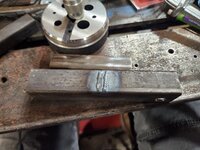
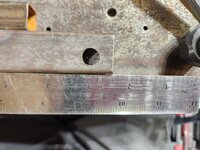
Just ran 2 beads across one side of this 1" tubing to similar a bead on each side of a T joint. Was straight before. Now you can see the gap at one end from it bowing in the middle from the welds cooling. This piece is about 5.5" long. Different shapes will pull different amounts. This was tig, and not the prettiest but I didn't clean anything at all, so not exactly an apples to apples comparison. This is just to give you an idea what happens when the weld cools.

20240405_231748.jpg

20240405_231415.jpg
 

J.A.F.E.

Well-known member
Joined
Sep 25, 2008
Messages
1,746
Location
Formerly Area 49 now Area 52
A really good resource is the book Modern Welding by Andrew D. Althouse, Kevin E. Bowditch, Mark A. Bowditch, William A. Bowdich and Carl Turnquist will give you all the details you could ever want. It was written as a textbook. The current edition is quite expensive but used older editions can be had very reasonably. Something around 2000 or newer will be more than adequate with plenty of of nice color photos, clear illustrations and well written text.
 
To avoid these ads, REGISTER NOW!
Top Bottom