To avoid these ads, REGISTER NOW!

MH High Bay Lighting for shop, need help !

Busted_Knuckles

Well-known member
Joined
Oct 9, 2009
Messages
2,613
Location
Northwest Illinois
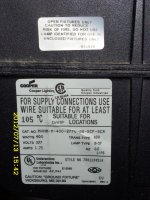
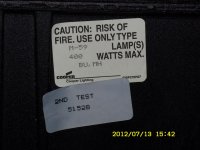
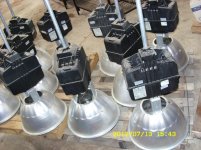
I came across a deal on some cooper 400w Metal Halide High Bay lights used. They are 277v ballasts, there are no other taps, they do not appear to be electronic, the lights are dated 1998, and they appear to be 277 or nothing.

The guy I got them from I know, and promises me they are all good take outs from a local school that got new lighting. My shop right now has a string of temp lighting (100w incans). You cant see anything at this time, with the lights on, I have a 15' lid and need some serious lumens !

I do not have 3 phase, and 3 phase is miles from my farm. That said, I have 200amps of single phase in my 5k sqft shop. Id like to use these lights, but I need someone who knows what they are doing to give me an "ok", or "no" it wont work.

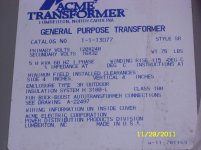
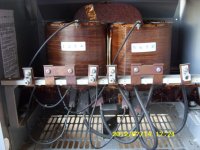
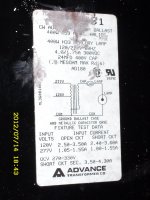
My first question is, will the buck boost transformer I have, give me something close enough voltage to run the lights ? 5KV 120/240- 16/32, it appears to be single phase.

If not, I have a step down 480/240 transformer, I think it is single phase, but not sure, can I grab one leg of this transformer running it backwards to power the lights ?

Any input is appreciated, thanks, BK.
 

Attachments
  • 07-13-2012 003.jpg
    07-13-2012 003.jpg
    143.9 KB · Views: 22
  • 07-13-2012 001.jpg
    07-13-2012 001.jpg
    148.2 KB · Views: 20
  • 07-13-2012 002.jpg
    07-13-2012 002.jpg
    145.8 KB · Views: 17
  • 11-29-2011 031.jpg
    11-29-2011 031.jpg
    82.8 KB · Views: 18
  • 11-29-2011 030.jpg
    11-29-2011 030.jpg
    76.2 KB · Views: 14
Last edited:
To avoid these ads, REGISTER NOW!

Speedy Petey

Well-known member
Joined
Apr 22, 2012
Messages
1,430
Location
NY State
I assume you mean 5kVA, or kW, transformer.
Unless the 480/240v transformer can produce a neutral, as in 277/480V, you cannot use it.
277V is half 480V but with a neutral.
 

Norcal

Well-known member
Joined
Mar 16, 2008
Messages
13,792
Go to eBay & look for ballast kits, the old ballasts have scrap value, to recover some money. 277V is a very popular non-residential voltage & when buying used fixtures a buyer needs to avoid them like the plague, they are worthless IMHO.
 

Stuart in MN

Well-known member
Joined
Sep 8, 2005
Messages
23,413
Location
Minneapolis
High bay fixtures are designed for 20' or higher ceilings, unless your garage is that tall I wouldn't use them as the light distribution will be off. You'll end up with a series of 'hot spots' under each light, and darker areas in between.
 
OP
B

Busted_Knuckles

Well-known member
Joined
Oct 9, 2009
Messages
2,613
Location
Northwest Illinois
High bay fixtures are designed for 20' or higher ceilings, unless your garage is that tall I wouldn't use them as the light distribution will be off. You'll end up with a series of 'hot spots' under each light, and darker areas in between.


Thanks, I know Im a little low, about 5', Ive got nothing in the lights, and have no lighting.. to speak of now. Figured allot of light unevenly distributed is better than little to no light. Was planning on putting 4 of these in each 35x25 bay. Each bay will have a lift, so the lift dictates where the lights go, so to speak.

I could pull the reflectors off, and just put tin hats on top of them. Ive worked commercial interior remodeling, and we have used these lights with no reflectors, its allot of bang for the buck, especially when they are almost free.
 
Last edited:
OP
B

Busted_Knuckles

Well-known member
Joined
Oct 9, 2009
Messages
2,613
Location
Northwest Illinois
Go to eBay & look for ballast kits, the old ballasts have scrap value, to recover some money. 277V is a very popular non-residential voltage & when buying used fixtures a buyer needs to avoid them like the plague, they are worthless IMHO.

I got them for almost nothing, as you pointed out 277 is usually one leg of 480 off 3 phase, which like all things 3 phase on the secondary market, just about worthless, which is perfect If you are poor and cheap like me, which is why Im trying to make this work. Right now its so dark in there, that I pretty much dont bother spending any time at night in there. I think these lights would brighten it up a bit.

Heres what I was thinking,...

Ive got a large single phase transformer that will step 120 to 240. On one line/leg, then I have the little transformer that will take my 240 to 272, basically 277. The tags in the first post are the two transformers, I guess Im looking for someone to tell me if this will work, or why it wont.

The lights are single phase, just have a black and white + ground, why wont that work ?
 
Last edited:

jeff000

Well-known member
Joined
May 6, 2012
Messages
437
Don't use a single leg of a 3 phase transformer.
Don't wire transformers backwards unless it is spec'ed to be able to do so. Some cheap ones will draw a high current without load when wired backwards and just overheat.

Ghetto rigging transformers to get a voltage is not a good idea.
Using two transformers to get your voltage, even if it does work, is going to cost you 30%+ more power to run these light then it should. And these lights are already going to cost you a lot. It'll be cheaper to buy tri-tap ballasts, They are like 60 bucks each.

But then you still have the crappy fact that the MH takes 15 minutes to give you useful light.

Basically best case it works, and you just double up on transformer losses, and I am going to assume these are either real old or real cheap transformers, so those losses will be high. If you can get an actual 272v, that's still on the low side of it working.
Worse case is one or both of the transformers light on fire.
 
OP
B

Busted_Knuckles

Well-known member
Joined
Oct 9, 2009
Messages
2,613
Location
Northwest Illinois
Don't use a single leg of a 3 phase transformer.
Don't wire transformers backwards unless it is spec'ed to be able to do so. Some cheap ones will draw a high current without load when wired backwards and just overheat.

Ghetto rigging transformers to get a voltage is not a good idea.
Using two transformers to get your voltage, even if it does work, is going to cost you 30%+ more power to run these light then it should. And these lights are already going to cost you a lot. It'll be cheaper to buy tri-tap ballasts, They are like 60 bucks each.

But then you still have the crappy fact that the MH takes 15 minutes to give you useful light.

Basically best case it works, and you just double up on transformer losses, and I am going to assume these are either real old or real cheap transformers, so those losses will be high. If you can get an actual 272v, that's still on the low side of it working.
Worse case is one or both of the transformers light on fire.

The transformers say on the label, that both are single phase, not 3.

The transformers dont declare if you can run them backwards, mechanically, I dont see the problem there, which is why Im asking here.

I expect the load to at least double, if not triple, for its all proportional math, no such thing as free lunch, and I understand I loose power each time I go into a transformer. For the little amount of juice these things run, in comparison to other lighting fixtures, I still see it as a win. Dont forget, Ive got nothing in the transformers or the lights. Yes, I understand that years of electrical use can add up. Im not dollar stupid, but I am cheap.

I got the transformers, and lights so cheap, as long as they dont burn down the shop, I dont much care if I burn them up.

I will research the transformers. Are ACME transformers cheap garbage ? They are made in the Carolinas, not like I picked them up at the Chicom retailer.

I will also look for the tri-tap ballasts, where do you suggest I look ?

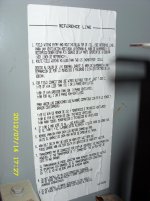
I just found this at the manufactures site:

7. Can Acme Transformers be reverse connected?
ACME dry-type distribution transformers can be reverse
connected without a loss of KVA rating, but there are certain
limitations. Transformers rated 1 KVA and larger single phase,
3 KVA and larger three phase can be reverse connected without
any adverse effects or loss in KVA capacity. The reason for this
limitation in KVA size is, the turns ratio is the same as the voltage
ratio. Example: A transformer with a 480 volt input, 240 volt
output— can have the output connected to a 240 volt source
and thereby become the primary or input to the transformer,
then the original 480 volt primary winding will become the
output or 480 volt secondary.
 
Last edited:

BFBOB

Well-known member
Joined
Sep 20, 2011
Messages
5,073
I like MH lights. I like the efficiency-same as fluorescents, I like the color-4100K in my case, and I like the directionality compared to long tubes. Personal taste.
Turn-on time is an issue, but for mine it's closer to 5 minutes than 15. I don't much like the idea of doubling up the transformers; if you had single 120-277V transformers, it would be different.
Sourcing 120V ballasts is a better idea, in my opinion. Start at the ballast manufacturer's website and see whether they make the same ballast in other voltages.
The capacitor should be ok, but you may need to change the ignitor. Read up! It ain't like changing a light bulb!
 

Executive

Well-known member
Joined
Jun 29, 2012
Messages
77
This is a bad idea all around. Connecting a transformer in an electrical system is what the code calls a separately derived system. Lots of grounding, bonding, and OCP requirements. Also, doubling a 120 volt circuit at 20 amps will net a 10 amp 240 volt circuit. The OP is looking to step up 120 to 240 and then boost the 240 to 277 using a buck-boost autotransformer. This is putting good money after bad. Many, many more bad things can happen with this attempted installation.

Best advice for the OP is to sell the lights he has on CL or EBay and buy new lights of the correct type and voltage.

Chris
 
Last edited:

Speedy Petey

Well-known member
Joined
Apr 22, 2012
Messages
1,430
Location
NY State
This is a bad idea all around. Connecting a transformer in an electrical system is what the code calls a separately derived system. Lots of grounding, bonding, and OCP requirements. Also, doubling a 120 volt circuit at 20 amps will net a 10 amp 240 volt circuit. The OP is looking to step up 120 to 240 and then boost the 240 to 277 using a buck-boost autotransformer. This is putting good money after bad. Many, many more bad things can happen with this attempted installation.

Best advice for the OP is to sell the lights he has on CL or EBay and buy new lights of the correct type and voltage.

Chris
But I truly don't think this is the answer he wants to hear.
 
OP
B

Busted_Knuckles

Well-known member
Joined
Oct 9, 2009
Messages
2,613
Location
Northwest Illinois
This is a bad idea all around. Connecting a transformer in an electrical system is what the code calls a separately derived system. Lots of grounding, bonding, and OCP requirements. Also, doubling a 120 volt circuit at 20 amps will net a 10 amp 240 volt circuit. The OP is looking to step up 120 to 240 and then boost the 240 to 277 using a buck-boost autotransformer. This is putting good money after bad. Many, many more bad things can happen with this attempted installation.

Best advice for the OP is to sell the lights he has on CL or EBay and buy new lights of the correct type and voltage.

Chris


Thanks Chris, just running what I brung.. I dont have the $$$$$$ for the proper lighting, if I did, I would not be on this forum trying to work my way through this, there would be a van in my drive and two electricians in my shop doing a several thousand dollar install as I type, but hell will freeze over before that happens, if I dont make it happen on a shoe string, its a no-go.

Anyway, I just got off the phone with a journeymen commercial electrician, he told me not to stack the transformers, due to their size, something to do with the windings and AMPS, said it was not a good idea.

He did however tell me that he has seen 277 MH lighting run on single phase 240v straight. He told me to wire it up using the acme transformer running it backwards, and to look at the amps and volts. He said it should be fine, if the transformer and lighting fixture are fine. Probably wont get full lumens.

I also put a call into an industrial electrician, and he told me to go for it as well. With little caveats, except to check my amps and volts when Im done.

Basically with the money I got in them, if I FUBAR both of them (Light and transformer), Im really not out much, not even a replacement ballast for one light $, including my cost for the transformer.

May be a bad idea, but no one has yet to spell out exactly, mechanically, why its a bad idea, that is what I was looking for. You did approach spelling it out, but you did it in "Latin", not laymen's terms, so I cant decipher your post, but am left to assume you know a reason not to do this, but Im not sure what it is.

Im do understand the math of amps and voltage, one goes up the other goes down and such, but Ive got 200amps in the shop and 37.5kv transformer, not sure where the problem there is. If I have all 4 bays lit up at the same time, after the transformer, Im looking at 50amps, maybe ?

Its only me in the shop, I only work in one bay at time...
 

Executive

Well-known member
Joined
Jun 29, 2012
Messages
77
Let me try an analogy. You have a Toyota truck and you are trying to make a GM Duramax diesel fit because you got it for free. You'd rather try to modify the fuel before it gets to the engine than change out the fuel tank and run proper diesel fuel.

Yeah, not the best analogy but in essence that is what you are trying to do.

When you install a transformer, you can not just run directly to the lighting you want it to power. It needs to go through an over current protection panel (fuse or circuit breaker box) first. This is on the secondary or output side of the transformer. The main problem is, you do not have the correct voltage to begin with to end up with true 277 and the scheme you have devised violates too many electoral codes to list. You *might* rig it to work but when a circuit or ballast (which, by the way are not electronic, they are old fashioned magnetic type) burns up due to low voltage and there is no proper fuse or CB to open the circuit, you WILL have a fire. Not trying to scare you but if that does happen, I assure you that your insurance will not cover any damage. You also run the risk of not grounding the transformer correctly. When a transformer is installed, it must be grounded to the premises ground system and all metal piping in the local area of that transformer must be bonded as well. Typically this goes to the "XO" tap on the transformer in a three phase system but since you do not have three phase to begin with, that "XO" is not doing what it is supposed to (manufacture a neutral) and any connection will likely cause stray currents of wildly differing voltages. These will likely show up on other properly grounded equipment and cause further headache. Honestly, this is not a DIY type installation and what you are trying to do really is not good. You don't have to trust me, but research some more and you will see. And the "licensed" guys who suggest that you "try it" are full of you-know-what.

Chris
 
Last edited:

nehog

Well-known member
Joined
Jan 2, 2010
Messages
7,935
Location
Jaffrey, NH
OP: that 5 KVA transformer wired to produce 32 volts on the secondary, boosting the 240 to 272 volts would work. Basically all you are doing is creating auto-transformer, a configuration that is commonly done as it is rather efficient. Do I recommend doing this? Nope, not the best solution, partially because you are then using a non-standard voltage configuration in your shop.

Wired as an auto-transformer that 5 KW unit would easily handle all the needed current assuming that the specs are correct as per the label you show.

...
Don't wire transformers backwards unless it is spec'ed to be able to do so. ...

Balderdash, no transformer knows its secondary from its primary. As long as you stay within the voltage and currents specified, a secondary winding can be used as the primary winding. I suspect you missed that in class when you studied power transformers. :beer:
 
OP
B

Busted_Knuckles

Well-known member
Joined
Oct 9, 2009
Messages
2,613
Location
Northwest Illinois
Let me try an analogy. You have a Toyota truck and you are trying to make a GM Duramax diesel fit because you got it for free. You'd rather try to modify the fuel before it gets to the engine than change out the fuel tank and run proper diesel fuel.

Yeah, not the best analogy but in essence that is what you are trying to do.

When you install a transformer, you can not just run directly to the lighting you want it to power. It needs to go through an over current protection panel (fuse or circuit breaker box) first. This is on the secondary or output side of the transformer. The main problem is, you do not have the correct voltage to begin with to end up with true 277 and the scheme you have devised violates too many electoral codes to list. You *might* rig it to work but when a circuit or ballast (which, by the way are not electronic, they are old fashioned magnetic type) burns up due to low voltage and there is no proper fuse or CB to open the circuit, you WILL have a fire. Not trying to scare you but if that does happen, I assure you that your insurance will not cover any damage. You also run the risk of not grounding the transformer correctly. When a transformer is installed, it must be grounded to the premises ground system and all metal piping in the local area of that transformer must be bonded as well. Typically this goes to the "XO" tap on the transformer in a three phase system but since you do not have three phase to begin with, that "XO" is not doing what it is supposed to (manufacture a neutral) and any connection will likely cause stray currents of wildly differing voltages. These will likely show up on other properly grounded equipment and cause further headache. Honestly, this is not a DIY type installation and what you are trying to do really is not good. You don't have to trust me, but research some more and you will see. And the "licensed" guys who suggest that you "try it" are full of you-know-what.

Chris

Thank you Chris, I work with analogies quite well, as well as facts, Im not looking to burn the place down, yes, Im trying to put something together for nothing, but thank you for the cause and effect of my attempts. That is what I was looking for.

I figured it would run hot and with a shortened life with low voltage. The fire part I was not considering, which is one of the reasons I posted this here, to get feedback for things like that.

Im not quite a DIY guy, I spent years wiring automated manufacturing machines and equipment from 480v ac down to 12v dc. I had to engineer allot of it on the fly, because the print rarely matched the equipment. I also worked for a commercial electrical contractor (Id call the ***** and talk to him, he knows exactly the answers to my questions, but stiffed me $ 10 years ago, and Im not up for the drama). Im just a little out of my element on this one, which is why Im soliciting input from the community. If I was entirely clueless, I would not have been able to put the math together, that suggests this would work, as I configured it, with what I have. Im actually better tooled, as an electrician than allot of full time employed sparkies. I also have all my digits...

Thanks for the detailed reply, BK.
 
Last edited:
OP
B

Busted_Knuckles

Well-known member
Joined
Oct 9, 2009
Messages
2,613
Location
Northwest Illinois
For the record (anyone else who comes along and finds this thread in the future), No. 7, states that the transformer can be used in either direction. This sticker is on the inside of the transformer. I thought I remembered that from school, as Nehog pointed out, a coil of wire does not now where the power is coming from or going too. (primary/secondary)
 

Attachments

  • 07-13-2012 002.jpg
    07-13-2012 002.jpg
    138.2 KB · Views: 7
  • 07-13-2012 001.jpg
    07-13-2012 001.jpg
    129.2 KB · Views: 9
  • 07-13-2012 005.jpg
    07-13-2012 005.jpg
    139.8 KB · Views: 7
To avoid these ads, REGISTER NOW!

Executive

Well-known member
Joined
Jun 29, 2012
Messages
77
For the record (anyone else who comes along and finds this thread in the future), No. 7, states that the transformer can be used in either direction. This sticker is on the inside of the transformer. I thought I remembered that from school, as Nehog pointed out, a coil of wire does not now where the power is coming from or going too. (primary/secondary)

A transformer is NOT directional equipment. The OP is quite correct in that a transformer WILL transform voltage (and the resultant available current) in either direction. Anyone that doubts this should put 16 volts to the terminals of a doorbell transformer and then measure the voltage at the leads.

Chris
 

Charles (in GA)

Well-known member
Joined
Jan 11, 2006
Messages
12,489
Location
50 mi south of Atlanta
Determine whether these are probe start or pulse start (pulse is newer) and then find the proper ballasts kits, either 120v or multi-taps (which are usually easier to locate than straight 120v) I got lucky, my MH lights have straight 120 ballasts in them, and I'm running them on multi-wire circuits. They are mounted with the BOTTOM of the light reflector at 15 ft and the reflectors are translucent polycarbonate. I set the reflector up as high as possible to get as wide a light spread as possible, and they work OK. With aluminum reflectors, you do not have any uplight, and you get what is known as "cave effect" because of the dark ceiling without any uplight from the fixtures.

The fixtures on 120v will draw exactly 4.0 amps each. Four lights in the area you describe is a lot of light.

Charles.
 

Norcal

Well-known member
Joined
Mar 16, 2008
Messages
13,792
I still say do a ballast swap, there are a lot of high bay & low bay HID fixtures being replaced in lighting retrofits, contact scrap yards,check C-list,etc. & with time they will be found, if you do it right you'll be better off then jury-rigging a installation, if you look at your fixtures there may be a few that had multi-tapped ballast kits installed if any failed.

I like a bargain like anyone else, but sometimes even free is no bargain.
 

Executive

Well-known member
Joined
Jun 29, 2012
Messages
77
400 watt ballast replacement kit is going to cost +/- $100.00. The OP could buy a four lamp T5 120 volt luminaire (code-speak for light fixture) with lamps for not much more than this and have the correct application for the ceiling height, better light distribution, operational savings, instant-on, and no voltage issues.

Chris
 
OP
B

Busted_Knuckles

Well-known member
Joined
Oct 9, 2009
Messages
2,613
Location
Northwest Illinois
Determine whether these are probe start or pulse start (pulse is newer) and then find the proper ballasts kits, either 120v or multi-taps (which are usually easier to locate than straight 120v) I got lucky, my MH lights have straight 120 ballasts in them, and I'm running them on multi-wire circuits. They are mounted with the BOTTOM of the light reflector at 15 ft and the reflectors are translucent polycarbonate. I set the reflector up as high as possible to get as wide a light spread as possible, and they work OK. With aluminum reflectors, you do not have any uplight, and you get what is known as "cave effect" because of the dark ceiling without any uplight from the fixtures.

The fixtures on 120v will draw exactly 4.0 amps each. Four lights in the area you describe is a lot of light.

Charles.

Thanks for the reply Charles,

I expecting the cave effect, as long as I have light on the floor, I dont much carw. My shop is a hobby shop, so its being built with " what I find along the way ", and usually really cheap. Im 5 years without a job, so buying new or even the right used, is not so much of an option. I didnt qualify for the 999 week unemployment, and dont qualify for anything else, and have too much pride to even consider cheating the system for a "check". I put back for a rainy day, but damn, I never had any idea how much "rain" we would get !

Norcal,...as you suggested,

The one sparky I talked to, told me to pull a ballast out and have a look at it, so tomorrow, Im going to do that and look at the other options, if any. Otherwise I will flip them, I know I can get my money out of them, for I have nothing in them (and they are taking up space !)

BK.
 
Last edited:
OP
B

Busted_Knuckles

Well-known member
Joined
Oct 9, 2009
Messages
2,613
Location
Northwest Illinois
400 watt ballast replacement kit is going to cost +/- $100.00. The OP could buy a four lamp T5 120 volt luminaire (code-speak for light fixture) with lamps for not much more than this and have the correct application for the ceiling height, better light distribution, operational savings, instant-on, and no voltage issues.

Chris

I dont have the money for that, but would probably go that route, buy 2 at a time and work my way across the shop, before re-ballasting these lights I have now, given my ceiling height, and the coverage the lights will provide, so yeah, Id agree with your on that one, probably a good idea.

For what I paid for them ($15 per unit) I thought it was allot of bang for the buck if they worked, even though not perfect for the application. I already had the transformers. I paid $35 for the pair.
 

Norcal

Well-known member
Joined
Mar 16, 2008
Messages
13,792
You will not even to remove a ballast to check, the ballast is exposed on those Lumark "Steeler" fixtures & the label is exposed also.

A word to anyone thinking about buying used HID or fluorescent fixtures CHECK THE VOLTAGE!!!!!! 277V is common for those fixtures & IMO, they are worth whatever you can get as scrap metal, if they are 277 only, multi-tapped is OK, & more recent fluorescent fixtures could have 120-277V ballasts.

Here is a google link for ballast kits: http://www.google.com/#hl=en&sclien....,cf.osb&fp=3ad06e325fe5a3f2&biw=1366&bih=663
 

dmaic

Member
Joined
May 4, 2012
Messages
23
Im late coming into this. I did a fluorescent to high bay swap a few years back. I had multi tap fixtures so the voltage wasnt an issue. Only problem I ran into was amperage draw on the circuit. I previously had 6 pair of 8' bulbs on one circuit. When I swapped them all over they would all turn on but as the bulbs heated up it would trip the breaker. I ended up putting them on a pair of circuits and the problem was solved.

2v9rb80.jpg

2gucv7r.jpg


In my experience 207/277 is typically used in industrial environments. Honestly, Id try to sell them to someone else and pick up some multitap on ebay. These lights used are a dime a dozen, well, not literally but damn cheap. Id contact this seller on ebay and see if theyd just sell you the ballasts assuming the domes interchange if you decide to keep them or just try to sell them locally. Im sure they can cut you a deal on whatever you need.

http://www.ebay.com/itm/50-400-Watt...126?pt=LH_DefaultDomain_0&hash=item1c292bf9be
 

jeff000

Well-known member
Joined
May 6, 2012
Messages
437
Balderdash, no transformer knows its secondary from its primary. As long as you stay within the voltage and currents specified, a secondary winding can be used as the primary winding. I suspect you missed that in class when you studied power transformers. :beer:

The reason you see the stickers saying you can reverse the connections is because on some transformers the sticker says do not reverse.

120 to 12vac, say rated for 1a @ 12vac. Perfect, but now you want 120 vac from a 12vac source. So now you have a 120vac rated for 0.1a.....
This would be a transformer marked down not reverse.
You would see do not reverse on phase shifting transformers too. Same with some power correction transformers.

Having some random transformer from some unknown install from who knows when is not the time to assume anything. More so when the descriptor of said transformer is trying to do something that would worry even bubba.
 

nehog

Well-known member
Joined
Jan 2, 2010
Messages
7,935
Location
Jaffrey, NH
... some transformers the sticker says do not reverse.

Can you show me an example of a standard step-up/step-down transformer with such a sticker?

...
120 to 12vac, say rated for 1a @ 12vac. Perfect, but now you want 120 vac from a 12vac source. So now you have a 120vac rated for 0.1a.....
This would be a transformer marked down not reverse.
You would see do not reverse on phase shifting transformers too. Same with some power correction transformers. ...

Sorry, I've read the above three time and still don't understand what you are saying.

As for special purpose transformers, we can leave that out of the equation since we're discussing step-up/step-down transformers here.

...
Having some random transformer from some unknown install from who knows when is not the time to assume anything. More so when the descriptor of said transformer is trying to do something that would worry even bubba.

I'll admit the labels on those two transformers is questionable (I suspect there is another label we don't see) but I would not call them unknown at this stage, but more "needs more research."

And as well I did say I don't recommend doing it, only that technically it could be done. I would be concerned to find 277 in a residential garage that is not wired three phase.

And finally (not aimed at Jeff!) I think these lamps are probably scrap. Once you buy new ballasts, new bulbs (the old bulbs are going to be probe start, the new ballasts will be pulse start, and on top of that the old bulbs are, well, old bulbs!) the total cost will far exceed just buying correct lighting.

When I did my HID lighting, I went with quad voltage fixtures, which made things much easier. The ones in the main shop (detached) are wired 240 volts, with a few in other locations wired 120 volts. Easy to do, just grab the right wire!
 
OP
B

Busted_Knuckles

Well-known member
Joined
Oct 9, 2009
Messages
2,613
Location
Northwest Illinois
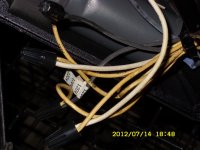
Ok, pulled a fixture apart, that the ballast will run either 120v or 277. (per 2 persons suggestions), although there is no mention of 120v on the label, the ballast has 120 volt in wires, as well 277.

Second point of reference, these lights are going in a 5ksqft shop on a farm, it is not a residential structure, further more, its not connected to the dwelling on the property. It is about 100' from the house.

Thirdly, I bought 40 more of these light this morning... Ive got 8 other buildings that need light, and at $15 a crack, its stupid not to buy them. I also got the word from the guy that changed them all out, that they all worked, and he threw in 3 boxes of new bulbs.

All is well that ends well !

Oh, I also included the sticker from the inside of the 37.5k transformer, even though it is now a moot point.
 

Attachments

  • 07-13-2012 007.jpg
    07-13-2012 007.jpg
    133.1 KB · Views: 13
  • 07-13-2012 010.jpg
    07-13-2012 010.jpg
    136.2 KB · Views: 10
  • 07-13-2012 001.jpg
    07-13-2012 001.jpg
    129.2 KB · Views: 9
Last edited:

Executive

Well-known member
Joined
Jun 29, 2012
Messages
77
Make sure you cap the unused 277v lead when you rewire for 120v. If not it WILL put out 277v and short against the fixture ballast enclosure.

Good luck.

Chris
 

nehog

Well-known member
Joined
Jan 2, 2010
Messages
7,935
Location
Jaffrey, NH
Looks like this was a long unnecessary debate! Great, you can run them on 120 and that solves all problems.

The image of the transformer windings/taps does show a lot of information that was earlier missing. Possibly it could have been used for this purpose, but considering it is not needed now who cares!
 
OP
B

Busted_Knuckles

Well-known member
Joined
Oct 9, 2009
Messages
2,613
Location
Northwest Illinois
Yes, the post was NOT all for not, but it will act as a guide for future cheap ****'s like me that want something for nothing.

Also was a good exercise in transformer review, and Executive, thanks for the pointer about capping the 277 leads.

So the moral of the story, not all MH ballasts are as marked on the fixture. I got lucky on this one.

Also, persistence pays off,...
 
Last edited:

FluxCore

Well-known member
Joined
May 28, 2012
Messages
229
Location
Born and raised in Germany, settled in Lousyana
Ok, pulled a fixture apart, that the ballast will run either 120v or 277. (per 2 persons suggestions), although there is no mention of 120v on the label, the ballast has 120 volt in wires, as well 277.

Second point of reference, these lights are going in a 5ksqft shop on a farm, it is not a residential structure, further more, its not connected to the dwelling on the property. It is about 100' from the house.

Thirdly, I bought 40 more of these light this morning... Ive got 8 other buildings that need light, and at $15 a crack, its stupid not to buy them. I also got the word from the guy that changed them all out, that they all worked, and he threw in 3 boxes of new bulbs.

All is well that ends well !

Oh, I also included the sticker from the inside of the 37.5k transformer, even though it is now a moot point.
Nuff said, you done good.....you suk bigtime cause you made such a find. ENJOY!:)
 
To avoid these ads, REGISTER NOW!
Top Bottom