A huge proportion of the comment and "reviews" of products on this website are driven by "
Confirmation Bias". As humans, it is difficult for us
not to do this. I really endeavor to remain as objective as I can - although I still have my favorites.
Listening to comments and reviews from other members here over the course of ten years has been something of an education.
In the world of pliers, it would be to one's advantage to be as objective as possible about "COO". American-made pliers are not always the best choice, unfortunately.
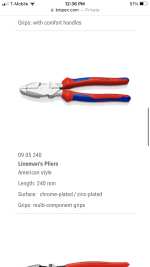
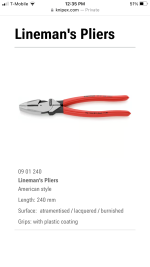
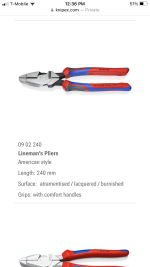
On the linemans pliers, however, I've not seen anything comparable to the Klein coming from Japan or Germany. (and certainly not Channellock or Wilde, and I own several pairs of Wilde linemans pliers.)
The old legacy designs remain a superior choice for that task.
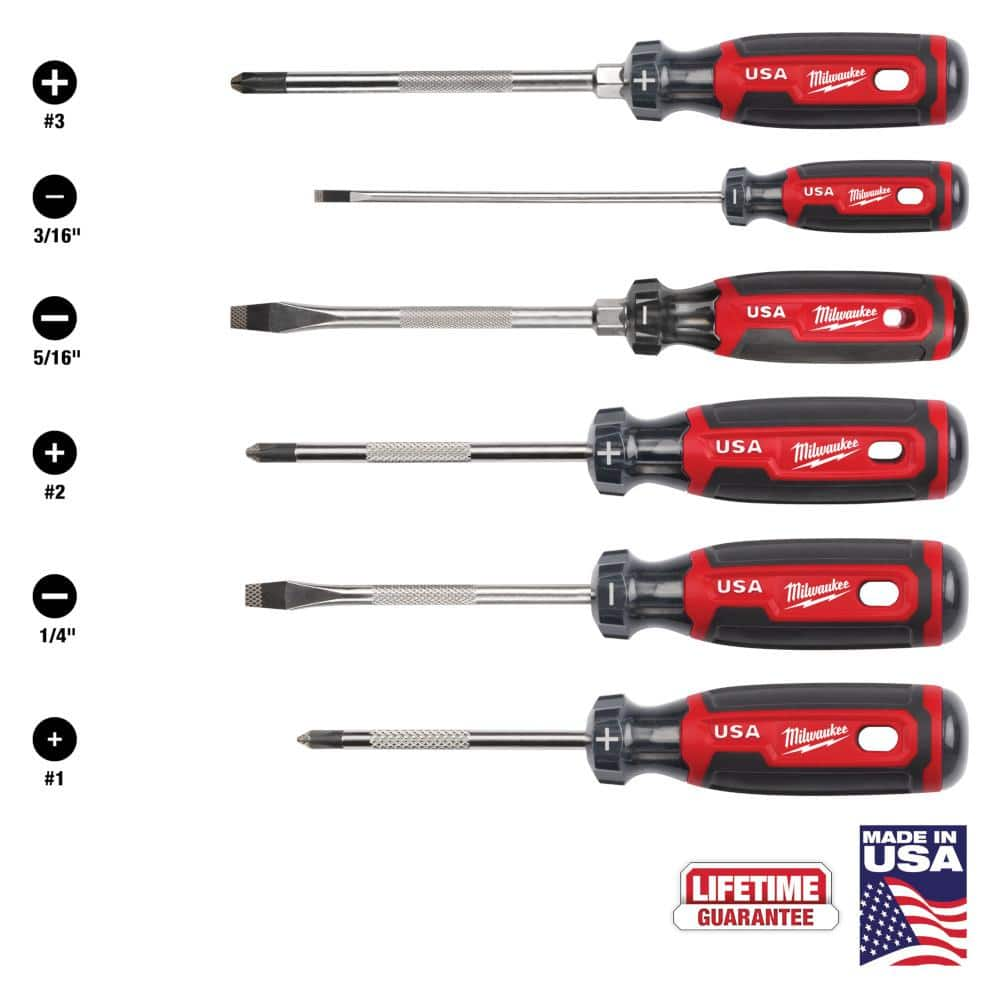
I started buying screwdrivers from German brands because they worked better than the previous USA made screwdrivers I had used.
This may simply have been the USA made screwdrivers bring standard “hardware store” grade screwdrivers, instead of higher end brands like Snap-On or Proto or whoever, or it might have been German manufacturers investing in better equipment 40 years ago.
Or maybe some tweak in standard and geometry.
Facom screwdrivers were also excellent.
Maybe other higher end screwdrivers from USA manufacturers like Apex and Zephyr would have been just as good.
At the line, the easier local “Industrial Hardware store” carried Wiha, and i think later Wera.
As I have mentioned before, US plier manufacturers usually don’t list actual cutting capacity like Euro and Japanese manufacturers seem to be legally required to do.
Plenty of local hardware stores used to give you **** about “using a tool inappropriately” if it broke or got damaged, so I opted for Euro tools where I could tell what capacity should be expectable, rather than some government regulation 99% of purchasers wouldn’t know, and which was not easy to look up.
US manufacturers still usually don’t list cutting capacity, except for certain tools like sheet metal Snips.
Most people don’t have an unlimited budget for tools, and maybe at most buy one or two examples of a tool from a couple different manufacturers, and that is where they get their feedback on tool quality, or that and coworkers, and tool reviews.
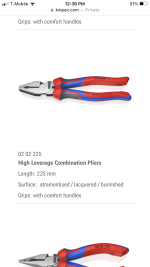
Knipex is certainly not the “best finished” plier manufacturer, nor are they always the “best” in certain aspects, but they are a reliable industrial plier manufacturer, where most pliers will eork fine for the tasks that they were made for, and then some.
Knipex also seems to manufacture the widest variety of plier types from a single manufacturer, which is close to the former catalogs from some older US brands such as Crescent, who keep dropping models from their catalog.
The only “standard” plier designs I can readily think if that Knipex doesn’t manufacture, are Bernard style parallel pliers, and standard type slip joint pliers, and groove lock pliers like Channellock.
Knopex used to manufacture slip joint pliers, but probably dropped the design due to low selling price, and the fact that dozens of other professional brands still do, so there was no point. (Maybe their main market in Germany also didn’t buy the Knipex version).
Groove lock pliers are more of a Us thing, and Knipex makes pliers that serve the same purpose.
Parallel pliers are a specialty thing requiring sheet metal forming, and precision jaw machining and assembling, and even when the patents expired 100 years ago, few manufacturers jumped on the bandwagon, so I’m guessing it’s a niche product that most manufacturers just don’t want to be bothered with without a government or other large contract.