To avoid these ads, REGISTER NOW!

Need advice on Solar

fred66

New member
Joined
Jun 23, 2025
Messages
2
I am looking at installing a solar system in my garage off grid. Garage is 26x26 foot. Roof is pitched but I have a ceiling at 10 foot. I also have a factory wall separating the back two thirds from the garage door and vehicles. I am only planning on air conditioning the rear of the building. I have redesigned my shed space so I could relocate all my wood working equipment and wood storage. The goal is to create a dust free, clean air conditioned area for a more climate sensitive equipment. The garage is insulated and I have blacked out the windows to keep sunlight from heating the space. Half the roof has an absolutely clear view of the sky and gets full sun all day long. I am located in southern Indiana and summers are hot and humid. For winter the goal would be to simply keep it warm enough to avoid water cooled equipment from freezing. This isn't as much of a concern since since our winters are fairly mild. We get a big snow dump a few times every winter but sustained freezing temp don't generally last for more than a week or so.

For the air conditioning unit, I am trying to power a 12000 BTU unit.
Power Supply: AC 115V-60 Hz, Current (cooling/heating): 10.5A/10.5A, Power input: 1100W/1020W.

For my solar array I am looking at 4 Renogy 200WATT 24V panels.
For Charge Controller I am also looking at Renogy Rover 60A MPPT
and a 3000W 12V inverter.

My questions come from energy storage. How much battery storage capacity do I need? Am I inputting enough energy to run the air conditioner and supply the batteries during the day?

Any info or experience you all have would be appreciated and I will thank you in advance for your time.
 
To avoid these ads, REGISTER NOW!

sjvicker

Well-known member
Joined
Aug 9, 2014
Messages
606
Location
SW Washington
The 200w renogy panels have an open circuit voltage of 36.5v and a 6.36a current rating. $216ea

The 60A Renogy MPPT SCC has a max PV voltage input of 140vdc and 20amp. $350ea

With 4 panels your max input is around 800w. This isn't enough to run your AC and charge the batteries at the same time. Your best bet with this charge controller and these panels is to do an array that is 4x3 (12 panels in a series parallel configuration). This brings your input up around 2400w and lets your charge your batteries while running your AC. Renogy's panel pricing is pretty high and also consider if your inverter can handle the AC startup load.


I'm not completely sure how to answer the "how much battery do I need" question with an AC that is likely running less at night or maybe not even at all. Accounting for gray days and adding heat in the winter also change your needs considerably. Any way you look at this, unless your looking for a cool hobby and to learn, its probably going to be more cost effective to have utility power run.
 

bluedog225

Well-known member
Joined
Jan 31, 2012
Messages
3,350
Location
Texas
I am looking at installing a solar system in my garage off grid. Garage is 26x26 foot. Roof is pitched but I have a ceiling at 10 foot. I also have a factory wall separating the back two thirds from the garage door and vehicles. I am only planning on air conditioning the rear of the building. I have redesigned my shed space so I could relocate all my wood working equipment and wood storage. The goal is to create a dust free, clean air conditioned area for a more climate sensitive equipment. The garage is insulated and I have blacked out the windows to keep sunlight from heating the space. Half the roof has an absolutely clear view of the sky and gets full sun all day long. I am located in southern Indiana and summers are hot and humid. For winter the goal would be to simply keep it warm enough to avoid water cooled equipment from freezing. This isn't as much of a concern since since our winters are fairly mild. We get a big snow dump a few times every winter but sustained freezing temp don't generally last for more than a week or so.

For the air conditioning unit, I am trying to power a 12000 BTU unit.
Power Supply: AC 115V-60 Hz, Current (cooling/heating): 10.5A/10.5A, Power input: 1100W/1020W.

For my solar array I am looking at 4 Renogy 200WATT 24V panels.
For Charge Controller I am also looking at Renogy Rover 60A MPPT
and a 3000W 12V inverter.

My questions come from energy storage. How much battery storage capacity do I need? Am I inputting enough energy to run the air conditioner and supply the batteries during the day?

Any info or experience you all have would be appreciated and I will thank you in advance for your time.

Great start. Don’t buy anything yet. Really, don’t. You will save a bunch of $ by waiting till you have a plan.

Couple of quick points.

Good roof is south facing and best angle is about your latitude for year round production. Close enough is fine. That is, south(ish) and angled.

Don’t buy renogy. Just dont.

Good, modern panels are cheap and 330-430 watts.

Cheap all in one (charge controller and inverter) high frequency units can be pretty good. Look at EG4. Quality individual components are more expensive and better. E.g.: Victron MPPT and Quattro. But the cheap/pretty good stuff really is pretty good these days. For example, an EG4 5000 watt all in one.

I like currentconnected.com based on service quality. Signature Solar may be cheaper. I strongly recommend checking reviews at diysolarforum.com

E.g.: https://www.currentconnected.com/pr...dc&brand[]=eg4-electronics&filteraction=apply

Go 48 volt from the start. Don’t mess around with 12V or 24V.

Some of the new air conditioners say they will run of pure DC. That is, they run when the sun shines. Seems like a bad idea to me. And hard on the equipment. So at minimum, I’d get one 48 volt server rack battery. It will serve as a buffer for clouds, birds, whatever.

About a grand for 100 amp hours server rack battery. (therefore 5000 watts). See the signature solar website. The wall mount batteries are pretty cool also.

Get as many of these batteries as you want or can afford. Your air conditioner uses about 1000 watts per hour. You will get 5-6 “good” solar hours per sunny day. The rest is battery powered.

This site will accurately predict your solar production. Use default values for things you may not understand yet. It will download an hourly sheet if you want it. https://pvwatts.nrel.gov/

You can run the LiFePO4 batteries from 100% to 0. Rinse and repeat.

You will need to decide if you are “grid tied” or “off grid.“. Makes a difference in equipment, permitting, etc. I like off grid. Simple.

Don’t call a solar installer. Or do, if you have to. But don’t.

Ground mount easier all around than roof. If you have the room.

All the best. Happy to answer questions.
 

dcg9381

Well-known member
Joined
Jun 20, 2018
Messages
11,929
Location
Austin, TX
My questions come from energy storage. How much battery storage capacity do I need? Am I inputting enough energy to run the air conditioner and supply the batteries during the day?

Any info or experience you all have would be appreciated and I will thank you in advance for your time.
So I've done a lot of residential solar installs and have some experience with inverters, batteries, and "off grid" campers.. Whatever that is worth.

This is NOT a precise science (if it's truly off grid) so what you can do is SWAG it and you build things to be "expanded" where capacity is necessary.

Here are my thoughts:

I am located in southern Indiana and summers are hot and humid. For winter the goal would be to simply keep it warm enough to avoid water cooled equipment from freezing. This isn't as much of a concern since since our winters are fairly mild. We get a big snow dump a few times every winter but sustained freezing temp don't generally last for more than a week or so.

You are in a relatively "mild" climate for HVAC. 12K BTU is probably OK. But at 600 sqft if you are only cooling this "part time" you might want to go up to 24K. It's more about the use case than a Manual J capacity like on residential. If you're there full time, you go smaller. If you need to knock the edge off go larger. Not all ductless systems will perform well below 25 degrees.

Warming things with PV (electrical) takes a TON of power. I'd recommend that you use propane. It's way easier. Tanks are "portable" up to 100 lbs.


Power Supply: AC 115V-60 Hz, Current (cooling/heating): 10.5A/10.5A, Power input: 1100W/1020W.

Do you have 240V tools? Because if you do, step up to a 240V AC unit. Main reason to stay 120V is to avoid 240V inverters if off grid. But if you need 240V, no reason to do 120V HVAC.


For my solar array I am looking at 4 Renogy 200WATT 24V panels.
For Charge Controller I am also looking at Renogy Rover 60A MPPT
and a 3000W 12V inverter.
So 800 watts is going to get you maybe 600 watts (real life) and it's going to be on a bell curve, assuming you're oriented right. You'll get peak power for 2 hours. Everything else is area under the curve.

So try to simplify it:
  • You need PV to produce more power than you are using over time.
  • You need to store the excess power, how large your storage is depends on how long you want to run "off grid" (solar can go down for days or a week due to overcast) - no such thing as "too much battery". It's shocking how much battery it might take.
  • I would avoid 12V at all costs. Do 24V, 36V, 48V. To invert 3000 watts from 12V, you need copper that will handle 250A - and that's Big Fat Copper. Go up on your DC voltage.
  • Buy a decent off grid inverter (Victron).
  • Most of this can be solved for or mitigated with by allowing the system to charge by a simple 2000W generator... Just have backup power. Make a huge difference.

For reference I'm running a 15K BTU unit on an "off grid" trailer. I have 1200 watts of solar, and 10KwH @ 48V batteries. That will self sustain in the heat of TX for 12 hours, assuming crappy sun.... Breaks even running the AC in full sun. But it's probably way more battery than you think you'd need.
 

bluedog225

Well-known member
Joined
Jan 31, 2012
Messages
3,350
Location
Texas
Here’s a very nice system build sheet. More watts than you need. But will give you an idea of the components. Note, you can choose what battery you want.


toplessHO

Well-known member
Joined
Oct 20, 2014
Messages
14,114
Location
central florida
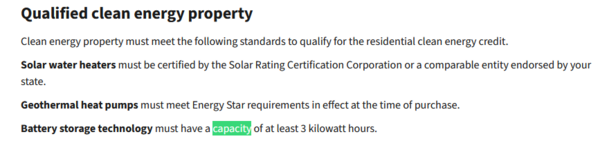
are you trying to make a system that is eligible for tax credits?
If so make sure you include batteries that are over 3KW.
 
To avoid these ads, REGISTER NOW!

bluedog225

Well-known member
Joined
Jan 31, 2012
Messages
3,350
Location
Texas
are you trying to make a system that is eligible for tax credits?
If so make sure you include batteries that are over 3KW.
I’m not familiar with this. do you have any more detail? Single battery? Or the whole bank?

thanks
 

dcg9381

Well-known member
Joined
Jun 20, 2018
Messages
11,929
Location
Austin, TX
are you trying to make a system that is eligible for tax credits?
If so make sure you include batteries that are over 3KW.
Why? Is there an IRS limit on batteries that are under 3kW? I write off every battery I add the house, every year. I write of solar power to the gate. It's all compliant and in-service.

The trick is that the IRS credit is focused at "primary home". If this is a structure somewhere, it may get a little messy:
"You may be able to claim a credit for certain improvements made to a second home located in the United States that you live in part-time and don't rent to others."
 
To avoid these ads, REGISTER NOW!
Top Bottom