To avoid these ads, REGISTER NOW!

New Trailer build

GaryM909

Well-known member
Joined
Apr 11, 2016
Messages
1,516
Location
Calgary, Alberta, Canada
I plan on picking up a side x side in the near future and plan on building a trailer. New prices are obscene right now. Good used trailers are hard to find and people are asking damn near new prices. I also checked out a few junkers that I could modify but nothing of any interest.

Anyways I am thinking of building a trailer with a single axle and a deck size 6' x 10'. My dilemma is whether to use channel iron (3 x 1.5) or rectangular tubing (3 x 2 x 1/8) for the frame. I will probably just use expanded metal mesh for the deck surface for ease of washing the machine.
Any advice would be great!
 
To avoid these ads, REGISTER NOW!

gearhead1

Well-known member
Joined
Oct 14, 2013
Messages
1,935
Location
NC
How much does the side by side weigh, or a weight of a model close to the one you’re looking at?
 

gearhead1

Well-known member
Joined
Oct 14, 2013
Messages
1,935
Location
NC
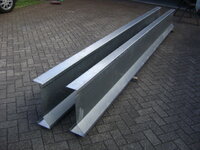
As far as the 3” tall channel, there are 3 versions.
In the second link, you will see Ixx, this is what you’re looking for when comparing bending strength of various shapes.

The thinnest 3x2 rectangular tubing this chart shows is 3/16, not an 1/8. The Ixx of 3x2x3/16 is 1.86 in4 at a weight of 6.23 lbs/ft.

So comparing C3x5 channel with an Ixx of 1.85, the weight is 5lbs per foot. The Ixx (strength) is essentially the same between these two, but the channel is 1.23 lbs per foot lighter.
 
Last edited:

gearhead1

Well-known member
Joined
Oct 14, 2013
Messages
1,935
Location
NC
Now, how much weight the C3x5 channel will carry is a different issue….have to do some math on that.
 

txvwnut

Well-known member
Joined
Jan 1, 2015
Messages
7,597
Location
Bedford, Texas
Channel iron or angle iron but not tube. Tube will sweat on the inside which will lead to rust and then a failure just when you don’t want it. Now I know it may take several years for that to happen but why even get it started.

If you haven’t priced steel yet make sure your sitting down.
 

jollygreengiant

Well-known member
Joined
Nov 10, 2013
Messages
2,354
Location
Ontario, Canada
I plan on picking up a side x side in the near future and plan on building a trailer. New prices are obscene right now. Good used trailers are hard to find and people are asking damn near new prices. I also checked out a few junkers that I could modify but nothing of any interest.

Anyways I am thinking of building a trailer with a single axle and a deck size 6' x 10'. My dilemma is whether to use channel iron (3 x 1.5) or rectangular tubing (3 x 2 x 1/8) for the frame. I will probably just use expanded metal mesh for the deck surface for ease of washing the machine.
Any advice would be great!

Looks like gearhead1 covered the capacities of the different frame options. My input is more concerning its longetivity. Personally I'd go with the C channel so that there is no possibility of moisture/salt getting inside the tube and leading to rot.

Also, unless this trailer will never see gravel roads I'd avoid using the expanded metal for the deck. Otherwise you'll have small rocks and dust being thrown up against your machine.
 
OP
G

GaryM909

Well-known member
Joined
Apr 11, 2016
Messages
1,516
Location
Calgary, Alberta, Canada
What sxs? I'd recommend at least 8.5'x12'.

I've always used C channel, but I'm no engineer.
Looks like gearhead1 covered the capacities of the different frame options. My input is more concerning its longetivity. Personally I'd go with the C channel so that there is no possibility of moisture/salt getting inside the tube and leading to rot.

Also, unless this trailer will never see gravel roads I'd avoid using the expanded metal for the deck. Otherwise you'll have small rocks and dust being thrown up against your machine.
The trailer will see gravel roads but the side x side will be on them full time. Years ago I had a couple quads and the trailer I used had a mesh deck. It worked out really well.
 
To avoid these ads, REGISTER NOW!

Bigblue&Goldie

Well-known member
Joined
Mar 12, 2009
Messages
10,665
Location
AZ
I looked at doing this very thing (for a SxS and all), even drew it up in CAD, but then gave up when steel prices hit the moon. I wanted to do a drive over fender with a torsion axle to keep the deck low. My current trailer sits fairly high, so the SxS was a wind catch. I'm looking forward to see what you come up with.
 
OP
G

GaryM909

Well-known member
Joined
Apr 11, 2016
Messages
1,516
Location
Calgary, Alberta, Canada
I looked at doing this very thing (for a SxS and all), even drew it up in CAD, but then gave up when steel prices hit the moon. I wanted to do a drive over fender with a torsion axle to keep the deck low. My current trailer sits fairly high, so the SxS was a wind catch. I'm looking forward to see what you come up with.
Steel prices are painful but around here new trailers are $3500 and up. And you get what you pay for.
After I am done I am sure it will be over built and way too heavy. Once I tow it out to our resort property I won't be towing it more than 10-20 miles on days I use it.
 

kerrynzl

Well-known member
Joined
Nov 8, 2013
Messages
5,054
Location
Tauranga, New Zealand
It’s only 50” wide

You only need a 10' x 5' deck for that.

As for steel sizes , it all depends on how you buy steel lengths [to be economical] that dictates what you use.

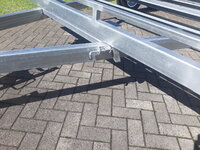
You really need 3" x 2" RHS tubing for the tongue or it will flex and start "Porpoising"
So if you have offcuts, then consider this on the main frame as well.

With steel "shape" is more important than size. RHS tubing frame rails would have 4x vertically stressed walls vs 2x for channel.
And you can also drill and hide your wiring inside the RHS tubing

Personally , for a UTV [or ATV] trailer I would recommend a gravity tilt trailer for ease of loading.
You want the Axle location 50/50 on the deck so it stays tilted by itself. [the hitch weight comes from the tongue weight and moving the payload forward]

Make an "A" frame tongue and pivot it off the same bolts as the front spring hangers. [the outer bracket I used was for Boat trailer rollers]

[here.... is a pivot , it gets welded on 3 sides and the wiring went inside the tongue tubing]
DSC04971.JPG

The A frame tongue removes the need for diagonal braces.
Note below [String-line the whole centreline of the trailer while building]

DSC04978.JPG

For latching the tilt I used off the shelf spring bolts and cut my own strikers on a 17deg angle so they self latched
20210312_111921.jpg

Put a boat trailer foldaway "jockey wheel" on the tongue, and if possible use electro-galvanized steel [touch up the welds with zinc paint]
The extra cost of the Galv steel outweighs the cost of painting 4x and is permanent [put your $$$ into materials not coatings]

Here is a simple Tandem trailer I built for a friends to tow his Porsche race car. He wanted to "write it off as a tax expense" on his farm.
So I built it dual purpose with a wooden flat deck.
[shown here tilted]
18.jpg

The whole thing was stupid simple underneath. It was made from 4"x2" x 1/8" and rated for 5500lbs [any more and our Road Nazi's move the goal posts on us]
20210312_111846.jpg
 
Last edited:

gearhead1

Well-known member
Joined
Oct 14, 2013
Messages
1,935
Location
NC
So let’s round up to 1500 lbs of cargo.

Bending stress formula is Mc/I.

This is just from memory and off the top of my head / back of the napkin analysis here:

Moment M would be 1500lbs x 60” = 90,000 in lbs
(60” is half the length of the 10’ length and assuming the weight is in the center which is not exactly reality but worst case so to speak)

c is 1.5”
(distance from neutral axis to outer most fiber, a 3” channel would be half of the height or 1.5”)

I is 1.85 in4
(moment of inertia from the chart for the C3x5 channel)

90,000 in lbs x 1.5 in / 1.85 in4 = 73,000 lbs/in2 (or psi) of stress in the beam. This is for one piece of channel. In reality you’d have a perimeter frame, so you’d have 2 beams. 73,000 psi /2 = 36,500 psi. This will not work because the yield strength of A36 steel is 36,000 psi. If you put 2 more channels or beams front to back, it’s would be 73,000 / 4 which gives 18,250 psi of stress in the beam. This is not enough margin against the yield strength.

I would absolutely not do this if it were me, I’d go up in channel size.
 

gearhead1

Well-known member
Joined
Oct 14, 2013
Messages
1,935
Location
NC
In contrast, let’s compare against something like the beams Kerry used. I say ‘like’ to show the concept as the chart has 4x2x3/16 not 1/8. So go back in the rectangular tubing chart, find Ixx for 4x2x3/16 tubing. It is 3.88 in4. So remember the Ixx of the C3x5 channel was 1.85 in4, now we have an Ixx of 3.88 in4. The 4x2 rectangular tubing is almost double strong in bending as compared to the C3x5 channel.

Lets do the math.

Moment M = 90,000 lbs (because beam length and load did not change)

C is now 2”

I is now 3.88 in4

90,000 x 2 / 3.88 = 46,000 psi of stress in the 4x2x3/16 beam as compared to 73,000 psi in the C3x5 channel.

Now in reality a perimeter frame would have 2 beams, one on each side. So the stress in each beam would be 46,000 / 2 = 23,000 psi as compared to 36,500 psi with the channel.

Some trailers, like U-Haul trailers, have a ‘runner’ where the tires go, a tire track so to speak. Some of those style trailers are putting a beam on each side of the tire track on each side of the trailer, so you have 4 beams carrying the load. So if you do that, 46,000 / 4 = 11,500 psi which is 3 times less than the yield strength. Now you’re getting into a safer stress range for the beam to live in.
 

gearhead1

Well-known member
Joined
Oct 14, 2013
Messages
1,935
Location
NC
The reason why we use yield strength of the material is that is the stress point at which the material will ‘yield‘ or bend. You can’t design right up to the limit of the material or it will bend on you and that’s no good. So you have to stay well below that.
 

gearhead1

Well-known member
Joined
Oct 14, 2013
Messages
1,935
Location
NC
So what do you do, if you don’t know all this? Simple. Go look at professional made trailers or someone that has made a lot of them and copy!

Kerry’s trailer for example is rated for 5500 lbs. Use the same size beams he has, and you’re good to go.
 

kerrynzl

Well-known member
Joined
Nov 8, 2013
Messages
5,054
Location
Tauranga, New Zealand
So let’s round up to 1500 lbs of cargo.

Bending stress formula is Mc/I.

This is just from memory and off the top of my head / back of the napkin analysis here:

Moment M would be 1500lbs x 60” = 90,000 in lbs
(60” is half the length of the 10’ length and assuming the weight is in the center which is not exactly reality but worst case so to speak)

c is 1.5”
(distance from neutral axis to outer most fiber, a 3” channel would be half of the height or 1.5”)

I is 1.85 in4
(moment of inertia from the chart for the C3x5 channel)

90,000 in lbs x 1.5 in / 1.85 in4 = 73,000 lbs/in2 (or psi) of stress in the beam. This is for one piece of channel. In reality you’d have a perimeter frame, so you’d have 2 beams. 73,000 psi /2 = 36,500 psi. This will not work because the yield strength of A36 steel is 36,000 psi. If you put 2 more channels or beams front to back, it’s would be 73,000 / 4 which gives 18,250 psi of stress in the beam. This is not enough margin against the yield strength.

I would absolutely not do this if it were me, I’d go up in channel size.

Thanks for posting this [very few people understand stresses involved and simply add more steel]

I wouldn't recommend using channel at all.
I'd use thinwall 3"x 2" tubing.
A 1500lb rolling payload could easily be supported by a 2"x 2" tubing frame [4000lb axles are made from 2" x 2" x 3/16" SHS Tubing]

Quoted from above.........."Moment M would be 1500lbs x 60” = 90,000 in lbs"

You forgot that this 1500lbs is divided by 2 frame rails [And 4 x load bearing points of the payload] so it would be more like 750lbs supported each side. [or 375lbs per corner]

So each frame rail would more likely be 750lbs x 45" = 33750 in/lbs"
60" would be if the whole frame straddled a central point but in reality there is also 4 load bearing points underneath each side [the front and rear spring hangers]
And there is also the weight load bearing points which can vary with the wheelbase of the payload. The average "side by side" has an 85" wheelbase.
An 85" wheelbase straddling each side of 30" trailer springs would be more like 27.5" AND the 4 load bearing points of the payload would be 375lbs each [on a perfectly balanced payload]

So "Moment M would be 375lbs x 27" = 10125 in/lbs bending stress.

To put this into perspective a 60" bending stress would require a 120" wheelbase to load bear weight at the extreme ends of the frame, and a solid axle [A 1970 Chevelle has only 116" Wheelbase, and weighs approx 3500lbs or approx 1750lbs each side of the centerline]

Also If the payload was moved forward the load is also shared with the tongue stacked vertically underneath [supported at the rear and the towball, but bearing partial load in the middle near the front of the frame]


I have used the backing plates of the Fenders as a stressed member near the centreline of the frame.
And also built the frame from folded 2mm [.080"] sheet steel.

DSC04871.JPG

DSC05130.JPG

I need to stop building them lightweight [one day I'll get caught out :LOL: ]


Last edited:

gearhead1

Well-known member
Joined
Oct 14, 2013
Messages
1,935
Location
NC
Kerry, I agree, it’s probably more like 45” in reality which reduces moment. Pretty cool trick using the fender backing plate as a structural member to keep the weight down.

Just curious, do you use FEA software to design your frames?
 

kerrynzl

Well-known member
Joined
Nov 8, 2013
Messages
5,054
Location
Tauranga, New Zealand
So what do you do, if you don’t know all this? Simple. Go look at professional made trailers or someone that has made a lot of them and copy!

Kerry’s trailer for example is rated for 5500 lbs. Use the same size beams he has, and you’re good to go.
Thanks for the vote of confidence !

I actually cheated on that one.
What most people don't understand is having 14 pieces of "one piece" wooden planks for the deck contributed a huge amount to the beaming strength of the trailer.
The wood was also glued together to dissipate loads over a wider area.

Wood is approx 1/10th the weight of steel by volume but a shitload stronger.
So 1/8 diamond plate has the same weight as 1-1/4 treated pine for the same area.

If I got a 36" long x 4" wide strip of 1/8 diamond plate , I could bend it around my knee [try that with a 36" long x 4" x 1-1/4" piece of wood.]


I don't use any software at all! I use the insomnia method [I lay awake all night scheming :LOL:(y)]
You would die if you had to work off my scribbled bits of paper and scraps of calculations.

here is a sheetmetal trailer I built , it weighed 650lbs and was used to cart a bobcat digger around [as well as dirt/gravel etc]
It had no frame just angle cross-members.
DSC02912.JPG

DSC03180.JPG

DSC03786.JPG

By keeping it small and lightweight, it didn't need brakes [when loaded] and just creeped in width wise not to need side marker lights etc. [**** that gets damaged]
 
Last edited:
To avoid these ads, REGISTER NOW!
Top Bottom