To avoid these ads, REGISTER NOW!

new used compressor to install

Bjuneau1

Member
Joined
Sep 20, 2016
Messages
10
Hello all,

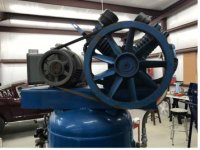
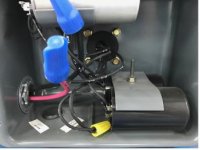
I am a new poster to the forum, although I have been using this board to learn and research. I think I came across a good deal on a compressor, and I would like to hear some advice on connecting electrical supply to the unit. I will be paying an electrician to do the work, but I don't want to be completely ignorant on what he is doing and have a few things ready to make terminations. The compressor is made by Emglo, model J5A-60V. According to the Jenny tech rep, it was built in March 2000. Some notable specs he pointed out to me... 4 cylinder single stage splash lubricated pump, 23 CFM @ 125 PSI, Marathon Electric 5hp motor (1735 rpm), and 60 gallon tank. I spoke with him before purchasing and he assured me it was a solid unit. To my eyes, the compressor looks pretty good for its age, especially the electrical components. I sure hope it runs, as I didn't get to hear it run before buying. I will change the oil (30 wt. motor oil?) and the fan belts before running for the first time. Open to suggestions for other preventative maintenance items to perform. By the way, it will be used for miscellaneous shop tools, a small sand blasting cabinet being the largest consumer.

I will be running MC cable across my shop to supply the power, roughly 60-70 feet, but I do not know what gauge wire to use. Also, the whip coming off the compressor where it was hooked up before only has two wires coming out of it. I though 220v would require 3? This should reveal how ignorant I am. I would like to get the MC cable run and sitting in place before the electrician arrives. I imagine I'll be needing a disconnect switch (suggestions??)to turn the compressor on/off, and would like to have this all mounted as well. I see lots of talk about magnetic starters... do I need to worry about one of these? Looking forward to hearing comments and criticisms. I will attempt to attach pictures below.
 

Attachments

  • emglo0.jpg
    emglo0.jpg
    14.3 KB · Views: 64
  • emglo2.jpg
    emglo2.jpg
    13.9 KB · Views: 29
  • emglo3.jpg
    emglo3.jpg
    19.8 KB · Views: 24
  • emglo4.jpg
    emglo4.jpg
    20.6 KB · Views: 18
  • emglo5.jpg
    emglo5.jpg
    20.3 KB · Views: 18
  • emglo6.jpg
    emglo6.jpg
    5.8 KB · Views: 18
  • emglo7.jpg
    emglo7.jpg
    13.8 KB · Views: 21
Last edited:
To avoid these ads, REGISTER NOW!
OP
B

Bjuneau1

Member
Joined
Sep 20, 2016
Messages
10
Here are a few more pictures...
 

Attachments

  • emglo8.jpg
    emglo8.jpg
    15.2 KB · Views: 21
  • emglo9.jpg
    emglo9.jpg
    17.1 KB · Views: 22

American Locomotive

Well-known member
Joined
Jan 8, 2017
Messages
10,933
Location
Rhode Island
Your compressor has a motor starter and pressure switch already on it. No need to worry about that. 3-wire 240v connections are only used when the device also has 120v loads or is 3-phase. Since your compressor doesn't have any 120v loads, and is single phase, you only need the two hot wires and a ground.

For wiring, if using MC, you'll only need 10 gauge wire with a 30 amp breaker to power that compressor. It's possible you may get nuisance trips on startup, so the NEC allows you to install a larger breaker if necessary. For 10 gauge wire and a 5HP motor, you can go up to a 70 amp breaker.
 

Garett

Well-known member
Joined
Nov 30, 2013
Messages
519
Location
BC Canada
Before you get into it, Id check to see if the condition on the tank. Take off that plug or a fitting and put a scope or point a camera inside and look for rust and corrosion.
 
OP
B

Bjuneau1

Member
Joined
Sep 20, 2016
Messages
10
Thank you for the reply, American Locomotive.

So, I can look for MC with the designation "10/2" plus a ground or is a ground not necessary? I didn't see one tin place that the previous owner used.

As for the disconnect switch, can this be any style with the proper ratings (30 amp, 240v & 5 hp)? I imagine a style similar to the one used on my a/c condenser outside. Is a motor starter more appropriate in this case?

On another note... any opinions on the compressor itself?
 
OP
B

Bjuneau1

Member
Joined
Sep 20, 2016
Messages
10
After doing a little more reading on the subject I see that since I have a magnetic starter, I don't need a switch rated for the full 5 hp motor. Some are saying that a standard switch rated for 120v will suffice. Is this just a regular light switch? Can someone provide a link to an example of what is commonly used and hopefully a photo or two? I have seen the pressure switches with on/off toggles on them but mine does not have that.
 

American Locomotive

Well-known member
Joined
Jan 8, 2017
Messages
10,933
Location
Rhode Island
My suggestion: Don't bother with a switch. If you don't have air leaks, your compressor will never run and can be left on 24/7. If you're going on vacation or something, just flip the disconnect or turn the breaker off.
 
OP
B

Bjuneau1

Member
Joined
Sep 20, 2016
Messages
10
Sounds easy enough. Thanks American Locomotive for your time and responses. I must be asking some pretty stupid questions, I expected a little more feedback than this.
 
To avoid these ads, REGISTER NOW!
OP
B

Bjuneau1

Member
Joined
Sep 20, 2016
Messages
10
OK. On one of the tags it states to use 30 wt. oil. Can this be any synthetic oil that is straight 30 wt?

I want to run the wires to the compressor to get ready for the electrician to connect it. Can someone advise which type of wire to buy? I will be getting 10 gauge metal clad, but don't know if I need 10-2 or 10-3 and if I need a separate ground.
 

The Tool Tyrant

ALLIANCE MEMBER
Joined
Dec 19, 2011
Messages
2,182
Location
Bonita, Ca. (San Diego)
Amsoil, Royal Purple and Emglo/ Jenny all sell synthetic compressor oil, designed specifically for compressor pumps. Some people say "Oil is oil" but, that's your call.

Regarding input power, you need 2 'hot' wires + ground. So 10-3 will work, but you will want to use green phase tape on one conductor to indicate it's used as a ground.

If your pressure switch does not have an 'On-Off' switch, you can mount an inline toggle switch to the side of the magnetic starter housing and then run the wire from the pressure switch thru the toggle switch.

Emglo pumps are great little pumps, made in the USA. They now go by 'Jenny' and if I recall this correctly, Jenny has always manufactured the pumps and sold them to Emglo to use on their line of compressors. Jenny has now purchased the Emglo line...I believe.
They are very popular in the construction industry as I'm fairly sure they invented the 'wheelbarrow' style twin tank portable units. The pumps are reliable and easy to service and rebuild (well...except for removing the damn blind hole roll pin they use to secure the pulley to the crankshaft) I have rebuilt several AND have used them for many years back in my framing days.
Being as your's is a 4 cylinder, single stage pump, it will produce a fair amount of CFM's, but tops out pressure wise @125. If you find that it needs to cycle too often to keep up with your needs, add more storage capacity to your receiver. Unless you're using a blast cabinet or doing a large amount of grinding / sanding, it will probably be all you'll ever need.

Was this enough feedback for you?
 

ckeboss

Well-known member
Joined
Aug 25, 2014
Messages
64
Ahh, you bought it before I could! I was eyeing that one. Glad you got it though, keeping it in the family so to say.
 
OP
B

Bjuneau1

Member
Joined
Sep 20, 2016
Messages
10
Thanks for the feedback tool fool. I will be doing some blasting, grinding and sanding, but not a large amount at all. I picked up a roll of 10-3 MC cable and getting it ready for power. Plumbing the shop will be next, which seems like a daunting task and pretty expensive to do it right.

Noise is my biggest concern, as I've read that single stages can be louder than two stage.

Ckeboss I picked it up Wednesday, I think I got it for a pretty good price. Where are you located?
 

The Tool Tyrant

ALLIANCE MEMBER
Joined
Dec 19, 2011
Messages
2,182
Location
Bonita, Ca. (San Diego)
Thanks for the feedback tool fool. I will be doing some blasting, grinding and sanding, but not a large amount at all. I picked up a roll of 10-3 MC cable and getting it ready for power. Plumbing the shop will be next, which seems like a daunting task and pretty expensive to do it right.

Tool Fool: 'Nothing to it, but to do it!' I prefer copper, looks clean, light weight, dissipates heat (which helps turn water vapor into droplets, which are easier to remove from the system) If you don't know how to 'sweat copper' (Solder), now is a great time to learn. :thumbup:


Bj: Noise is my biggest concern, as I've read that single stages can be louder than two stage.

Tool Fool: B.S... :bs:has NOTHING to do with how loud or quiet a pump is. The main factor is how many RPM a pump turns, the slower, the quieter. The second is the intake air silencer, most of the sound a pump makes is generated by the valves opening and closing. The better the intake silencer, the quieter the pump...same as muffler on an engine.
 

ckeboss

Well-known member
Joined
Aug 25, 2014
Messages
64
Thanks for the feedback tool fool. I will be doing some blasting, grinding and sanding, but not a large amount at all. I picked up a roll of 10-3 MC cable and getting it ready for power. Plumbing the shop will be next, which seems like a daunting task and pretty expensive to do it right.

Noise is my biggest concern, as I've read that single stages can be louder than two stage.

Ckeboss I picked it up Wednesday, I think I got it for a pretty good price. Where are you located?

Woops, now that I look at it, it's actually not the one I was looking at. There was another new poster that was looking at a similar compressor. https://www.garagejournal.com/forum/showthread.php?t=366824
 
OP
B

Bjuneau1

Member
Joined
Sep 20, 2016
Messages
10
Update on my compressor install... I was able to get it hooked up with guidance from a trusted electrician. I am thrilled with how it runs, it is much quieter than expected and fills the tank to 125 psi in what seems like no time... about 3 minutes.

Now comes the plumbing and air filtration... I don't want to start a new thread because I know this topic has been brought up many times already. I will do more reading on copper and check prices to see if it will be comparable in cost to cast iron which is what I had planned for. I think even if copper is more expensive, that will be compensated for by headaches and time consumed from black iron pipe.
 

The Tool Tyrant

ALLIANCE MEMBER
Joined
Dec 19, 2011
Messages
2,182
Location
Bonita, Ca. (San Diego)
Update on my compressor install... I was able to get it hooked up with guidance from a trusted electrician. I am thrilled with how it runs, it is much quieter than expected and fills the tank to 125 psi in what seems like no time... about 3 minutes.

Now comes the plumbing and air filtration... I don't want to start a new thread because I know this topic has been brought up many times already. I will do more reading on copper and check prices to see if it will be comparable in cost to cast iron which is what I had planned for. I think even if copper is more expensive, that will be compensated for by headaches and time consumed from black iron pipe.

Great! Glad to hear you got it running! :beer:

Regarding copper vs. black iron pipe, no only is copper lighter, dissipates heat faster, and stays clean internally (no rust) it LOOKS cool! :thumbup:

Regarding air filtration, remove moisture before it enters the air line by adding an air cooled aftercooler, which mounts on the rear of the belt guard, in line with the pump pulley, so the air being drawn across the aftercooler by the pulley blades cools the compressed air passing thru the tubing within the aftercooler causing the water vapor to condense and turn into droplets that make their way to the receiver drain. They are simple to install and maintenance free. I really like the 'zero loss' (Bekomat) receiver drains, although they are a little pricey, but occasionally you can find a deal on e-bay. Next add a good cartridge type filter and you should be golden. If you want to really be OCD when plumbing your air lines, pull your drops from the top of your main runs and place a drain trap & valve below your hose coupling. :bowdown:
 
To avoid these ads, REGISTER NOW!
Top Bottom