To avoid these ads, REGISTER NOW!

Nylon wire wheels for gasket surfaces.

bigredcornhead

Well-known member
Joined
Aug 9, 2011
Messages
445
Just a quick question, have you guys had success using nylon wire wheels for gasket surface preparation? I have used my die grinders with those plastic scuff pads in the past, and read that they can hurt the gasket surface if too much pressure is applied. Are those nylon wire wheels for lack of a better term better to work with? Also, do you usually use them in a drill, grinder, or die grinder? Let me know your thoughts.
 
To avoid these ads, REGISTER NOW!

RTM

Well-known member
Joined
May 13, 2019
Messages
13,370
Location
SF Bay Area
I've never used the 3m radial bristle brush on a gasket surface, but on a clamped ¿Interference? fit surface (all metal marking gauge), and it would not clamp as well afterwards, without fear of fouling up the screw. I did remove a lot of rust, which could be part of the problem

They are not meant for high speed, so only 2/5 on my Dremel, or a ~3600 rpm bench grinder

PXL_20210720_154525000-X2.jpg
 

RoninB4

Well-known member
Joined
Jul 22, 2020
Messages
3,666
Location
Under My House
What is the gasket surface made of? If it's steel I sometimes use a brass bristle brush after the razor blade. If the surface is made from any of the white metals (aluminum, zinc die-cast, pot metal) then it's strictly a razor blade and a light touch with a medium, kerosene-soaked, India stone. The white metals are too soft, IMO, to use any sort of power tool on that can easily remove gasket surface material where you don't want it to or round over a flat gasket surface. Sometimes I'll use a file if I can verify it to be flat (newer ones may not be) to true a flat surface but you have to have a very light touch and a good eye for what's being removed and where or the surface won't be planar (flat) anymore.
 

darkzero

Well-known member
Joined
Oct 20, 2011
Messages
3,341
Location
SoCal
I'm guilty of using scotchbrite pads with a die grinder on gasket surfaces many years ago.

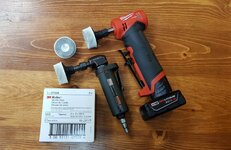
I now have/use those 3M bristle discs. I only have the white (fine) & is all I have ever tried for these. Works pretty well but man are they expensive. But I got them way before inflation skyrocketed & was an AWD. They seem to last a while but I don't get to use them much these days.

20191218_233250.jpg
 

Rockable

Well-known member
Joined
Jan 6, 2019
Messages
493
Location
Oak Ridge, NC
Someone here turned me on to the Lisle 81780 scrapers they are very good.. I usually us a razor blade to get the worst off and then clean up with this. I do not like using abrasives on perfectly flat machined surfaces.

 
To avoid these ads, REGISTER NOW!
OP
B

bigredcornhead

Well-known member
Joined
Aug 9, 2011
Messages
445
Yep those carbide scrapers are awesome, but i do still sometimes have a need to use a right angle die grinder to get into spots not all that accessible with them. Water pumps are the most common example where a quick light buzz makes sure that gasket sets. I might just have to buy some of those 3M roloc brushes and see how they do on an upcoming job.

Here are the ones i am looking at:


They are pricey for only two but, if you say they are worth i will give these a shot. They should thread onto all die grinders without issue correct?
 

rlitman

Well-known member
Joined
Oct 18, 2010
Messages
24,726
Location
Long Island
...Here are the ones i am looking at:


They are pricey for only two but, if you say they are worth i will give these a shot. They should thread onto all die grinders without issue correct?
I own the green version (slightly more aggressive), and use it for a number of tasks, but I would only use it with a very gentle touch on a cast iron gasket surface, and wouldn't consider them on anything softer. The bristles on these are abrasive loaded, and they're a fantastic cleaning tool, because they give you the softness of Scotchbrite without any of the media clogging, so they can remove gummy materials VERY quickly. But they're still abrasive and aggressive and will strip paint, rust and even lightly blend metals (nothing like a flap wheel, but they do still remove metal).

If you think the 2" discs are expensive, you should see the 4-1/2" angle grinder wheels...

Anyway, as for fit, there are different Roloc thread sizes, but these (the ones you linked) should be used with a 2" pad that accepts the plastic coarse thread Roloc discs. They don't fit the knockoff pads that take metal fine threaded discs.
 

dnschmidt

Well-known member
Joined
Oct 3, 2014
Messages
7,327
Location
Phoenix, AZ
Most factory service manuals specify the white Roloc's on a right angle die grinder for aluminum. This is probably for speed and not quality considerations as don't forget this job is being done by somebody on flat-rate. I've extensively used the green versions on cast iron gasket surfaces without issue (Powerstroke 6.0). But for aluminum white (120 grit) is as coarse as I'd ever go.
 
Last edited:

Wamsutta

Well-known member
Joined
Jan 8, 2014
Messages
10,906
Location
Amarillo, Texas
With an aluminum cylinder head on off a Briggs & Stratton, I'll use the factory Dremel wire cup wheel in conjunction with WD-40.

What that does is remove all the carbon from the combustion area. The WD-40 "floats" the carbon in a "black soup" and keeps it from making smudge marks. The cup wheel is made of very fine stainless steel strands, so by that, it doesn't leave any marks. It actually leaves a semi-gloss polished finish. No need to worry about inter-granular corrosion because the wire wheel is stainless steel.

What the heck has this got to do with gasket surfaces you say? Not a damn thing. 😁
 

Packard V8

Well-known member
Joined
Mar 16, 2009
Messages
7,380
Location
Spokane, WA
What is the gasket surface made of? If it's steel I sometimes use a brass bristle brush after the razor blade. If the surface is made from any of the white metals (aluminum, zinc die-cast, pot metal) then it's strictly a razor blade and a light touch with a medium, kerosene-soaked, India stone. The white metals are too soft, IMO, to use any sort of power tool on that can easily remove gasket surface material where you don't want it to or round over a flat gasket surface. Sometimes I'll use a file if I can verify it to be flat (newer ones may not be) to true a flat surface but you have to have a very light touch and a good eye for what's being removed and where or the surface won't be planar (flat) anymore.
Those of us who've spent time in auto machine shops would agree with you. The homehandyhack who cleans aluminum gasket surfaces with a power tool often buys himself serious trouble.

jack vines
 

RoninB4

Well-known member
Joined
Jul 22, 2020
Messages
3,666
Location
Under My House
Those of us who've spent time in auto machine shops would agree with you. The homehandyhack who cleans aluminum gasket surfaces with a power tool often buys himself serious trouble.

jack vines
-Thanks Jack, nice to hear from professionals now-n-then. My experience comes from being a retired tool and die maker / mold maker where cleaning precision surfaces can be a bit finicky. I sometimes get flak here that I'm being too fussy with things but I try to offer advice appropriate for the application. Excess precision and/or fussiness is wasted but sometimes it's the right thing to do in critical applications.

Mu postings are not about "Look at me", I just try to give something back to this website for all the knowledge I've gotten from the collective membership here. Just my way of saying thank you.
JMO
 
Last edited:
To avoid these ads, REGISTER NOW!
Top Bottom