To avoid these ads, REGISTER NOW!

Picking a 230V socket

TWX

Well-known member
Joined
Apr 1, 2010
Messages
817
Location
Phoenix
Hi, new here, looks like a good forum...

I'm adding some conduit and electrical to the side of my house where I've had a slab poured, and I'm considering adding a higher voltage circuit while I'm at it. At the moment the device that I have that can use 230V is an air compressor, but I would like to keep my options open for other devices with higher amperage draws, like a welder. Currently the compressor is wired for 115V, but both the motor and the pressure switch support 230V, so it's as simple as replacing the cord and moving some wires.

The location is on the west side and while ultimately I want to cover and enclose the slab, it will be exposed to the Arizona sun at the worst time of day. Whatever outlet I use, it needs to support being in a weather-resistant service enclosure, such that the plug can be in the outlet while the outlet is protected.

I would also appreciate advice on wire gauge. It looks like I can get away with 12awg or 10awg if I go with 230V 15A, but I'm not sure what to use beyond that.

Thanks!
 
To avoid these ads, REGISTER NOW!

BioHazard

Banned
Joined
Feb 3, 2010
Messages
743
It really depends on how many amps you want. 15 amps would barely run a compressor. I'd go a minimum of 30, if not 50 amps. 30 is a minimum wire size of 10ga, 50 is 6ga, although it depends on the length.

I really like 240v 30 amp twist lock sockets. Obviously they can't pull apart. If you get a big enough welder you'd need a 50 amp outlet, usually the type they use for stoves or an L6-50 (welder) outlet. (although most welders will run on 30A/240V just fine)
 

sdowney717

Well-known member
Joined
Mar 17, 2010
Messages
964
Is the compressor easily portable? If so consider keeping it at 120 volts. You might need to use it somewhere else.
Mine needs a 20 amp circuit or it will trip breakers. And you cant run it on a standard extension cord, the motor wont even start.
 
OP
T

TWX

Well-known member
Joined
Apr 1, 2010
Messages
817
Location
Phoenix
I have a portable 19 gallon compressor already, so this one can be converted to 240 no problem.

I'm mainly looking to this so that I can run the wiring now, even if I don't hook up the circuit in the main panel right away. As long as the wire is run, I guess I can pick the actual outlet/socket itself later.

I'll go price out enough 6 gauge and 10 gauge for the 30-40ft I'll need. It looks like I'll minimally need three wires, possibly four depending on the configuration.
 

sberry

Banned
Joined
Jun 18, 2005
Messages
35,747
Location
Brethren, Michigan
Welders and compressors need 3 wires, 2 conductors and a ground. Most home comps (5 hp box store stuff) use a 10/2 and welders are all over the place depending on models, almost anything that comes with a factory 50A plug runs on 8, some of the small feeders as low as 12 but in reality I wouldn't run less than 10 for a welder circuit, covers most machines except for a couple of the 250A wire feeders.
 
OP
T

TWX

Well-known member
Joined
Apr 1, 2010
Messages
817
Location
Phoenix
Another dumb question...

Can I use a common (properly sized, obviously) ground wire for this circuit in addition to some 120V 15 and 20 amp circuits that I'm running in the same hard conduit? I think that I can, but as I'm new to higher voltage circuits I figured I'd better ask.

This whole thing started when we decided to install some lights and 20 amp 120V circuits on the side of the house where I work on things (also where the panel is). We had received a quote for just a temporary light in addition to a whole bunch of in-ceiling and in-wall wiring, figuring later we'd upgrade the circuits over there when we have the patio cover extended. The quote was high enough that I started pricing out first a temporary light, then putting in thin-wall metal conduit with circuits for other power deviaces, borrowing power from one 15 amp circuit for a couple of floods, and one or two 20 amp circuits for some power tool plugs. Thing is, if I add the wiring for the 240V circuit now, it won't cost me a whole lot to let the electricians hook the circuit up in the panel as long as I get the wiring to it with enough slack that they can work with it.

I remember while typing this what my other 240V device is that I already have- a Sorensen DCS55-55 2U current-limited power supply for electronics testing. It certainly won't live out there in the elements, but if I decide to work on something and I'm worried about fire then using it outside on the concrete slab is probably the safest idea. The power supply can be wired for either a four-plug three-phase connector, or for a single phase three plug connector, which it currently has, in one of the twist-locking type connectors. I'm not 100% sold on that connector for its sheer size though, and changing the cable on the power supply is fairly easy.
 
Last edited:

sberry

Banned
Joined
Jun 18, 2005
Messages
35,747
Location
Brethren, Michigan
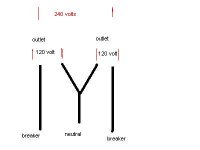
For a ground wire I like to use a 10, good for circuits to 60A and anything smaller, you can use it for several circuits in the same pipe. For a couple of 120V circuits when using pipe I really like a multi wire circuit, there is a limit to conduit fill and loading (derating requirements) usually 9 current carrying conductors I believe, use of multi wire circuits can reduce the fill and the conductor count as well as reduce V drop in some circumstances.
These drawings do not include over current requirements.
 

Attachments

  • multi wire.JPG
    multi wire.JPG
    8 KB · Views: 35
  • multiwire.jpg
    multiwire.jpg
    10 KB · Views: 38
Last edited:
To avoid these ads, REGISTER NOW!

bluesman2a

Well-known member
Joined
Aug 16, 2005
Messages
1,312
Location
Atlanta, Ga.
I like the NEMA 6-50R plugs. Most welders and plasma cutters have that plug already on them. In my shop I just wired all my 220V outlets for 6-50R's, so that I didn't have multiple 220 plugs. This also allows me to get away with fewer different types of extension cords too.

The plug itself is overkill for most compressors but you can size the breaker appropriately to the anticipated load instead of the plug ratings as long as the breaker is less than 50 Amps.
 
OP
T

TWX

Well-known member
Joined
Apr 1, 2010
Messages
817
Location
Phoenix
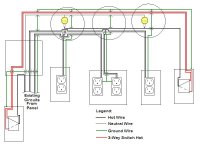
Okay, I've made a diagram of the whole circuit. It's obviously not to scale. The runs between the round junction boxes are going to be 10', and the whole thing is a little over 40' from end to end. The vertical lines are around 4'. I'm looking at 70' of 12g ground, 100' of 14g red for the lights, 40' of 14g hot, 40' of 14g neutral, 26' 12g hot and 26' of 12g ground for one receptacle circuit, and about 42' of 12g hot and 42' of 12g neutral for the other receptacle circuit. Assuming the design doesn't get a 240 circuit.

There are are three boxes for electrical sockets in the diagram. The ones on the ends have only one circuit and one set of outlets each. The one in the middle has two sets of outlets, one on each circuit.

If the two outlets on separate circuits are out of phase to each other, would it literally be as simple as taking the hot wire from each and putting them to each of the hot pins on the 6-50R? Would I have to increase the gauge of the hot wires on these two circuits as far as they go toward the 240V socket? Or am I going about this entirely incorrectly and will lead to folly if I try this?
 

Attachments

  • circuit.JPG
    circuit.JPG
    58.2 KB · Views: 39
Last edited:

mrb

Well-known member
Joined
Dec 31, 2008
Messages
3,734
Okay, I've made a diagram of the whole circuit. It's obviously not to scale. The runs between the round junction boxes are going to be 10', and the whole thing is a little over 40' from end to end. The vertical lines are around 4'. I'm looking at 70' of 12g ground, 100' of 14g red for the lights, 40' of 14g hot, 40' of 14g neutral, 26' 12g hot and 26' of 12g ground for one receptacle circuit, and about 42' of 12g hot and 42' of 12g neutral for the other receptacle circuit. Assuming the design doesn't get a 240 circuit.

There are are three boxes for electrical sockets in the diagram. The ones on the ends have only one circuit and one set of outlets each. The one in the middle has two sets of outlets, one on each circuit.

If the two outlets on separate circuits are out of phase to each other, would it literally be as simple as taking the hot wire from each and putting them to each of the hot pins on the 6-50R? Would I have to increase the gauge of the hot wires on these two circuits as far as they go toward the 240V socket? Or am I going about this entirely incorrectly and will lead to folly if I try this?

you cant tap off the 6-50 to supply 15 or 20 amp receptacles. Everything needs to be protected by a properly sized breaker. 15 amp breaker for 14awg wire, 20 amp breaker for 12awg wire, 50 amp breaker for 6awg wire.
 
OP
T

TWX

Well-known member
Joined
Apr 1, 2010
Messages
817
Location
Phoenix
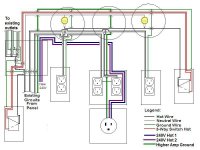
Okay, that's part what I needed to know. I will just have to revise and add two 6 gauge hot wires and one 8 gauge ground. I'll probably replace all of the ground from the receptacle back to the junction box with 8 gauge, and tie the grounds for the lesser branching ground wires to that circuit.

Since I'm using all metal conduit all of the way back to the main panel, can I get away with a ground wire less than 8 gauge? The existing circuit wire is probably 12, though from the panel to the junction box *might* be 10.

Basically this house had three dedicated circuits run to some AV gear before we lived here, and my AV gear has low enough power draw to run on a single circuit with room to spare. That junction box is where the three circuits currently have a splice. I'm going to hook all three runs to one breaker and use that breaker for the lights, and I'm going to use the other two for the two receptacle circuits.

I do appreciate all of the help I'm getting here, I'm fairly good with DC and with electronics, but AC isn't something I've worked with much beyond changing outlets for GFCI and replacing switches and the like.
 
OP
T

TWX

Well-known member
Joined
Apr 1, 2010
Messages
817
Location
Phoenix
I've revised the drawing a bit. Bigger ground, whole new 240V dual-hot lines. Most of branch grounds are still smaller wire, as there's no need for the big wire. Assume for sake of argument that the two 6ga go through the round junction boxes, even though there wasn't room on the drawing...
 

Attachments

  • circuit2.JPG
    circuit2.JPG
    73.5 KB · Views: 29

Goobzilla

Well-known member
Joined
Dec 19, 2005
Messages
321
Location
Wellington, CO
I like the NEMA 6-50R plugs. Most welders and plasma cutters have that plug already on them. In my shop I just wired all my 220V outlets for 6-50R's, so that I didn't have multiple 220 plugs. This also allows me to get away with fewer different types of extension cords too.

The plug itself is overkill for most compressors but you can size the breaker appropriately to the anticipated load instead of the plug ratings as long as the breaker is less than 50 Amps.

Exactly what I did with my new shop.
 
To avoid these ads, REGISTER NOW!
Top Bottom