To avoid these ads, REGISTER NOW!

Question for the 12V Lithium battery guys regarding testing..

mrb1

Well-known member
Joined
Aug 20, 2021
Messages
5,445
Location
Miami County, Ohio
Finally made the switch this year from the old lead acid for the trolling motor. Loving it so far. Only used on a small Bass Buggy twice, and a friends jon boat in a farm pond once. Between me and him, the battery has been run for several hours and covered a good amount of water. Still tests 100% and 13.2V on the meter without recharging. I know they are kinda all and done quickly, not slowly draining like lead. Are they just that efficient, or is it just my cheap meter, Will the battery show 100% until it suddenly dies? I guess I could run it on the bench all night and monitor, but not keen on that for motor heating up issues. It is a $150 battery with BMS, but no bluetooth or app available for monitoring. Better meters available just for LiFePo4? Does the meter recognize a difference?
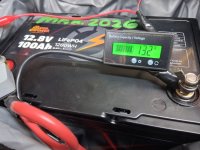
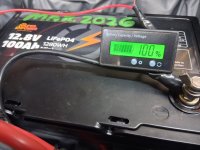
bt.jpg

bt22.jpg

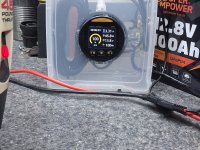
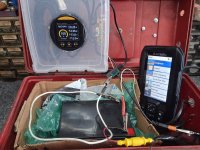
The cheap $5 meter does show increments on a lead acid, shots from my truck just now
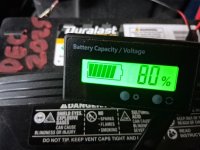
bt1.jpg

bt2.jpg
 
To avoid these ads, REGISTER NOW!

gte718p

Well-known member
Joined
Mar 12, 2009
Messages
3,962
Voltage is useful on a Pb acid battery as an approximation of capacity. For lithium chemistries voltage is almost useless. The voltage vs capacity charts are almost flat and then they drop off a cliff. This is the curve for a battery bank for 4 batteries, but is pretty representative. To be useful, you need to measure how much energy is coming out of the battery. Do a search for a coulomb meter on your favorite shopping site and you will find a ton of different options at different ranges of price and quality from all the standard chinese suspects. The electronics are commodity grade at this point, so unless you need metrology precision, the generics work pretty well.

1781075007851.png
 

Tactile

Well-known member
Joined
Sep 2, 2020
Messages
226
Location
Melbourne, AU
Just bang it on the charger after you use it every time...will increase the life of the battery as well. You have a proper charger for the chemistry right?
 

gte718p

Well-known member
Joined
Mar 12, 2009
Messages
3,962
Yes, a NOCO Genius charger ordered at the same time. Will miss using the 50 year old Fisk charger :LOL:

Thanks @gte718p. Looking at those meters now.

I forgot to add, I prefer the hall effect type, like the one linked below from the forest company. It doesn't look like this particular one is avaialbe any longer, but you have find 10 varieties of the same thing from Aliexpress.


kbeefy

Well-known member
Joined
Sep 14, 2013
Messages
3,444
Location
Harington, Eastern Washington
The problem is it's much smaller voltage gradient from fully charged to flat.
I use a general rule of thumb 13.6+ is full, 12.8 is flat.
The meter you are using is likely calibrated to lead acid, so 12.8 is still fully charged (100%).

For a better idea I use a shunt that measures power out and displays it relative to a fully charged battery, giving me an idea of how much is left. It's a little more accurate than the voltage method, which can and does vary when there is a load on the battery or it's charging.

A voltage based meter sees a fully charged (13.6v) battery with a heavy load at 12.5v and thinks it's dead. A shunt based battery monitor in the same scenario shows 90%.

Conversely, while charging a voltage based monitor sees 13.6v while charging a flat battery and shows 100%, while a shunt based one shows 10%.

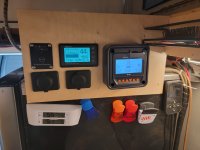
Shunt based battery monitor is top center. Important to note that when you disconnect the battery it resets the monitor. If transfering the battery to multiple applications you would want to keep the shunt installed so it can accurately display power used, or fully charge it so it has a good baseline.

20251213_162447.jpg
 
OP
M

mrb1

Well-known member
Joined
Aug 20, 2021
Messages
5,445
Location
Miami County, Ohio
Thanks @kbeefy , @Perrorojo ..^^^^ all replies appreciated. Meter with a shunt ordered earlier, shows up tomorrow. What I'm not grasping is testing the battery on the bench, without the trolling motor. These meters/shunts on the negative side have to be under load to display, correct? IOW,,,how to test the battery state without the trolling motor.
 

Snapped-off

Well-known member
Joined
Feb 22, 2012
Messages
4,729
Location
Indiana
Voltage is useful on a Pb acid battery as an approximation of capacity. For lithium chemistries voltage is almost useless. The voltage vs capacity charts are almost flat and then they drop off a cliff. This is the curve for a battery bank for 4 batteries, but is pretty representative. To be useful, you need to measure how much energy is coming out of the battery. Do a search for a coulomb meter on your favorite shopping site and you will find a ton of different options at different ranges of price and quality from all the standard chinese suspects. The electronics are commodity grade at this point, so unless you need metrology precision, the generics work pretty well.

1781075007851.png
Interesting chart. My lithium battery banks go from 565V to about 440V before they cut off on low voltage.
 
To avoid these ads, REGISTER NOW!

pembol

Well-known member
Joined
Feb 13, 2014
Messages
269
Thanks @kbeefy , @Perrorojo ..^^^^ all replies appreciated. Meter with a shunt ordered earlier, shows up tomorrow. What I'm not grasping is testing the battery on the bench, without the trolling motor. These meters/shunts on the negative side have to be under load to display, correct? IOW,,,how to test the battery state without the trolling motor.

The shunt is on the negative lead, but there is a small wire to the positive terminal to power the meter. You do need to get the battery all the way full to calibrate the meter to 100% SOC. Given the choice these days, I would buy a battery with a State of Charge meter built into the battery itself. Nothing else to buy and no issue if you move the battery between applications.
 
OP
M

mrb1

Well-known member
Joined
Aug 20, 2021
Messages
5,445
Location
Miami County, Ohio
The shunt is on the negative lead, but there is a small wire to the positive terminal to power the meter. You do need to get the battery all the way full to calibrate the meter to 100% SOC. Given the choice these days, I would buy a battery with a State of Charge meter built into the battery itself. Nothing else to buy and no issue if you move the battery between applications.
Gotcha, thanks. Yea, this was a spur of the moment purchase without much research on a cold snowy day dreaming of being on the water :LOL: Next unit will have the bluetooth and meter built in. This one was $129 on March 4...today listing for $174 :eek:
 

Perrorojo

Well-known member
Joined
Jun 8, 2012
Messages
1,765
Location
Northern IN
Thanks @kbeefy , @Perrorojo ..^^^^ all replies appreciated. Meter with a shunt ordered earlier, shows up tomorrow. What I'm not grasping is testing the battery on the bench, without the trolling motor. These meters/shunts on the negative side have to be under load to display, correct? IOW,,,how to test the battery state without the trolling motor.
You'll most likely need to program the shunt to the battery. It will ask what the "full voltage" is and what the "amp hour capacity" is. You should have to pick "tail current" if it's a good shunt. Lithium batteries don't follow Peukert's theory so they have a setting for "discharge Floor". The battery probably has all the charger and shunt settings listed online. You can hook the shunt up without charging it. Set up the parameters and turn on the charger. When the battery reaches full the shunt should flip to 100% charge. That's the way Victron and most shunts operate.
 

Perrorojo

Well-known member
Joined
Jun 8, 2012
Messages
1,765
Location
Northern IN
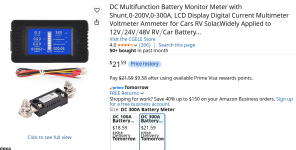
Keep in mind this battery is just for a couple small boats cruising down the river and a couple farm ponds :LOL: Not near the league of the Victron equipment. Not sure what the options will be with this $20 unit I ordered.

Screenshot 2026-06-10 at 09-01-22 CGELE DC Multifunction Battery Monitor Meter with Shunt 0-20...png
That should work fine. It has the ability to program.
 

Attachments

  • Screenshot_20260610_115343_Chrome.jpg
    Screenshot_20260610_115343_Chrome.jpg
    500.3 KB · Views: 2

kbeefy

Well-known member
Joined
Sep 14, 2013
Messages
3,444
Location
Harington, Eastern Washington
Thanks @kbeefy , @Perrorojo ..^^^^ all replies appreciated. Meter with a shunt ordered earlier, shows up tomorrow. What I'm not grasping is testing the battery on the bench, without the trolling motor. These meters/shunts on the negative side have to be under load to display, correct? IOW,,,how to test the battery state without the trolling motor.

Without accessing the BMS or monitoring total current flow, I'm not sure there is a better way to measure SOC than direct resting voltage measurement. This is the rough estimation I use. Before I had the Battery Monitor I just had this chart printed off and stuck to the wall by a volt meter. It goes from 12.8 to 12.0 really fast, so I just try to recharge by 12.8. Also, the voltage drop under load gets much larger as the SOC gets closer to 12.5 and some of my equipment will trigger a low voltage shutoff.

LiFePO4-Battery-Voltage-Charts-Image-8.jpg


Edit to add: If it's on the bench the best way to determine SOC is just to hook up the charger and let it go until it stops. Then you know it's 100%.
 

gte718p

Well-known member
Joined
Mar 12, 2009
Messages
3,962
Interesting chart. My lithium battery banks go from 565V to about 440V before they cut off on low voltage.
That seems really low. 565v means probably -170ish cells. The lowest I would really want to run is -500 volts. The exact numbers depend on chemistry. Monolithic LiFePO4 is not the same as Lion 18650s.

It is a trade off though. A deep discharge is going to hurt the pack. If it is a house hold backup, If you are going that low you are probably in extremis. It may be worth damaging the pack to keep the heat pump running as long as possible or the refrigerator cold. For a car that might mean lining to the next exit. It is all risk/reward calculation. You pack will definitely not last with that kind of abuse.

If the pack is Lion 440v is right at the limit of being able to safely recharge it without starting a fire. I dropped the liFePO4 pack in my motorcycle to zero and while I absolutely damaged the cells, I salvage 8 of 10. But did lose about 30% capacity in that single cycle.
 

gte718p

Well-known member
Joined
Mar 12, 2009
Messages
3,962
Thanks @kbeefy , @Perrorojo ..^^^^ all replies appreciated. Meter with a shunt ordered earlier, shows up tomorrow. What I'm not grasping is testing the battery on the bench, without the trolling motor. These meters/shunts on the negative side have to be under load to display, correct? IOW,,,how to test the battery state without the trolling motor.
Without starting with a full charge, there is not a good way to determine state of charge on the bench. You can SWAG by voltage, but you really need a good multimeter. A 1% error is going to really throw of your estimate. Even then if you are not full an extremely small voltage range covers a lot of ground from 80% charged to 20% charged. You will at least know you are not at one of the extremes I guess.
 
To avoid these ads, REGISTER NOW!
Top Bottom