To avoid these ads, REGISTER NOW!

Recommendations for my garage floor?

GuyintheSouth

New member
Joined
Jun 1, 2026
Messages
4
Needing recommendations for my one car garage floor. Trying to decide between epoxy/poly/flakes, polishing, or painting. Doing a lot of research into all three and undecided, but starting to lean towards painting as the least expensive. I do know prep is the most important factor.

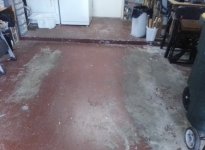
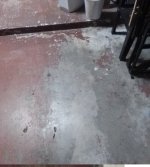
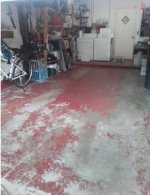
Garage is used only for the car, storing items and the waste and recycle cans, and has a small tool bench. No heavy duty jobs. THe floor has old paint peeling, water stains, divots and spalling in places. No oil stains I believe. See pics

I know to do moisture testing. I will do the plastic test several times a month. A rep tested with moisture meter in one spot and it was around 4.4, which I understand is good.

I have many resurfacing companies nearby to chose from. I've had some resurfacing reps out and they all say it just needs prep of grinding and patching, then the base coat, flakes, and polyaspartic. One rep recommends only epoxy because it's best as a moisture barrier. Another rep recommends only polyurea because it's stronger and can do it in 1 day.

I don't care about flakes, a solid light grey would be ok with me. Maybe a few scattered flakes, but I'm not really sold on the full flake layer technique. Flakes are simply pieces of vinyl which doesn't impress me much. One rep says full flakes are required. Another said they can do it without flakes. I know flakes add grip but you can also add sand grip product.

I'd be ok with just semi smooth concrete with a clear protected coat, or even a painted coat maybe. And retouch the paint when needed. I read one review that paint they used lasted 10 years then needed easy touch up. However, in videos polished concrete looks very good to me, not even painted. I don't need the highest gloss, just a touch of gloss would be ok. But polished concrete still needs some kind of a clear coat protection, right?

concrete surface repair kits?
I found there are concrete repair kits that apply a layer of concrete which sounds like a good idea to me, and more reassuring than epoxy to me. Is it? Will a layer of concrete hold up over time?

A fresh layer of concrete over properly repaired cracks, divets and spalling sounds really good and long lasting. Anyone done this? Thoughts?

paint?
Or I'd be ok with painting over the properly prepared surface of grind/patch. I believe paint would be much cheaper then polishing. Any recommendations for a good paint?

It seems every technique I look into has good and bad reviews. I know prep is the key for a lasting resurfacing. So I want to get prep done right, and not skip on any needed prep.
 

Attachments
  • 1.jpg
    1.jpg
    181.8 KB · Views: 17
  • 2.jpg
    2.jpg
    298.3 KB · Views: 16
  • 3.jpg
    3.jpg
    313 KB · Views: 14
  • 4.jpg
    4.jpg
    209.8 KB · Views: 14
  • 5.jpg
    5.jpg
    155.7 KB · Views: 16
Last edited:
To avoid these ads, REGISTER NOW!

mrtynafixit

New member
Joined
Jun 3, 2026
Messages
3
Few thoughts that might help cut through the contradictory advice from the reps.

On that 4.4 moisture reading — depending on the meter, that's actually borderline, not "good." Most concrete meters read 0–5 and anything above 4 is in the watch-out zone. The plastic test you're already planning is the real test, so do that in a few spots before committing to anything. If any plastic comes up with condensation underneath, no coating is going to stick long-term.

The reps are giving you conflicting advice because they're each selling what their company carries. Nobody serious installs just epoxy or just polyurea as a full system anymore — the good ones are layered, with an epoxy or polyurea base coat that bonds to concrete and a polyaspartic topcoat that handles UV and chemicals. The chemistry matters less than the prep does.

On flakes — they aren't required for performance. They hide slab imperfections (which yours has plenty of from the pics) and add grip. You don't have to do full flake or none. Partial or scattered flake gets you the slip resistance without the busy look, and most reps won't volunteer that option.

Honest read on your situation — with the peeling paint, water stains, divots, and spalling, the cheapest durable path is a full grind down to clean concrete, patch the damage, and then either porch and floor paint if you want budget (knowing you'll be repainting every few years), or a thin epoxy + polyaspartic system if you want 10+ years and forget about it. The concrete resurfacing kits don't bond well over peeling paint and tend to delaminate. The "polyurea in one day" pitch usually means the prep got rushed.

If it helps, there's a breakdown of the coating chemistries and what to actually ask the reps over at garagefloorsrsm.com — written for homeowners trying to make exactly this decision.

Good luck either way. You're already doing the right thing by getting multiple opinions before committing.
 

b-boy

Well-known member
Joined
Oct 2, 2013
Messages
2,155
Location
Buffalo NY
Look into rust bullet as well. I did mine about 7 years ago and I'm very happy with it. It's easier to apply than epoxy and requires minimal prep.
 
OP
G

GuyintheSouth

New member
Joined
Jun 1, 2026
Messages
4
Few thoughts that might help cut through the contradictory advice from the reps.

On that 4.4 moisture reading — depending on the meter, that's actually borderline, not "good." Most concrete meters read 0–5 and anything above 4 is in the watch-out zone. The plastic test you're already planning is the real test, so do that in a few spots before committing to anything. If any plastic comes up with condensation underneath, no coating is going to stick long-term.

The reps are giving you conflicting advice because they're each selling what their company carries. Nobody serious installs just epoxy or just polyurea as a full system anymore — the good ones are layered, with an epoxy or polyurea base coat that bonds to concrete and a polyaspartic topcoat that handles UV and chemicals. The chemistry matters less than the prep does.

On flakes — they aren't required for performance. They hide slab imperfections (which yours has plenty of from the pics) and add grip. You don't have to do full flake or none. Partial or scattered flake gets you the slip resistance without the busy look, and most reps won't volunteer that option.

Honest read on your situation — with the peeling paint, water stains, divots, and spalling, the cheapest durable path is a full grind down to clean concrete, patch the damage, and then either porch and floor paint if you want budget (knowing you'll be repainting every few years), or a thin epoxy + polyaspartic system if you want 10+ years and forget about it. The concrete resurfacing kits don't bond well over peeling paint and tend to delaminate. The "polyurea in one day" pitch usually means the prep got rushed.

If it helps, there's a breakdown of the coating chemistries and what to actually ask the reps over at garagefloorsrsm.com — written for homeowners trying to make exactly this decision.

Good luck either way. You're already doing the right thing by getting multiple opinions before committing.
Thanks. Also I forgot to mention that the main slab has no cracks anywhere. The step up section has one long hairline crack.
 
Last edited:
OP
G

GuyintheSouth

New member
Joined
Jun 1, 2026
Messages
4
Look into rust bullet as well. I did mine about 7 years ago and I'm very happy with it. It's easier to apply than epoxy and requires minimal prep.
Thanks, I didn't know about rust bullet products. How much touch up have you needed to do in the 7 years>

I'm taking a close look at rust bullet for concrete. Says you don't have to etch etc. I need to remove old paint and do divet and spalling fixes. After that I don't need to grind with rust bullet for concrete?
 
Last edited:
To avoid these ads, REGISTER NOW!

dcg9381

Well-known member
Joined
Jun 20, 2018
Messages
11,660
Location
Austin, TX
Says you don't have to etch etc.
Sus. Read the fine print:
"However, looking at their actual Technical Application Guidelines, there is a distinct difference between "no grinding required" and "no preparation required. The product relies entirely on its ability to penetrate open pores in the concrete to form a mechanical bond. Because of this, its "no-grind" promise depends entirely on a Porosity Test"

You have to get that old paint off anyway. I'd grind. Problem solved. I've seen way worse floors.

I like polyurea if you're going to grind. But then again I've never used "rust bullet".
 

b-boy

Well-known member
Joined
Oct 2, 2013
Messages
2,155
Location
Buffalo NY
Thanks, I didn't know about rust bullet products. How much touch up have you needed to do in the 7 years>

I'm taking a close look at rust bullet for concrete. Says you don't have to etch etc. I need to remove old paint and do divet and spalling fixes. After that I don't need to grind with rust bullet for concrete?

No touch ups so far.

This stuff is very tough. I did 2 coats, full flake coverage, and 2 coats of clear. My concrete was pretty new, maybe 2 years old?

For prep I rented an regular orbital sander from HD and did a light sanding of the floor followed by a power wash. No grinding.

It's not cheap, but I'm happy with it.
 
OP
G

GuyintheSouth

New member
Joined
Jun 1, 2026
Messages
4
Few thoughts that might help cut through the contradictory advice from the reps.

On that 4.4 moisture reading — depending on the meter, that's actually borderline, not "good." Most concrete meters read 0–5 and anything above 4 is in the watch-out zone. The plastic test you're already planning is the real test, so do that in a few spots before committing to anything. If any plastic comes up with condensation underneath, no coating is going to stick long-term.

The reps are giving you conflicting advice because they're each selling what their company carries. Nobody serious installs just epoxy or just polyurea as a full system anymore — the good ones are layered, with an epoxy or polyurea base coat that bonds to concrete and a polyaspartic topcoat that handles UV and chemicals. The chemistry matters less than the prep does.

On flakes — they aren't required for performance. They hide slab imperfections (which yours has plenty of from the pics) and add grip. You don't have to do full flake or none. Partial or scattered flake gets you the slip resistance without the busy look, and most reps won't volunteer that option.

Honest read on your situation — with the peeling paint, water stains, divots, and spalling, the cheapest durable path is a full grind down to clean concrete, patch the damage, and then either porch and floor paint if you want budget (knowing you'll be repainting every few years), or a thin epoxy + polyaspartic system if you want 10+ years and forget about it. The concrete resurfacing kits don't bond well over peeling paint and tend to delaminate. The "polyurea in one day" pitch usually means the prep got rushed.

If it helps, there's a breakdown of the coating chemistries and what to actually ask the reps over at garagefloorsrsm.com — written for homeowners trying to make exactly this decision.

Good luck either way. You're already doing the right thing by getting multiple opinions before committing.
I can report no moisture with the plastic test. I taped two 3' plastic sheets down in different places and waited 24 hours. Not a bit of moisture or anything on the sheets. But I do understand moisture can appear later, a test on one day doesn't mean it can't change. I do know a MVB can be applied anyway.

What do you think of polyaspartic as a base coat? I was kinda shocked I found a recent yt from a pro company applying a polyaspartic base coat after grinding because it was a newer slab and it "cures in 1 hour". They will do either epoxy or polyaspartic as base coat. I've read polyaspartic is not best as base coat because it cures so fast and thus the bonding is not as strong because of that. They do not say what brand they use.
 

FJ4FUN

Well-known member
Joined
Jul 28, 2014
Messages
622
Location
NorCal
I can report no moisture with the plastic test. I taped two 3' plastic sheets down in different places and waited 24 hours. Not a bit of moisture or anything on the sheets. But I do understand moisture can appear later, a test on one day doesn't mean it can't change. I do know a MVB can be applied anyway.

What do you think of polyaspartic as a base coat? I was kinda shocked I found a recent yt from a pro company applying a polyaspartic base coat after grinding because it was a newer slab and it "cures in 1 hour". They will do either epoxy or polyaspartic as base coat. I've read polyaspartic is not best as base coat because it cures so fast and thus the bonding is not as strong because of that. They do not say what brand they use.
That is correct, polyaspartic is not recommended as a base coat and both surface moisture meters and the plastic sheet tape down test represent a snapshot in time with regards to measuring/predicting MVT. If you have reason to suspect that MVT may be an issue i.e. visible evidence such as staining, presence of efflorescence, prior coatings disbonding etc. then, at a minimum, you should specify a MVT barrier prime coat applied over a diamond ground slab. If significant MVT is a known issue then shot blasting followed with multiple applications of a high quality MVT barrier would be required.
 
To avoid these ads, REGISTER NOW!
Top Bottom