To avoid these ads, REGISTER NOW!

School me on capacitors

SteelHorseHD

Well-known member
Joined
Apr 27, 2011
Messages
188
Location
Illinois
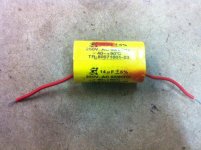
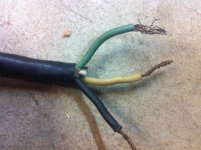
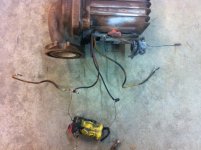
Some of you may have seen my posts about a outdoor wood burner that I bought off of eBay not too long ago. If not, I bought one that had been involved in a fire and all of the electrical was melted. I have been replacing all of the parts that were ruined. The guy that I bought it from told me that the pump ran when he hooked it up. I took the cover off of it and noticed that the capacitor was melted. I bought a new capacitor for the pump and I got a hold of a used power cord for it. The problem is, I don't know anything about capacitors and I'm not really sure how to hook up the new one. The wires are still connected on the pump but it wasn't as easy as just hooking wires of the same color together like I thought it would be. There are three wires in the cord. The green one I am assuming is a ground, a black and a white. The pump has a red, white and black. Here are some pictures of what I am working with. If any of you know how this should be hooked up it would really help me out as I am trying to get the furnace hooked up before next weekend so I can avoid giving my propane guy any more of my money! Thank you!
cap 1.jpgcap 2.jpgcap 3.jpg
 
To avoid these ads, REGISTER NOW!

jasonreck71

Well-known member
Joined
Dec 30, 2011
Messages
129
Location
Newnan,GA
I recently had major issues with my heat pump and trouble shot every thing inside of the thing...I would give you links but there are so many...just go to youtube and type in capacitor...taught me everything i needed to know
 

MBfreak

MEMBER EMERITUS
Joined
Dec 10, 2010
Messages
2,301
Location
Linkoping , Sweden
Steel Horse
Please spend some of the money you plan to save on propane to :
Alternative 1
Buy a basic electric textbook and a simple multimeter. For electric repairs, what is not understood and not tested is by definition faulty, even if it works
Alternative 2
Use part of the propane saving to get an electrician to help out.

I do not want to be an ah, but a picture of a cable end with three wires and asking for advice has me rattled.
And also q The green one I am assuming is a ground uq is worrying.

Like the main character in a Guy Ritche movie said :
" Assumption is the mother of all fups."

Be careful, please.

Ola,
 

geologist

Well-known member
Joined
Dec 14, 2011
Messages
5,326
A $10 Craftsman multi-meter could save your life. Capacitors are sort of like a filtering battery in that they store energy and can be used to block DC (direct current) while allowing AC (alternating current) to pass. They are also used to smooth the output of power supplies. Needless to say, you could potentially rapidly discharge one by accident, which wouldn't be nice. When I was in college, we would tinker around with building capacitor banks (and fully charging them) before rapidly discharging them. The result:

coins5.jpg
 
OP
S

SteelHorseHD

Well-known member
Joined
Apr 27, 2011
Messages
188
Location
Illinois
I own a multimeter and I understand electricity. I wired my entire shop with no issues. A multi meter won't tell me how to hook up a capacitor though. What I am looking for is something like a diagram showing which wires a capacitor should be connected to. I'll check out those YouTube videos. Thanks!
 

aandpdan

Well-known member
Joined
Nov 12, 2009
Messages
849
Location
In between MA and PA
Taco pump? What model?

The capacitor gets wired just like the old one. Both the black and the red wire from the pump get hooked to the capacitor.

Either the black or white wire from your cord goes to the YELLOW wire on the pump.
The other wire goes to the RED from your pump. Taco states in their instruction sheets that there is no "hot" or "common" wire on the pump.

Green is most definitely the ground.
 

theoldwizard1

Well-known member
Joined
Feb 22, 2011
Messages
43,536
Location
SE MI
The capacitor gets wired just like the old one. Both the black and the red wire from the pump get hooked to the capacitor.

Either the black or white wire from your cord goes to the YELLOW wire on the pump.
The other wire goes to the RED from your pump. Taco states in their instruction sheets that there is no "hot" or "common" wire on the pump.

Green is most definitely the ground.

:thumbup:

I'm not certain what you would find Googling or checking YouTube for capacitors, but you could widely varying answers.
 

cide1

Well-known member
Joined
Jul 6, 2011
Messages
508
Ok, I will take a stab at helping. I work with much smaller electronics on a daily basis, this is a bit bigger than normal for me. If someone follows up with more knowledge, please follow their advice over mine.

On your power cable, the green is ground, the white is hot, and the black should be common. This should be standard for building wiring, and things external to machinery.

On your motor, red should be hot, black should be common, and green should be ground. This should be standard for inside machinery.

Some capacitors are not polarized, meaning that you don't have to worry about which side is positive and which is negative. If a polarized capacitor is hooked up opposite of correct, they are damaged (sometimes violently) pretty much immediately. The capacitor that you show appears to not be polarized, but if you think it might be, put the positive side on hot, and the negative side on the common. Also, wear safety glasses, or stand several feet away the first time you power up.

So with all that said, connect your hots together, connect your grounds together, and connect your commons together. The capacitor goes between the common and the hot, and should be placed with as little wire as possible between the capacitor and the motor.

The capacitor serves two purposes. First, a motor takes a lot more current at startup than while running, this capacitor stores energy over a period of time, and delivers it quickly at startup. Secondly, motors create a lot of electrical noise. The capacitor acts as a filter to reduce the amount of this noise that is transmitted back into the electrical circuit. The motor will probably run just fine without the capacitor, but it is best to have one there.
 
OP
S

SteelHorseHD

Well-known member
Joined
Apr 27, 2011
Messages
188
Location
Illinois
Taco pump? What model?

The capacitor gets wired just like the old one. Both the black and the red wire from the pump get hooked to the capacitor.

Either the black or white wire from your cord goes to the YELLOW wire on the pump.
The other wire goes to the RED from your pump. Taco states in their instruction sheets that there is no "hot" or "common" wire on the pump.

Green is most definitely the ground.

It's a Taco 009. This is exactly what I needed to know, Thank you! For all of the others that posted thank you as well!
 
To avoid these ads, REGISTER NOW!

Gooman24

Member
Joined
Jun 17, 2011
Messages
14
Ok, I will take a stab at helping. I work with much smaller electronics on a daily basis, this is a bit bigger than normal for me. If someone follows up with more knowledge, please follow their advice over mine.

On your power cable, the green is ground, the white is hot, and the black should be common. This should be standard for building wiring, and things external to machinery.

On your motor, red should be hot, black should be common, and green should be ground. This should be standard for inside machinery.

Some capacitors are not polarized, meaning that you don't have to worry about which side is positive and which is negative. If a polarized capacitor is hooked up opposite of correct, they are damaged (sometimes violently) pretty much immediately. The capacitor that you show appears to not be polarized, but if you think it might be, put the positive side on hot, and the negative side on the common. Also, wear safety glasses, or stand several feet away the first time you power up.

So with all that said, connect your hots together, connect your grounds together, and connect your commons together. The capacitor goes between the common and the hot, and should be placed with as little wire as possible between the capacitor and the motor.

The capacitor serves two purposes. First, a motor takes a lot more current at startup than while running, this capacitor stores energy over a period of time, and delivers it quickly at startup. Secondly, motors create a lot of electrical noise. The capacitor acts as a filter to reduce the amount of this noise that is transmitted back into the electrical circuit. The motor will probably run just fine without the capacitor, but it is best to have one there.

That sounds bass ackwards to me. I am not an electrician but I play one on TV. YMMV.
 

nehog

Well-known member
Joined
Jan 2, 2010
Messages
7,935
Location
Jaffrey, NH
...
On your power cable, the green is ground, the white is hot, and the black should be common. This should be standard for building wiring, and things external to machinery.
...

Backwards: Black is hot, white is neutral... (green or green with yellow stripe is ground)

For European stuff, Blue is neutral, brown is hot, green with yellow stripe is ground. Many computer type cords are European standard.
 

racingtadpole

Well-known member
Joined
Dec 3, 2011
Messages
2,029
Location
The far side of crazy.. but sometimes Australia
Long time lurker first time poster, was going to save my first post to start my 'garage gallery' showoff but ths thread has me convinced I need to use it to prevent someone from dying.

I work with much smaller electronics on a daily basis, this is a bit bigger than normal for me.

No you dont (at least not as a down to component tech anyway)...Nothing personal mate, but the lack of theoretical understanding based upon what you have written leads me to this conclusion.


The capacitor serves two purposes. First, a motor takes a lot more current at startup than while running, this capacitor stores energy over a period of time, and delivers it quickly at startup. Secondly, motors create a lot of electrical noise. The capacitor acts as a filter to reduce the amount of this noise that is transmitted back into the electrical circuit. The motor will probably run just fine without the capacitor, but it is best to have one there

NO it doesnt, and NO it wont... It serves one purpose only. You are partially correct with your assertion that it is for start up. The momentum required to make the rotating bits move requires more energy than can be delivered by the application of mains voltage only, so to assist and give it the extra oomph they need they use a cap to shift the phase of incoming mains voltage and apply it to a second winding. Size of shift is a product of the size of the capacitor and frequency of the incoming supply. As the power supply is AC the cap DOES NOT store energy, this is what happens with a cap at DC, the rules of DC dont apply here. Most motor manufacturers dont give a rats about filtering the transmission line, unless its a medical or aerospace application, for a blower for a pizza oven, methinks not (but stranger things do happen).
You MUST have a cap on this type of motor, if you dont eventually the motor will get hot and probably catch fire (possible cause of the fire in the first place from the look of the cap in the picture). I wont bore you with the details of what happens with magnetic saturation and resulting current draw in a copper core (like a winding of a motor), but the results are pretty similar to the picture of the burnt out terminal box already on display.

I am not going to attempt to help with colour coding on the the wiring (the way I spelt colour, should give an idea).

As the motor has been through a fire, it should be tested for insulation integrity. Heat destroys the insulation on the windings of the motor, these should be tested with a Megger (1000V insulation tester) prior to any test firing of the motor. And while you have it at a Sparkwah's shop for testing, slip them extra coin to wire it correctly so no-one dies.

Please dont take any of this personally anyone, Im not suggesting that your not capable, Im suggesting that electrickery is effing dangerous if you get it wrong.
Ask yourself, is your life worth the half hours labour you would pay to have it tested and wired (any more than half an hour and youre being robbed)?
 

PrecisionTools

Well-known member
Joined
Jun 4, 2011
Messages
703
Location
Victoria, Australia
^^^ What he said! Except I dont now what the long term reliability/safety of the motor would be even if it got through a HT test. I'd be putting a new motor on it because it looks like its been hot...real hot.
 

Teken

Well-known member
Joined
Jan 2, 2010
Messages
8,214
Location
The Bad Lands
Long time lurker first time poster, was going to save my first post to start my 'garage gallery' showoff but ths thread has me convinced I need to use it to prevent someone from dying.


No you dont (at least not as a down to component tech anyway)...Nothing personal mate, but the lack of theoretical understanding based upon what you have written leads me to this conclusion.


NO it doesnt, and NO it wont... It serves one purpose only. You are partially correct with your assertion that it is for start up. The momentum required to make the rotating bits move requires more energy than can be delivered by the application of mains voltage only, so to assist and give it the extra oomph they need they use a cap to shift the phase of incoming mains voltage and apply it to a second winding. Size of shift is a product of the size of the capacitor and frequency of the incoming supply. As the power supply is AC the cap DOES NOT store energy, this is what happens with a cap at DC, the rules of DC dont apply here. Most motor manufacturers dont give a rats about filtering the transmission line, unless its a medical or aerospace application, for a blower for a pizza oven, methinks not (but stranger things do happen).
You MUST have a cap on this type of motor, if you dont eventually the motor will get hot and probably catch fire (possible cause of the fire in the first place from the look of the cap in the picture). I wont bore you with the details of what happens with magnetic saturation and resulting current draw in a copper core (like a winding of a motor), but the results are pretty similar to the picture of the burnt out terminal box already on display.

I am not going to attempt to help with colour coding on the the wiring (the way I spelt colour, should give an idea).

As the motor has been through a fire, it should be tested for insulation integrity. Heat destroys the insulation on the windings of the motor, these should be tested with a Megger (1000V insulation tester) prior to any test firing of the motor. And while you have it at a Sparkwah's shop for testing, slip them extra coin to wire it correctly so no-one dies.

Please dont take any of this personally anyone, Im not suggesting that your not capable, Im suggesting that electrickery is effing dangerous if you get it wrong.
Ask yourself, is your life worth the half hours labour you would pay to have it tested and wired (any more than half an hour and youre being robbed)?

I have to agree with the poster here. This device came out of a fire and the state of the devices internal components can not be verified.

From a insurance perspective, no carrier would allow you to put this device back into service.

Too much risk, and unknowns . . . Please be careful here.

Teken . . .
 

MBfreak

MEMBER EMERITUS
Joined
Dec 10, 2010
Messages
2,301
Location
Linkoping , Sweden
Steven Biars

Your coin shrinker has got everybody except the real nerds confused, since no comments.

But me, I like it A LOT.
Used to do it with 6 mF caps charged to 33 kV DC and discharged thru a very heavy duty MV CB into the shrinking coil. Sorry , no pics. We did it at work in the sixties.

If you have pictures of your, most likely lethal, setup that would be great.

Ola
 

nehog

Well-known member
Joined
Jan 2, 2010
Messages
7,935
Location
Jaffrey, NH
The 'coin shrinker' is an application of very high magnetic flux over a very short period of time. Basically a (sacrificial) coil of a turn or two, a HUGE bank of capacitors charged up, and then put across the coil. Typically the current is sufficiently high the coil vaporizes, whatever was in the center of the coil gets hammered by the magnetic field.

There are some YouTube videos of this I believe (were a couple of years ago) showing how it is done, and a few demonstrations. Keep in mind the power (though for a very short period of time) is massive and rather hazardous.
 
OP
S

SteelHorseHD

Well-known member
Joined
Apr 27, 2011
Messages
188
Location
Illinois
Got the capacitor back in there and the wood burner hooked up last weekend. Everything works great! Thanks!
 
To avoid these ads, REGISTER NOW!
Top Bottom