To avoid these ads, REGISTER NOW!

Some General Concrete Questions

Monstertorque

New member
Joined
Oct 21, 2007
Messages
2
I am planning to build a pole building next spring and am now in the process of doing the grading work to get the site prepped. The building will be 30' x 54' with 10' ceiling height. The building site has a slight slope and I will need to add some fill to one end of the area to bring it up to grade. I do have access to an almost unlimited supply of a material we refer to where I work as "Bottom Ash". Bottom ash is the residue left from the burning of coal to produce electricity. This is a ground up coal slag that is nearly as fine as coarse sand. For those of you who aren't afraid to date themselves it is the same stuff that they used to spread on the highways in the winter to give motorists better traction on snowy roadways:thumbup: My question is: What would be the best choice for fill? Rock? Sand? Or the aforementioned bottom ash? I have some other questions as well. I plan to pour a 4" floor inside the building once it is erected.
1. Concrete with added fiber. Worth it? Necessary? Opinions?
2. Concrete reinforcement. Roll wire? Sheet wire? Rebar? How much? Layout patterns? Opinions? Other options?

Thanks in advance. I have been reading this forum daily and really enjoy the great ideas and projects you guys come up with.:)
 
To avoid these ads, REGISTER NOW!

CraigFL

Well-known member
Joined
Nov 1, 2005
Messages
704
Location
Panama City, FL
Whatever fill you use, you need to be sure it's "sharp" and will pack good as opposed to "round" which is like a bunch of ball bearings that won't pack down solid. You can buy regular sand both ways.
 

kbs2244

Well-known member
Joined
Nov 11, 2006
Messages
14,065
Is "bottom ash" a common fill materiel in your area?
If it is almost free, and other concrete contractors use it, then it must be OK.
If they don't, there must be a reason.
 

Will67

Well-known member
Joined
Nov 17, 2006
Messages
852
Location
Hell's half acre
See Here: http://www.tfhrc.gov/hnr20/recycle/waste/cfa54.htm


Coal fly ash has been successfully used as a structural fill or embankment material for highway construction projects in a number of different locations throughout the United States. Compared with conventional soils used to build embankments, fly ash is somewhat of a unique engineering material. When dry, fly ash is cohesionless and considered by many as a dusty nuisance. When saturated, fly ash becomes an unmanageable mess. But, as with most fine-grained soils, fly ash can be easily handled and compacted at more intermediate moisture contents, and does exhibit some cohesion.
Nearly all of the fly ash used for embankment construction is anthracite or bituminous coal fly ash. Lignite or subbituminous fly ashes, which are usually self-cementing, can harden prematurely when moisture is added, resulting in potential handling problems and inability to achieve the required degree of compaction. Fly ash use as a structural fill or embankment material was pioneered during the 1950’s in Great Britain, where it is still bid as an alternate borrow material on roadway fill projects in areas where it is available.
 
To avoid these ads, REGISTER NOW!

motofly196

Active member
Joined
Mar 3, 2006
Messages
27
Location
Washington
Might be a little late here with a response,...but I hope this helps someone out. If you're building anything with concrete, you don't want to skimp on the most important step in your garage floor... The basecourse or material you use underneath the concrete should be of angular material, and be compacted with water before concrete is poured ontop of it. A standard in the industry, is 5/8" minus...basically, it has no aggregrate larger than 5/8", and everything else is smaller (smaller rock and sand). When compacted with water, it will become as hard as concrete itself. On a shop floor, I would recommend using no less than 4" of compacted base course, with 4" of concrete poured. Increase thickness if you live in extreme cold areas, or if you plan on parking something really heavy, like an RV.
A "shot" of fiber...or fiberglass in a concrete mix works well for curbing on streets, and it can work well in garage floors, but when finishing the concrete surface, the fiber "hairs" will work up through the paste, and will be noticable until they wear off. I would recommend using rebar, and lay the metal out into a 3 foot square. Mesh metal, or expanded metal in a 6"x6" grid pattern works well, but it will probably end up costing just as much as rebar would in the long run.
Concrete is expensive...but it's even more expensive if you have to do it twice. (Factor in breaking it up and hauling it away too!) In my experience, I always convince a customer to pay the extra for basecourse and rebar...I won't guarantee any work completed unless those steps are done. Good luck! If you have any other concrete questions...just PM me...

Scott
 

SDBOB

Member
Joined
Oct 26, 2007
Messages
12
We used 2B (#57's,1 1/2 max,30% passing 1/2") because they were readily available at few quarries where we live.If you are pouring this yourself I would recommend getting the concrete first round in the morning.Sometimes the shipper (depending on his boss) if he has 'leftovers' from first,second round will add enough for your load.Then you will more than likely get a 'hot' load that will set up fast on you.footers it can be used.been down this street. If you use stone(quarries)gravel(rivers,gravel in some locations is also crushed during sizing to prevent rolling),we added about 10% extra concrete to allow for voids in the aggregate.Then if we did have extra(again you are trusting the shipper) we had extra forms ready. Bob
 

Dustoff 35

Well-known member
Joined
Nov 16, 2007
Messages
160
Location
Northern Kentucky
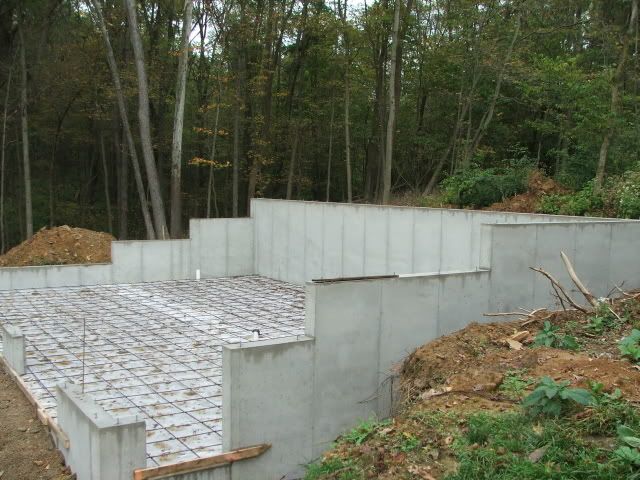
If you must use fill, definitely compact it and use rebar. Make sure that you get the rebar into the slab by elevating it prior to the pour. Otherwise the rebar will just rest at the bottom of the slab. You can get plastic rebar chairs at your local concrete supply house or some guys just use chunks of brick or block to elevate the steel. I placed the rebar for my slab myself, took a few hours on a Saturday to wire and elevate it.
rebar2.jpg

rebar3.jpg

I wouldn't rely on fiber reinforced concrete alone, a friend's builder talked him out of rebar or wire mesh in his new driveway and less than six months later, he has significant structural cracking.
 
To avoid these ads, REGISTER NOW!
Top Bottom